Armchair Apocalypse: What About Those Four Horsemen?

The Four Horsemen Weren’t a First-Century Marvel Movie

When John’s original readers heard “Four Horsemen,” they probably didn’t imagine four supernatural cowboys waiting to invade the twenty-first century. They recognized an ancient warning: empire, war, famine, and death travel together.

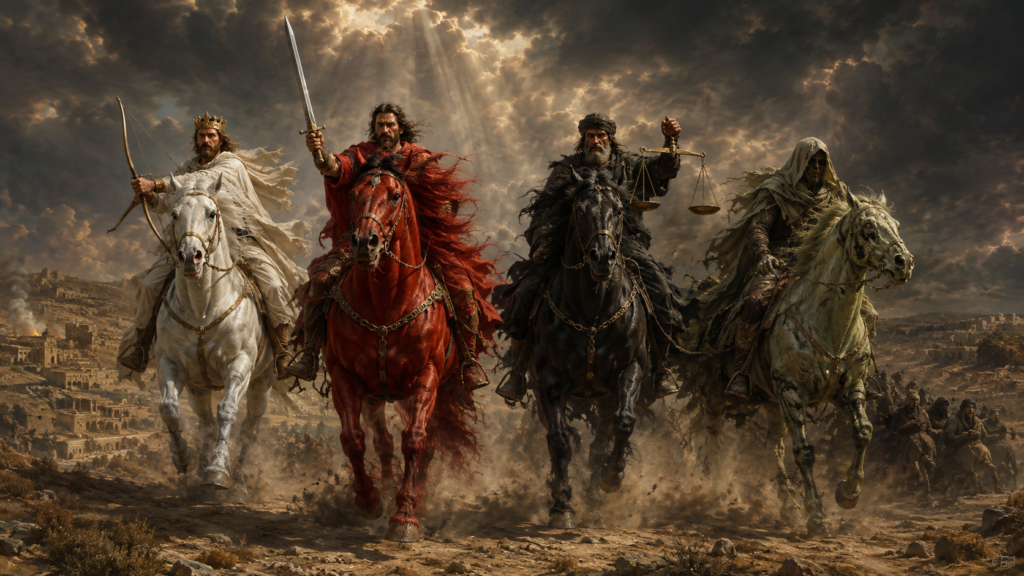
The Four Horsemen appear in Revelation 6, after John is taken up in a vision, sees God upon His throne, and watches the Lamb—Jesus Christ—receive the sealed scroll containing God’s purposes for judgment and redemption. As the Lamb opens the first four seals, the horsemen ride out in sequence: conquest leads to war, war produces famine, and famine ends in death. Their appearance shows what happens when human rebellion, violent empire, and the lust for power are allowed to run their course. But the horsemen are not running the show. Each rider is summoned only after the Lamb opens a seal.

This scene moves John’s vision from heavenly worship to earthly suffering and sets up Revelation’s central conflict: corrupt kingdoms may bring devastation for a time, but the slain and risen Lamb will judge evil, vindicate His people, and ultimately establish God’s kingdom.

John drew the imagery from Zechariah 1:8–11 and 6:1–8, where colored horses and chariots are sent throughout the earth. Revelation reshapes that Old Testament imagery into a terrifying procession of conquest, war, famine, and death.

The white horse carries a bow and receives a victor’s crown. Many scholars interpret him as military conquest—possibly evoking the Parthians, Rome’s feared bow-carrying enemies.

The red horse removes peace and carries a machaira—a short sword commonly associated with violence and bloodshed. This isn’t merely two nations politely declaring war. It includes rebellion, civil conflict, and people slaughtering one another.

Then comes the black horse, carrying scales:

The Greek choinix—translated “measure”—was roughly one person’s daily grain ration. A denarius—the KJV’s “penny”—was an entire day’s wage. Translation: work all day, buy enough wheat to feed yourself, and watch your family go hungry. Barley was cheaper, lower-quality survival food.

Then comes the puzzling command: “Hurt not the oil and the wine.” Oil and wine were not simply rich-people luxuries; ordinary people used them too. The line may picture selective or limited scarcity: grain is devastated while longer-lasting olive trees and grapevines survive. Either way, the economy is badly broken—and suffering isn’t evenly distributed. Sound familiar?

Finally, the pale horse is actually chloros—a sickly green-gray, like a corpse. Its rider is explicitly named Death, with Hades—the realm of the dead—following behind.

The broad interpretive consensus is that the riders symbolize the repeating chain of conquest, violence, scarcity, and death—realities John’s readers knew under Roman power. Realities that nearly every generation in human history have known, or will know.

That is interpretation: what the vision communicated to them.

Application asks what it says to us. The horsemen still ride whenever fallen human nature produces war, economic misery, and graves. Revelation isn’t giving us four celebrity villains to identify in some distant future. It is exposing the brutal machinery of a rebellious world—and reminding us that the Lamb, not the horsemen, opens the seals and will ultimately rule.
Armchair Apocalypse: Nicanor And The Antichrists

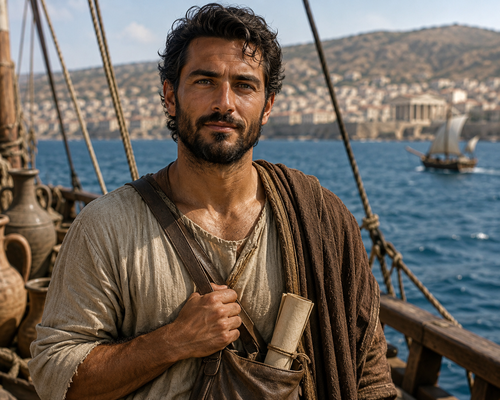
Nicanor is the main character in our short historical fiction episodes showing how the Book of Revelation may have first traveled from Patmos in the Aegean Sea in the first century to the churches in Asia Minor—and eventually to the whole world and people in every age since.

During this “Armchair Apocalypse” series, we’ll follow Nicanor on his travels to better understand the Book of Revelation by exploring the people and the times in which it was first revealed.


The last words of John’s Revelation still hung in the cramped upstairs room in Ephesus. Oil lamps flickered against plaster walls as perhaps twenty believers sat shoulder to shoulder—Jews, Greeks, slaves, merchants, men and women. Jacob ben Ezra, the church elder, had read John’s letter aloud in Greek, and nobody had checked the time. They had heard about beasts, Babylon, persecution, judgment—and a slain Lamb who ultimately conquers.

They knew Rome’s power firsthand. When John wrote of an arrogant empire demanding allegiance and persecuting God’s people, they didn’t need a prophecy chart. They knew what oppressive power looked like. And when they heard Christ say, “Be thou faithful unto death, and I will give thee a crown of life,” they understood that following Jeshua the Messiah might actually cost them theirs.

By sunrise, Nicanor was preparing to leave. He pulled a rough wool cloak over his knee-length tunic, tightened his leather sandals, and secured John’s precious scroll inside a leather wrapping beneath his cloak. Outside, Ephesus was waking up. Merchants shouted in Greek along its broad marble-paved streets. Carts rattled over stone. Sailors called from the harbor. Somewhere beyond the rooftops towered the magnificent Temple of Artemis—a constant reminder that Christianity was definitely not the hometown religion.

Jacob walked with Nicanor toward the road leading north. Before they separated, the elder lowered his voice. “John warned us that many antichrists have already come.” Nicanor knew the words from John’s teaching. An antichrist wasn’t merely some mysterious supervillain waiting thousands of years in the future. John had warned believers about deceivers already operating in their own world—people denying Christ and opposing the truth. “Even now are there many antichrists,” John had written (1 John 2:18 KJV). Jacob gripped Nicanor’s shoulder. “Watch whom you trust.”

Nicanor understood the danger. The scroll hidden beneath his cloak contained language about beasts, kings, Babylon, judgment, and a kingdom that would outlast every earthly empire. To believers, it was hope written in symbols they could recognize from the Hebrew Scriptures and their own world. To Roman authorities who understood its implications, it could sound dangerously subversive.

The Emperor demanded loyalty. John proclaimed Jesus Christ “King of kings, and Lord of lords.” If the letter were discovered and interpreted as defiance of imperial authority, Nicanor could find himself standing before a magistrate—and giving the authorities another excuse to investigate the churches receiving it.

Nicanor tightened his cloak and started north along the Roman road. Behind him, the noise of Ephesus slowly faded. Ahead lay miles of dusty road, roadside shrines, inns, merchants, soldiers, strangers—and plenty of opportunities for the wrong person to ask the wrong question. Beneath his cloak rested a message Rome could never completely suppress: Empires fall. In the end, every knee will bow, not to the Emperor, but to the resurrected and returning Jesus Christ. Evil loses. God wins. Somewhere farther up the road another small gathering of believers waited to hear the Revelation.

Smyrna.

Armchair Apocalypse: Who Or What Is The Antichrist – Part One

Say the word “Antichrist” and people picture a global supervillain, a smooth-talking dictator with a sinister smile, or the guy from every end-times movie ever made.

But what does the Bible say? The word “Antichrist” appears only FIVE times in the entire Bible.

The term “Antichrist” doesn’t appear anywhere at all in the books of Revelation or Daniel. Nada. Zilch. Zero. Surprised?

It’s only used in John’s letters. Here’s where:

1 John 2:18Little children, it is the last time: and as ye have heard that antichrist shall come, even now are there many antichrists; whereby we know that it is the last time. (KJV)

John tells believers that many antichrists had already appeared and says that they were living in the “last time” back in the first century. He also mentions that they had heard that an “Antichrist” was coming, but his emphasis is on the many antichrists already active in his own day.

1 John 2:22Who is a liar but he that denieth that Jesus is the Christ? He is antichrist, that denieth the Father and the Son. (KJV)

An antichrist is anyone who denies that Jesus is the Christ, the Messiah, and rejects him as the only begotten son of the Father. There were lots of Jews and Gentiles at the time who would have fallen into that category, right? Of course, that has also been true ever since then, including in our own day and age.

1 John 4:3And every spirit that confesseth not that Jesus Christ is come in the flesh is not of God: and this is that spirit of antichrist, whereof ye have heard that it should come; and even now already is it in the world. (KJV)

The “spirit of antichrist” is any teaching that refuses to confess that Jesus Christ came in the flesh, is who he claimed to be. And that spirit of antichrist was already present in the world over 2,000 years ago.

2 John 1:7For many deceivers are entered into the world, who confess not that Jesus Christ is come in the flesh. This is a deceiver and an antichrist. KJV

Those are the only four passages in the entire Bible that use the word “antichrist”, and only five occurrences of the word itself.

Notice that John isn’t describing a politician taking over the United Nations. He’s talking about false teachers denying the Messiah and spreading lies about Jesus.

What Does “Antichrist” Actually Mean?

The Greek word is ἀντίχριστος (antichristos).

It’s made from two parts:

  • anti (ἀντί) — against, opposed to, or in place of.
  • christos (Χριστός) — Christ, the Anointed One, the Messiah.

So an antichrist is someone or something that opposes Christ or tries to replace Him.

That could be a false teacher or a counterfeit gospel. It could also refer to a movement that offers salvation without a Savior or to anyone pointing people away from the real Messiah.

John says that many antichrists already existed in the first century because deception didn’t start in the future—it started almost immediately after Jesus’ resurrection.

That doesn’t mean there won’t be powerful opponents of Christ in the future. Scripture certainly speaks about rebellion, lawlessness, and evil rulers. But we shouldn’t force every scary end-times passage to mean “the Antichrist.”

The Bible is only correctly understood when the historical context is understood and we should never read movie scripts, popular novels, or modern-day, ear-tickling preachers and prophecy peddlers into it.

So What?

Instead of letting Hollywood define your theology, let Scripture do it. This week, read 1 John from start to finish. It takes about 20 minutes, and you’ll learn more about the Antichrist from the apostle who actually used the word than from a dozen conspiracy videos.

Armchair Apocalypse: First Steps of Revelation

Meet Nicanor, a character in a short historical fiction story showing how the Book of Revelation may have first traveled from Patmos in the Aegean Sea in the first century to Ephesus—and eventually to the whole world and people in every age since.

During this “Armchair Apocalypse” series, we’ll follow Nicanor on his travels to better understand the Book of Revelation by exploring the people and the times in which it was first revealed.


The old man carefully rolled the parchment and tied it with a simple cord. John—exiled on the rocky island of Patmos—looked across at Nicanor, a broad-shouldered Greek Christian in his early thirties whose weathered face and sun-darkened skin betrayed years spent working merchant ships across the Aegean. His short black beard was flecked with salt, and a coarse brown wool cloak hung over a simple linen tunic.

“This isn’t just a letter,” John said quietly in Greek. “It’s a revelation from Jesus Christ himself. The churches will be encouraged… and corrected. Rome won’t like either one.” Nicanor nodded, instinctively resting a hand on the leather satchel that concealed the scroll beneath spare clothing and food. If Roman officials searched him and discovered its contents, prison would be the best outcome. Execution wasn’t impossible. John placed a weathered hand on his shoulder. “Don’t rush. Don’t panic. Deliver it faithfully.” Then, with the kind of smile only someone who had seen such a vision of the glorified Christ could give, he added, “Besides… God has already handled bigger problems than bad weather and Roman soldiers.”

Nicanor boarded a small coastal merchant sailing vessel—a sturdy wooden cargo boat loaded with amphorae of olive oil, grain, and wine. Salt spray soaked his leather sandals as the ship crossed the blue waters toward Ephesus. Days later the city’s magnificent harbor appeared, crowded with fishing boats, cargo ships, and Roman patrol vessels. Merchants shouted prices in Greek while Roman soldiers barked commands in Latin. Citizens wearing bright linen tunics hurried along gleaming marble streets lined with columns, fountains, and towering temples dedicated to Artemis and the emperor. Every corner reminded people who Rome demanded they worship. Nicanor quietly smiled beneath his beard. He knew a greater King.

After sunset, he slipped through narrow stone alleys until an elderly man opened a plain wooden door. Jacob ben Ezra, one of the elders of the Ephesian church, stood slightly stooped with silver hair, deep lines around kind eyes, and a neatly trimmed white beard. Born and raised in the Jewish community of Ephesus, Jacob had spent decades studying the Law and the Prophets before becoming convinced only a few years earlier that Jesus of Nazareth was Israel’s promised Messiah. Some old friends now refused to speak to him. Others considered him a traitor. Yet his quiet joy never seemed to fade.

Inside, about thirty believers gathered in a modest courtyard lit by flickering oil lamps. Among them sat Eliab, a young Jewish craftsman who had only recently come to the same life-changing conclusion. Seeing another Jewish believer leading the gathering gave him courage.

Jacob carefully untied the scroll and began reading: “The Revelation of Jesus Christ…” The room became silent enough to hear the lamps crackle. As John’s words unfolded, the Jewish believers immediately recognized echoes of Daniel’s beasts, Ezekiel’s visions, Zechariah’s horses, and Isaiah’s promises, while the Gentile believers listened as those familiar Scriptures came alive in ways they had never imagined. This wasn’t a puzzle for clever people centuries later. It was a message for persecuted Christians living under Rome’s shadow: stay faithful, reject compromise, don’t worship Caesar, because Jesus—not the emperor—has already won and will reign. Some quietly wept. Others gripped each other’s hands. Eliab felt chills run down his spine. Following Jesus suddenly seemed both more dangerous… and more worth it than ever before.

As Nicanor carefully rolled the scroll back into its leather case, he glanced eastward. Six more churches were still waiting.

Armchair Apocalypse: Revelation Mail Call

Before we imagine dragons, beasts, and mysterious numbers, picture something much more ordinary: a guy walking down a dusty Roman road carrying a scroll.

Most people picture Revelation as a mysterious book that somehow dropped out of heaven. It didn’t. It arrived by mail. Well… first-century Roman mail.

A Scroll Written in Greek

The Book of Revelation was almost certainly written in Koine Greek—the everyday language spoken across much of the Roman Empire. John didn’t type it on a laptop or print a paperback. It was carefully handwritten with ink on a long papyrus scroll.

The Original Delivery Guy

After John wrote Revelation while exiled on the island of Patmos, someone he trusted—possibly a Christian or recently converted Messianic Jewish messenger or elder—likely carried the scroll across the Aegean Sea to Ephesus, the first church listed.

From there, the scroll would have traveled in the order given in Revelation:

Ephesus → Smyrna → Pergamum → Thyatira → Sardis → Philadelphia → Laodicea.

That’s basically a giant postal route through western Asia Minor (modern-day Turkey).

At each church, the believers would gather in someone’s home, and one person would stand up and read the entire scroll out loud. Yes… the whole thing.

Imagine hearing Revelation for the very first time with no chapter numbers, no study Bible, and no YouTube prophecy channel telling you what every beast supposedly represents.

“Don’t Add or Take Away”—Why So Serious?

Revelation 22:18 says:

John wasn’t warning people not to make notes in the margins. He was warning against changing God’s message.

Since churches depended on handwritten copies, someone could intentionally—or carelessly—alter the text while copying or reading it. John makes it crystal clear: Don’t edit God’s Word to fit your opinions. Don’t soften it. Don’t improve it. Don’t weaponize it. Just pass it on faithfully.

How Long Did It Take?

The entire journey probably took several weeks, perhaps one to two months, depending on weather, sea travel, road conditions, and how long the messenger stayed at each church to read the scroll and allow scribes to begin copying it.

Today we can read Revelation in seconds on our phones, but the first Christians had to wait patiently for a single handwritten scroll to arrive—and when it did, they listened as though God Himself were speaking.

So What?

We don’t have to wait for the letter to arrive. We already have it at our fingertips, 24/7/365.

So, lets take our time and first try to understand what Revelation was saying to the people it was originally written to. If we are patient enough to do that, then we can begin to understand what Revelation means to us today.

Armchair Apocalypse: Revelation Is Like Football

You can never really understand the Book of Revelation until you understand that it was not written to people who live in modern Western cultures. It’s a letter written to folks who lived a long time ago in a culture and time that was very different from our own.

Below, I’m borrowing a passage from my book, Your Life And What Comes After, to make that point.

“Adriana, a football fan, wrote a letter to her friend who also really liked following and watching football games. In the letter, Adriana described a high school football game she went to recently like this:

‘It was raining cats and dogs as if the sky had sprung a leak, but the game marched on as if the gridiron were Noah’s front yard. The quarterback was trying to thread the needle through a secondary playing tighter than a drum. Some of the fans were hollering that the offense needed to stop shooting themselves in the foot with their false starts and do a better job of establishing the run.

By the second half, the field had turned into a mud pit worthy of a hog-calling contest, and the players were slipping and sliding like greased lightning. The defense was bringing down the house with all-out blitzes on three straight downs.

Finally, midway through the fourth quarter, our junior kicker split the uprights. The score held, and that missed point-after attempt in the first quarter didn’t come back to haunt our squad.

If you aren’t familiar with American football, then Adriana’s report on the game would be kind of confusing to you.

Now just try to imagine how strange and confusing that letter would sound to a young girl in a little fishing village in a faraway country who knew nothing about America, football, or the figures of speech in the English language, like ‘shooting themselves in the foot.’ That young girl would have to see everything through the eyes of the friend Adriana wrote the letter to in order to understand its meaning.”

That doesn’t mean that we can’t learn and apply lessons from Revelation in our own lives. We certainly can. But first we have to understand what John’s vision from God meant to the churches in Asia Minor in the first century. How would they have understood the seemingly strange language, symbols, figures of speech, and images when the letter was read to them?

Armchair Apocalypse: Why Revelation Feels So Jewish

If you’ve ever tried reading Revelation and thought, “Why does this sound like a bizarre mashup of dragons, beasts, and ancient symbolism?” — you’re not alone.

Well, Revelation wasn’t written primarily for modern Americans scrolling social media. It was written to people who knew the Jewish Scriptures inside and out.

Why Are There So Many Old Testament References?

Revelation contains hundreds of references and connections to the Old Testament, yet it never directly quotes it. Why? Because John assumes his readers already know the background story.

The beasts come from Daniel. The plagues echo Exodus. The heavenly throne room resembles Ezekiel and Isaiah. The New Jerusalem points back to God’s promises throughout the prophets.

Think of Revelation as the Bible’s season finale. If you skip the previous seasons, you’ll miss half the plot.

John the Revelator isn’t inventing new ideas. He’s connecting the dots from Genesis to Revelation and showing how God’s grand plan reaches its climax.

Why Does When It Was Written Matter?

Most scholars place Revelation around A.D. 95 during the reign of the Roman Emperor Domitian. Others believe it was written earlier than that, before A.D. 70 when Rome sacked Jerusalem and destroyed the Jewish Temple.

Either way, the important point to remember is that Revelation was written during a time when Christians were facing persecution and pressure to worship the emperor as a god.

So some of the symbols and imagery make more sense when you understand a little bit about the history and culture of the time.

The beast isn’t just a random monster. It represents oppressive political power. Babylon isn’t ancient Babylon. It’s a symbolic picture of a corrupt world system standing against God.

The original readers weren’t asking, “Who is the Antichrist in 2026?” They were asking, “How do we stay faithful when the empire wants our loyalty and may kill us if we don’t bend the knee?”

What Is the Cultural, Geographic, and Historical Context?

John received the vision while exiled on the island of Patmos, a small rocky island off the coast of modern-day Turkey and it was sent as a letter to be read to seven real groups of believers in Asia Minor.

These churches, fellowships of the faithful, many of whom were recently converted Jews, lived in wealthy Roman cities filled with emperor worship, pagan temples, trade guilds, and cultural pressure.

So, we must try to read and understand the Book of Revelation from their point of view. How would those people have understood the letter they received?

Revelation isn’t mainly about predicting tomorrow’s headlines, what 666 really means, or who the Anti-Christ may be among current famous folks. It’s about encouraging believers in all times and places to remain faithful and focused on the return of our Lord Jesus Christ and his coming kingdom, no matter what culture, government, or trend is demanding their allegiance.

So What?

The Book of Revelation is not a puzzle designed to confuse us. It’s a message of hope. The Jewish imagery tells us where the story came from. The historical setting tells us who first received it. The cultural context tells us why it mattered.

And the ending tells us who wins.

“Be thou faithful unto death, and I will give thee a crown of life.” — Revelation 2:10 (KJV)

Armchair Apocalypse: The Most Misunderstood Book in the Bible?

Last week I listed a bunch of questions that a lot of folks ask about the Book of Revelation. This week we start looking at some answers.

Before we dive in though, let’s clear up something that always comes up – the last book of the Bible is NOT “Revelations,” plural; it’s “Revelation,” singular.

What Does “Revelation” Mean?

The Greek word translated as “Revelation” is apokalypsis, from which we get the English word “apocalypse.”

Apokalypsis doesn’t mean destruction or “the end of the world”. It literally and simply means “an unveiling,” “a revealing,” or “a disclosure.” Like pulling a curtain back so you can finally see what’s really going on.

The first verse says: “The Revelation of Jesus Christ…” (Revelation 1:1)

It’s important to understand that the book isn’t mainly about the Antichrist, beasts, dragons, 666, or end-times speculation. It’s about Jesus Christ being revealed.

When most people hear “Revelation,” they think zombies, world war, meteors, and that one weird guy on the internet with 47 prophecy charts. Nope. Forget about the movies, novels, and heavy metal imagery as we start answering the basic questions.

Who Wrote Revelation?

The author identifies himself simply as John (Revelation 1:1, 1:4, 1:9). Most early Christians believed this was John the Apostle—one of Jesus’ closest friends and the same John connected with the Gospel of John. But it may have been someone else writing as “John”, so I call the author of Revelation “John the Revelator.” Either way, the source is the same — a vision from God through Jesus Christ.

At the time, John the Revelator had been exiled to a small rocky island called Patmos for his faith in Christ. Not exactly a luxury vacation destination for sure. While there, he received a series of visions and wrote them down.

When Was Revelation Written?

Most scholars place the writing of Revelation around A.D. 95–96 during the reign of the Roman Emperor Domitian. That means the book was written nearly 2,000 years ago when believers were facing pressure, persecution, and uncertainty about the future.

They wondered about some of the same things many believers all over the world wonder about in our own time:

  • Is evil winning?
  • Does God care?
  • How does this story end?

Revelation was written to answer those questions.

So What?

Revelation isn’t a horror movie script or a puzzle designed to confuse people. It’s a book written by John the Revelator around A.D. 95 that unveils who Jesus is, who ultimately wins, and how human history repeats itself, pitting empires and tyrants against God’s people.

So, read Revelation chapter 1 for yourself. You might discover the book is far less weird—and far more hopeful—than you’ve been told.