Wednesday Armchair Apocalypse Series: Questions And Topics

This is the second installment of the Armchair Apocalypse series.

Once again, my goal in this series is not to do a verse-by-verse commentary or a scholarly study of Revelation, but rather to try to answer the common questions that come up about Revelation, the Apocalypse. I will try to answer those questions in simple, plain language that makes sense to everyday folks.

Let’s look at the questions and topics we will be answering and discussing in this ongoing Armchair Apocalypse series, which will appear every Wednesday here on Bible Rebel.

  • What Is Revelation Really About?
  • Who Wrote Revelation, and When Was it Written?
  • Can We Understand Revelation?
  • Literal or Symbolic?
  • Is Revelation Being Fulfilled Right Now?
  • Does Modern Israel Play a Role in Prophecy?
  • What do the Seven Churches Represent?
  • Why Does God Allow Such Terrible Judgments?
  • The Seven Seals
  • The Seven Trumpets
  • The Seven Bowls
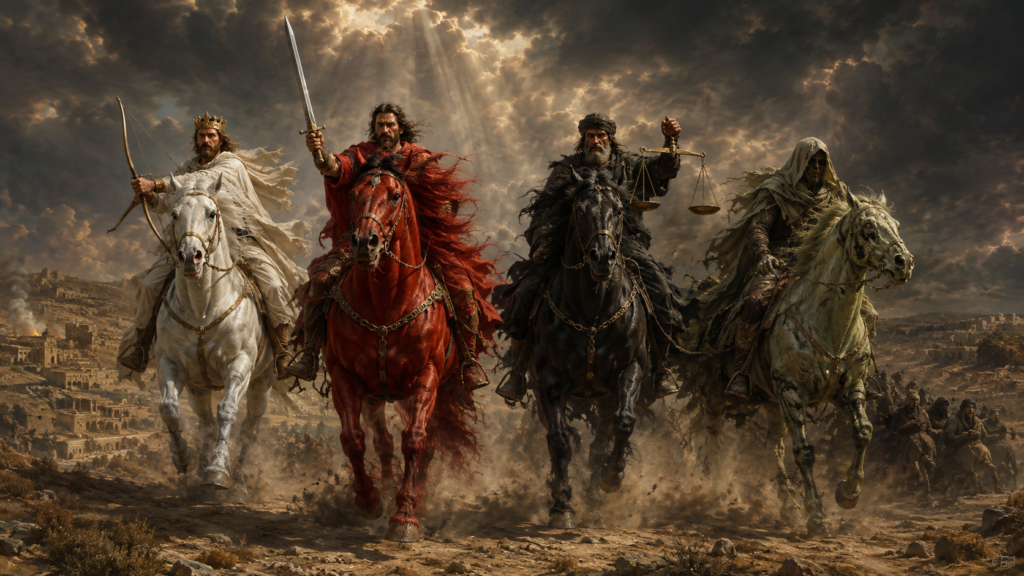
  • The Four Horsemen
  • The Antichrist
  • The Mark of the Beast
  • The Great Tribulation
  • The Rapture Debate
  • The 144,000
  • The Two Witnesses
  • Armageddon
  • The Millennium
  • The Final Judgment
  • The New Heaven and New Earth
  • Why Revelation Is Ultimately a Book of Hope

We have a lot to get to, so plan on joining me every Wednesday for this exciting ride.

Thursday Watchdog Alert: Prophecy Junkies

Iran. Israel. Hezbollah. Gaza. Houthi missiles. “Wars and rumors of wars.” Sound familiar?

This week alone, headlines focused on escalating Iran-Israel tensions, renewed Hezbollah activity, and political leaders openly using end-times language while discussing war in the Middle East. – The Guardian

And yes — many Christians immediately start flipping to Ezekiel, Daniel, and Revelation.

But the Bible never told believers to panic. It told us to pay attention.

Jesus said:

“See that ye be not troubled.” — Matthew 24:6

That’s the part many prophecy junkies conveniently skip while trying to turn every missile launch into a fulfillment of biblical prophecy.

Could current events connect to biblical prophecy? Maybe. The Middle East has always mattered in the biblical storyline, and nations like Persia (modern Iran) do appear in prophetic passages Christians have debated for centuries.

But prophecy isn’t meant to turn Christians into bunker-dwelling doom addicts. It’s supposed to wake us up spiritually.

The real issue is this: while nations rage, millions of ordinary people — including Christians trapped in conflict zones — are suffering, afraid, and searching for hope.

So instead of obsessing over timelines and hashtags, let’s try this:

Pray for persecuted believers. Open our Bibles instead of rage-scrolling. And shine light into a world addicted to darkness and chaos.

Because whether Christ returns tomorrow or 100 years from now, our mission today remains exactly the same.

Wednesday Focus: Our Armchair Apocalypse Series

There are lots of novels and movies about the end of the world, and some of those stories use the images and words from the Bible’s Book of Revelation.

But let’s not get all worked up and frightened by novels, movies, or other forms of apocalypse fiction. Instead, let’s look at what Revelation actually says — and doesn’t say — rather than what others say about it.

That is what this new series, “Armchair Apocalypse,” which will appear every Wednesday on the Bible Rebel blog, is all about.

My goal in this series is not to do a verse-by-verse commentary or a scholarly study of Revelation, but rather to try to answer the common questions that come up when the last book of the Bible is considered. I will try to answer those questions in simple, plain language that makes sense to everyday folks.

I look forward to having you along for the journey.

Tuesday Watchdog Alert: When Politics Tries to Play Prophet

Iran’s ruling clerics don’t just talk politics — some openly talk apocalypse.

Recent reporting highlighted how hardline Iranian leaders and Revolutionary Guard figures continue using “Mahdist” language — the belief that chaos, war, and resistance against global powers can help prepare the way for the return of the Hidden Imam, or Mahdi. Analysts warn this ideology is becoming more central inside Iran’s leadership culture.

“Clerical figures aligned with the Guard have made their views explicit. As Hojatoleslam Ali Saeedi, formerly the Supreme Leader’s representative to the IRGC, said in a 2012 speech: ‘The IRGC is one of the tools for paving the way for the emergence of the Imam of the Age [Mahdi] in the field of a regional and international awakening.’ “- From the Hungarian Conservative

In plain English? Some leaders believe global conflict is not a problem to avoid — it’s a stage to set. That should wake people up.

The Bible warned long ago that rulers and nations would chase power through deception, fear, and spiritual blindness. Christians aren’t called to panic over every headline, but we are called to recognize when political movements start sounding like counterfeit salvation stories.

Our Lord already told us who wins history.

The world keeps looking for a warrior-politician, a system, or an ideology to save humanity. But broken people cannot build heaven on earth with missiles, propaganda, or “holy” revolutions. That usually just creates more graves.

And honestly, if your end-times plan requires nukes and chaos to “help God out,” maybe rethink the strategy.

The real Kingdom of God will come with great power and glory when Jesus Christ returns, but that won’t be according to man’s timetable — and it won’t be by any manufactured apocalypse.

So what?
Today, spend 10 minutes reading Matthew 24 and praying for discernment. Don’t let headlines shape your worldview more than Scripture does.

Your Life And What Comes After (43): You Are In Training

Jesus often used stories, called parables, to teach His followers important lessons. One of those lessons is that if you’re faithful with small things now, God will trust you with bigger things later.

In the coming kingdom and the new heaven‑on‑earth, that means real responsibility—leadership, creativity, and purpose.

Your character—the kind of person you decide to be—takes work. You have to practice to develop good qualities like courage, patience, honesty, love, and wisdom. And sometimes facing hard things and going through hard times can be God’s way of helping you shape that good character.

Those good qualities you develop aren’t for this life only, they don’t disappear; they continue into eternity.

What Will Follow You?

Your works are the things you do and the words you speak.

Good works are the ones you do out of love for God and His people. Those works add value to the world around you and they glorify our heavenly Father.

Not-so-good works are the ones that are selfish and dishonest – they don’t glorify God and they aren’t helpful to others around you. In fact, sometimes they can even be harmful.

That means the good works you do now don’t vanish. They show up again in the world to come. What kind of works do you want following you into God’s new heaven-on-earth?

Practicing For Your Future Job

In the future kingdom, we will serve and reign with Him.

That means that the good character we build now prepares us to rule and serve forever in God’s restored creation.

This life is not a waiting room. It’s a training ground for the new life in the kingdom.

Your Life And What Comes After (31): Ending The End Of The World?

So what is the Book of Revelation all about?

It’s about the victory of God over evil by way of His grand plan through Jesus Christ.

It’s about God winning even when it looks like Satan and the wicked kingdoms of this world have all the power.

It’s about God’s people staying faithful and trusting in Him – no matter how long it takes until He sets things right.

Revelation is meant to encourage and bless God’s people – not scare them or cause them to freak out over 666 and the Antichrist.

The End is Really a Beginning

After Jesus was raised from the dead, he spent many days with his followers, being with them and teaching them about things to come. They asked him about the end of the world as they knew it.

And the same is true for us today, over 2,000 years later — no one knows when the end times will come. So, if you hear someone say they know the date that Jesus will return, you can be sure that they really don’t know. Only God knows.

But don’t think of it as the end of the world, because it will actually be the beginning of forever — with God and each other in a glorious new creation.

I’m not sure who first said this, but it’s worth saying again here: “In the end, everything will be all right. And if it’s not all right, it’s not the end.”

Next, we’ll start digging into what that glorious new forever looks like.

Your Life And What Comes After (30): What’s Going On In Revelation?

There are lots of fiction novels and movies about the end of the world, and some of those stories use the images and words from the Bible’s Book of Revelation.

Let’s not get all worked up and frightened by novels and movies, though. Let’s look at what Revelation actually says and doesn’t say, rather than what others say about it.

It helps to get an idea of the “who” and “what” of Revelation. It is a short book written around 2,000 years ago by a man named John, describing a vision from God, and then sent out in a scroll to be read to groups of believers.

Our goal here is not to do a deep study of it, but it’s important to understand that Revelation is a vision with deeper meanings beneath what many of the words seem to be saying at first.

At times in the Bible God gave visions and dreams to people, using mysterious pictures and symbols that aren’t meant to be taken literally.

Years Not Ears

Here’s an example from the Old Testament Book of Genesis where Pharaoh tells Joseph about a dream he had and Joseph tells him what it meant:

See? The ears of corn weren’t meant to be understood as actual ears of corn, they were dream symbols that actually meant years.

Most of Revelation is just like that – you have to understand the symbols and how the people back in that time and place would have understood those symbols. By the way, the time was about 2,000 years ago and the place was Asia Minor, which is the modern-day country of Turkey, under the rule of the ancient Roman Empire.

Symbols in Revelation

Here’s what Jesus looked like in John’s vision in the first chapter of Revelation:

Does Jesus actually look like this? Does he have a sword coming out of his mouth and feet made of brass? No, these are symbols and images to tell us something deeper. And if we want to understand what those symbols mean we first have to understand how the people who first heard and read those words understood them.

That makes for an interesting, but much longer study. For now, let’s take a peek at the overall subject and point of the Book of Revelation. That’s coming next.

Your Life And What Comes After (29): Starting The End Of The World

Adriana, a football fan, wrote a letter to her friend who also really liked following and watching football games. In the letter, Adriana described a high school football game she went to recently like this:

“It was raining cats and dogs as if the sky had sprung a leak, but the game marched on as if the gridiron were Noah’s front yard. The quarterback was trying to thread the needle through a secondary playing tighter than a drum. Some of the fans were hollering that the offense needed to stop shooting themselves in the foot with their false starts and do a better job of establishing the run.

By the second half, the field had turned into a mud pit worthy of a hog-calling contest, and the players were slipping and sliding like greased lightning. The defense was bringing the house with all-out blitzes on three straight downs. Finally, midway through the fourth quarter, our junior kicker split the uprights. The score held, and that missed point-after attempt in the first quarter didn’t come back to haunt our squad.”

If you aren’t familiar with American football, then Adriana’s report on the game would be kind of confusing to you.

Now just try to imagine how strange and confusing that letter would sound to a young girl in a little fishing village in a faraway country who knew nothing about America, football, or the figures of speech in the English language, like “shooting themselves in the foot.” That young girl would have to see everything through the eyes of the friend Adriana wrote the letter to in order to understand its meaning.

The Book of Revelation

Have you ever heard about the Antichrist, or the mark of the beast, 666? How about stars falling from heaven, earthquakes and wars, and the four horsemen of the Apocalypse at the end of the world?

Those are all images from the Book of Revelation, the last book in the Bible, which is full of strange language, numbers, and symbols that some say foretells what will happen at the end of the world.

Here we are in modern times reading Revelation kind of like the young girl in the faraway fishing village reading Adriana’s letter, not really understanding that “raining cats and dogs” doesn’t mean that thousands of cats and dogs are actually falling out of the sky.

So, what do all of those weird visions and scary beasts and such we hear about in stories about the end of the world actually mean? Is Revelation a play-by-play, exact preview of what’s going to happen to us at the end of the world?

Nah.

Next, we’ll take a closer look at it all.

Your Life And What Comes After (28): What The Hell

Have you ever heard anyone say, “If you’re bad, you’re going down there!” as they point to the ground?

The idea that you’ll go “up there” if you’re good and “down there” if you’re bad is not an idea found in the Bible, and is not part of God’s grand plan.

Cartoon devils with pitchforks tossing bad people into flames and movie images of an underground fire pit of hell are pictures and ideas that have been made up by some to scare others for various reasons. Can you think of why some people in the old days, and even now, would do that?

What and Where Is Hell

The Bible does teach that there is some kind of punishment for people, and for evil spiritual forces, who do evil things on purpose and who don’t want or accept God’s love and forgiveness. So, hell is a kind of punishment and judgment for them.

But just like heaven isn’t a location somewhere in the universe but instead the realm where God exists, hell also isn’t a physical location somewhere, but instead a description of God’s judgment on evil.

But punishment and judgment for who, where, and when — and what kind of punishment is it?

Those are questions that people who have studied the Bible, now and in the past, have had very different answers for.

Some believe that everyone who is bad or doesn’t accept God’s forgiveness goes to hell when they die to burn forever, and those who are good and accept God’s forgiveness go to heaven to play harps and sing praises forever. I don’t believe that either of those ideas is what the Bible teaches.

Fear Not

The Bible teaches that God’s plan includes a day and time when God will raise all people from the dead, and then comes the judgment. If we have put our faith in Jesus Christ, then we know that when that day comes, He has taken any punishment or judgment we may deserve on Himself. We are forgiven and cleared for takeoff into eternal life with our Savior and with our Heavenly Father.

Over and over in God’s Word, He encourages His people to “fear not” or “don’t be afraid.” About 140 times, in fact. At least six times in the Bible, it was the first thing angels said when they appeared to people.

When it comes to the topic of hell, we should all focus on the “fear not” message rather than the “be afraid of hell, you sinner” message.

What’s Next?

As I said a little bit ago, God’s plan includes a day and time when God will raise all people from the dead. Next, we’ll be talking about what happens during that day and time, and what it means for you and me.

Rethinking The Rapture: What Does ‘Delivered From Wrath’ Mean?

Many Rapturists believe that 1 Thessalonians 1:10 must be interpreted to mean that God will not allow believers to go through a 7 or 3 1/2 year tribulation period and that the Rapture will rescue the saved who are alive at the time.

Here’s the thing – there are other ways of reading “delivered from the wrath to come” that, in my opinion, make way more sense and fit more accurately with the overall themes of the Bible in the context of judgement and salvation.

So, asked Mr. Art Intelligence to provide a summary of what it means, here’s what I got:

“The phrase “delivered from the wrath to come” refers to a key theme in Christian theology, particularly in relation to salvation, judgment, and the end times. It’s most directly found in 1 Thessalonians 1:10:

“…and to wait for his Son from heaven, whom he raised from the dead—Jesus, who delivers us from the wrath to come.” (ESV)

Here’s what it generally means:


1. “Wrath to Come” = God’s Future Judgment

  • In biblical context, “wrath” refers to God’s righteous anger and judgment against sin and evil.
  • “The wrath to come” is typically seen as a future event — often associated with the Day of the Lord, end-time judgment, or the Great Tribulation.

2. Deliverance Through Jesus Christ

  • Christians believe that Jesus’ death and resurrection satisfy the demands of divine justice, so those who trust in Him are not subject to God’s wrath.
  • To be “delivered from the wrath to come” means being spared from God’s judgment, whether that’s:
    • eternal separation from God (hell),
    • or specific apocalyptic judgment in the end times (depending on one’s eschatological view).

3. Different Theological Interpretations

There are several interpretations of how and when this “deliverance” happens:

  • Pre-Tribulation View (Dispensational):
    • Believers will be raptured before a time of tribulation and judgment on earth (Revelation-style wrath).
    • This is a common belief among many evangelicals and in popular media like Left Behind.
  • Historical View:
    • The “wrath” may refer to eternal condemnation, not necessarily a future earthly tribulation.
    • In this view, deliverance is more about salvation from hell than escape from earthly suffering.
  • Ongoing Deliverance:
    • Some theologians see this as a present spiritual reality: Jesus continually intercedes for believers, shielding them from God’s wrath (Romans 5:9; John 3:36).

Summary:

To be “delivered from the wrath to come” means that through faith in Jesus Christ, Christians are spared from God’s future judgment, whether that’s understood as eternal damnation or a specific time of tribulation. It underscores the Christian hope of salvation, security, and peace with God, even in the face of future judgment.”

End AI answer. I’ll be exploring these ideas in more detail in the next post on “Rethinking The Rapture”.

Rethinking The Rapture: Introduction

Rethinking The Rapture: Questions

Rethinking The Rapture: More Questions

Rethinking The Rapture: N.T. Wright’s ‘Farewell to the Rapture’

Rethinking The Rapture: What 1 Thessalonians 4:16-17 Doesn’t Say

Rethinking The Rapture: Millions Of Christians Were Not Delivered From Wrath