Wednesday Armchair Apocalypse Series: Questions And Topics

This is the second installment of the Armchair Apocalypse series.

Once again, my goal in this series is not to do a verse-by-verse commentary or a scholarly study of Revelation, but rather to try to answer the common questions that come up about Revelation, the Apocalypse. I will try to answer those questions in simple, plain language that makes sense to everyday folks.

Let’s look at the questions and topics we will be answering and discussing in this ongoing Armchair Apocalypse series, which will appear every Wednesday here on Bible Rebel.

  • What Is Revelation Really About?
  • Who Wrote Revelation, and When Was it Written?
  • Can We Understand Revelation?
  • Literal or Symbolic?
  • Is Revelation Being Fulfilled Right Now?
  • Does Modern Israel Play a Role in Prophecy?
  • What do the Seven Churches Represent?
  • Why Does God Allow Such Terrible Judgments?
  • The Seven Seals
  • The Seven Trumpets
  • The Seven Bowls
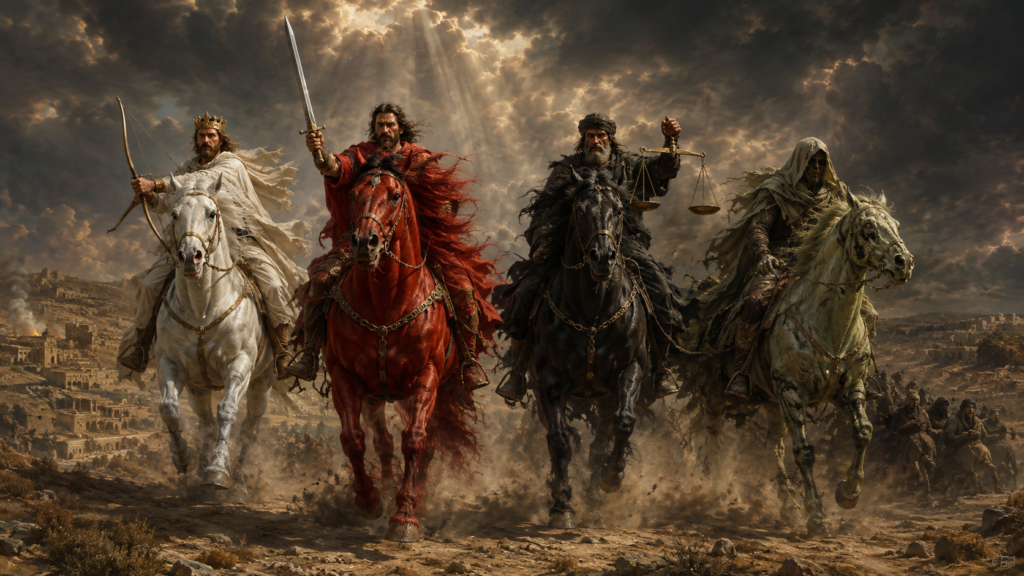
  • The Four Horsemen
  • The Antichrist
  • The Mark of the Beast
  • The Great Tribulation
  • The Rapture Debate
  • The 144,000
  • The Two Witnesses
  • Armageddon
  • The Millennium
  • The Final Judgment
  • The New Heaven and New Earth
  • Why Revelation Is Ultimately a Book of Hope

We have a lot to get to, so plan on joining me every Wednesday for this exciting ride.

Tuesday Watchdog Alert: Young Men Are Showing Up

For years, we’ve been told the story was simple: Christianity is declining, churches are emptying, and faith is becoming irrelevant. All certainly true enough.

But maybe there’s some light starting to show at the end of this tunnel.

A recent Gallup poll found that young men are becoming more interested in religion, with significantly more men ages 18–29 saying faith is important in their lives and attending religious services than just a few years ago. At the same time, reports from churches around the country describe growing numbers of Gen Z men looking for community, purpose, and meaning.

Why?

Because endless scrolling isn’t a substitute for purpose, online influencers can’t answer life’s toughest questions, and because human beings were created for something bigger than themselves.

And maybe some folks are starting to get a better understanding of priorities.

Notice what these young men aren’t looking for: more entertainment, more apps, or more self-help slogans. They’re looking for meaning, purpose, and the Big Picture

So What?

Try this: Read Matthew 5–7 and ask God to show you where you’re seeking meaning in the wrong places. The answer may be closer than you think.

Wednesday Focus: Our Armchair Apocalypse Series

There are lots of novels and movies about the end of the world, and some of those stories use the images and words from the Bible’s Book of Revelation.

But let’s not get all worked up and frightened by novels, movies, or other forms of apocalypse fiction. Instead, let’s look at what Revelation actually says — and doesn’t say — rather than what others say about it.

That is what this new series, “Armchair Apocalypse,” which will appear every Wednesday on the Bible Rebel blog, is all about.

My goal in this series is not to do a verse-by-verse commentary or a scholarly study of Revelation, but rather to try to answer the common questions that come up when the last book of the Bible is considered. I will try to answer those questions in simple, plain language that makes sense to everyday folks.

I look forward to having you along for the journey.

Saturday Watchdog Alert: Something’s Broken

One recent headline reported that AI companion apps are exploding in popularity because people are lonely, anxious, and emotionally disconnected. Another explored how some users are now treating AI chatbots almost like spiritual guides or romantic partners.

Think about that for a second.

God created human beings for real relationship — with Him and with each other. Now people are asking algorithms for emotional comfort, life advice, and fake intimacy. We built machines to answer questions, and now some people are asking them to fill the hole in their soul.

But spiritual hunger can’t be sated by wearing a Bluetooth headset and chatting with digital algorithms.

The culture keeps promising salvation through screens:
More apps and followers. More digital therapy from a robot that learned empathy from the internet. What could possibly go wrong?

Meanwhile, depression, loneliness, and confusion keep climbing. Because the human soul was never designed to run on artificial connection.

Here’s the truth: we do not need a synthetic god, a chatbot therapist, or a digital soulmate. We need truth and purpose. We need a relationship with our heavenly Father through His son, Jesus Christ — the only relationship that is fully real, fully loving, and fully eternal.

Today, replace 20 minutes of scrolling with 20 minutes of actual human connection. Call someone. Pray with someone. Read Psalm 139 out loud. The cure for isolation isn’t better technology. It’s restored relationship with God and people.

Is That Thief In Heaven?

Most of us are familiar with this passage in Luke about the others crucified with Jesus:

Luke 23:40–43 (KJV)
But the other answering rebuked him, saying, Dost not thou fear God, seeing thou art in the same condemnation? And we indeed justly; for we receive the due reward of our deeds: but this man hath done nothing amiss. And he said unto Jesus, Lord, remember me when thou comest into thy kingdom. And Jesus said unto him, Verily I say unto thee, today shalt thou be with me in paradise.

Many use this as a proof text that believers go immediately to heaven—or somewhere—when they die.

But is that really what this passage is about? Or is there something else going on here?

Let’s start by asking what should be some obvious questions if we are to assume the traditional theological narrative about Luke 23:40–43.

Is saying a few words, sticking up for Jesus, and asking to be remembered by him all that is required for thieves and malefactors to get into “heaven”?

Is being in “paradise” the same thing as “going to heaven”?

Did Jesus come into his kingdom on the day of the crucifixion?

Did the malefactor go immediately to “heaven” with Jesus after they died?

Did the malefactor miss Jesus for the 40 days or so that Jesus was carrying out his post‑resurrection ministry on earth?

Is the malefactor in heaven right now with Jesus?

What was the point of Jesus being raised from the dead after three days if he and the malefactor crucified with him were already alive together in paradise or heaven on the very same day they died on crosses?

We should all be asking questions like this, and many of the other things we’ve been taught from religion and churchianity, to see if they make sense and if they are actually biblical.

Stay tuned as we start examining the questions raised here in detail.

Saturday Watchdog Alert: The Soul of America Is Still Searching

America is weird right now.

One headline says more Americans are becoming “spiritual” again. Another says traditional faith keeps declining while younger generations experiment with everything from astrology to paganism to “manifesting the universe.” Translation? People are starving for meaning but trying to fill the God-shaped hole with crystals, TikTok gurus, and “energy cleansing.” That’s like trying to fix a flat tire with whipped cream.

Meanwhile, Pew data shows religious “nones” remain historically high, even while some Gen Z young adults are suddenly curious about faith again after years of nihilism and anxiety. Turns out endless scrolling, hookup culture, and worshiping yourself doesn’t actually heal the human soul. Shocking. – FAITHWIRE

The Bible already explained this thousands of years ago:

When a culture removes God, something else always rushes in to take His place. Politics. Pleasure. Identity. Occult spirituality. Rage. Self-worship. But none of them can carry the weight of eternity.

Here’s the good news: people searching for meaning are closer to the truth than people pretending life has no meaning at all. The hunger itself points to God.

Take 20 minutes and read from the Book of Matthew today. Look specifically for what it says about God’s mission statement for His people and His Creation.

I dare you.

Why Did God Permit The Holocaust? Rabbi Sacks Answers

As I’ve said before, question everything. Faith requires a healthy dose of skepticism about everything we think we know.

One of the most often asked about and pondered upon questions is a simple one: why does God allow evil to thrive?

And to narrow it down to a more concrete example: why did God permit the unspeakable horror of the Holocaust to occur?

I recently came across some of Rabbi Jonathan Sacks videos and writings. Rabbi Sacks, who has passed away, articulated the answer very well. Here are four of his quotes.

Faith Requires Skepticism

Question everything. Faith requires a healthy dose of skepticism about everything we think we know.

Wait, faith requires skepticism?

Of course it does. Our Heavenly Father commands us to love Him with all of our hearts, souls, and minds. Did you get that last one? Minds.

God wants us to ask questions, examine His wonders, and search the Scriptures seeking truth. That requires an inquisitive mind.

The most dangerous aspect of the doctrines of men is that they are usually close enough to biblical truth that they fool even the most sincere and honest among the faithful.

Some of those doctrines of men are so convoluted and confusing that they present stumbling blocks to those outside the faith and sometimes cause the faithful to abandon the faith.

We should faithfully seek to understand God’s truths about His nature, His creation, and His will for His people, even if that means challenging long‑held doctrines and theologies that were devised and propagated by religious folks for their own benefit — or for the purposes of the principalities and powers behind them.

Remember who the enemies of our Lord were? The religious leaders of his time and culture who had perverted and changed the Word of God into the doctrines of men.

Remember the lesson of the Reformation? Churchianity was challenged, and the centuries‑old religious status quo was called to task — salvation by grace, not ceremonies and dead works.

Bible Rebel will be asking questions and challenging assumptions here. We believe it’s high time for a New Reformation, or at least a fresh look at the old wine in the old wineskins.

Every Wednesday we will be raising some important questions about commonly held doctrines and assumptions within modern Churchianity.

Stay tuned.

Same Ground, Same Pressure, Same Plan

The headlines out of the Middle East keep tightening—escalation, retaliation, alliances shifting, pressure building from every side. It feels unstable.

But that region has always been a pressure point—not just politically, but spiritually. Nations rise, fall, negotiate, and fight over the same land because it was never just about land. It’s about God’s plan for His creation.

Let’s go back to the beginning, where God tells Abraham in Genesis 17:7–8, “I will establish my covenant as an everlasting covenant between me and you and your descendants after you for the generations to come, to be your God and the God of your descendants after you. The whole land of Canaan, where you now reside as a foreigner, I will give as an everlasting possession to you and your descendants after you.”

Where? Not Ireland or Rome. Not America or France. It’s the land of Canaan—the place where both the modern and ancient state of Israel is and was located. The general area of what we now call the Middle East.

It’s called the Holy Land for a reason.

For how long? God established it by a holy covenant and gave it to Abraham and his seed forever—not just until the Church was born, not paused for a few thousand years, not waiting to restart when Jesus returns.

Forever means forever.

Who? Abraham and his, “…descendants after you for the generations to come, to be your God and the God of your descendants after you.”

The world keeps trying to solve something God already defined. Peace deals come and go. Ceasefires break. Tensions reset.

Everlasting peace doesn’t come from negotiation—it comes from the return of the King. Until then, pressure builds, and the Holy Land still matters. Israel still matters. A lot.

Let’s be vigilant and watch—but not through the eyes of fear. Through the lens God gave us.

Watchdog Alert: Pope Leo XIV Is Wrong

In his Palm Sunday homily, Pope Leo XIV explicitly that God “does not listen to the prayers of those who wage war,” quoting Isaiah 1:15: “Even though you make many prayers, I will not listen: your hands are full of blood.”

The Pope is counting on the biblical illiteracy of Christians when he isolates this verse from Isaiah without regard to its context and uses it as a universal proclamation against all war for all time.

Isaiah chapter one is specifically referring to the idolatrous and exceedingly sinful nation and people of Judah and Jerusalem.

Isaiah 1:4 (KJV) – Ah sinful nation, a people laden with iniquity, a seed of evildoers, children that are corrupters: they have forsaken the Lord, they have provoked the Holy One of Israel unto anger, they are gone away backward.

Of course God heard and answered the prayers of His prophets, kings and others during their wars and delivered victory into their hands. Just read the Bible.

Moses & Joshua — Israel defeated Amalek when Moses interceded (Exodus 17).

Joshua at Jericho — Victory came and God commanded the battle (Joshua 6).

David — Before fighting the Philistines, David repeatedly asked, “Shall I go up?” and God answered (2 Samuel 5:19).

Jehoshaphat — God delivered Judah miraculously when they prayed and worshiped (2 Chronicles 20).

The Pope is wrong. The Bible is clear.