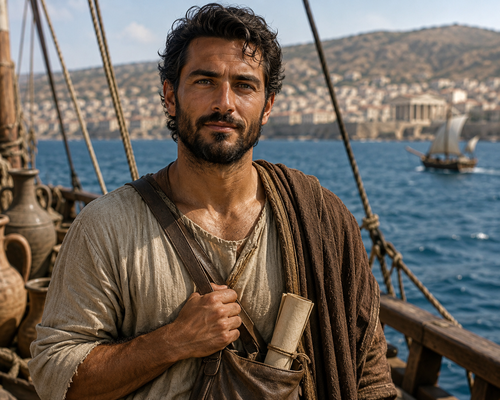
Nicanor is the main character in our short historical fiction episodes showing how the Book of Revelation may have first traveled from Patmos in the Aegean Sea in the first century to the churches in Asia Minor—and eventually to the whole world and people in every age since.
During this “Armchair Apocalypse” series, we’ll follow Nicanor on his travels to better understand the Book of Revelation by exploring the people and the times in which it was first revealed.
Nicanor and the Road Beyond Smyrna
The last words of John’s letter still hung in the crowded upstairs room.
“Fear none of those things which thou shalt suffer…. Be thou faithful unto death, and I will give thee a crown of life.” — Revelation 2:10, KJV
No one spoke for several moments. Below them, Smyrna continued as if nothing had happened. Merchants shouted in the street. Carts rattled over stone. Somewhere near the harbor, a priest called citizens to offer incense for the emperor. Rome’s noise had not stopped—but something inside the room had changed.
At dawn, Nicanor rolled the scroll carefully, wrapped it against the sea air, and placed it inside his leather bag. His next destination was Pergamum. As he tightened the strap, the church’s elder, a gray-bearded man named Justus, handed him bread, dried figs, and a small flask of water.
“John wrote that we will have tribulation,” Nicanor said. “Some in the room looked frightened. Do they believe something worse is coming?”
Justus glanced toward the street. “Something worse is always coming when men worship power. But tribulation is already here.”
He picked up an olive from the morning meal and pressed it between his fingers. “The word John used means pressure—the kind that crushes grapes or olives until what is inside comes out. Rome applies that pressure every day. Honor Caesar. Join the feast. Offer the incense. Call him lord. Most people think it is harmless. A pinch of incense, a few words, and everyone goes home happy.”
“Except those who refuse,” Nicanor said.
“Exactly. A merchant may lose his customers. A craftsman may be pushed out of his guild. A family may lose its home. Some will be imprisoned. Some may die.” Justus looked back toward the room where several believers still slept. “Tribulation reveals what is inside us. Fear—or faithfulness.”
Nicanor thought about the phrase “ten days” from Johns letter. “Does John mean their suffering will last only ten days?”
“Perhaps. Perhaps it is a symbol, like much of the vision. Daniel and his friends were tested for ten days. Whatever John means, the message is clear: the suffering has a limit. Rome does not decide how the story ends.”
Nicanor lifted the bag onto his shoulder. “Then how should they prepare?”
Justus smiled faintly. “Not by hiding in caves with baskets of grain.”
He pointed toward the believers upstairs. “We prepare by knowing who we belong to before the pressure comes. We feed the families of prisoners. We care for those who lose work. We teach our children that Caesar is not Lord. We refuse to become cruel when cruel men rule us. And when one of us becomes afraid, the others stand beside him.”
Nicanor looked north toward the road to Pergamum. Another city. Another church. Another place where Roman power demanded what belonged only to God.
Justus gripped his arm before he left. “Tell them in Pergamum what you saw here.”
“What did I see?”
“A frightened church listening to a dangerous letter,” Justus said, “and deciding to remain faithful anyway.”
Nicanor stepped into the waking street. Behind him stood Smyrna, proud, wealthy, and loyal to Rome. Ahead waited Pergamum, where John had written that Satan’s throne stood.
Tribulation, Nicanor now understood, was not merely a disaster scheduled for some later time or distant generation. It was the pressure every empire applied when it demanded the heart, mind, and obedience of God’s people.
The faithful prepared for it by deciding—before the pressure came—whom they would worship.