Armchair Apocalypse: Nicanor Continues His Journey

Nicanor is the main character in our short historical fiction episodes showing how the Book of Revelation may have first traveled from Patmos in the Aegean Sea in the first century to the churches in Asia Minor—and eventually to the whole world and people in every age since.

During this “Armchair Apocalypse” series, we’ll follow Nicanor on his travels to better understand the Book of Revelation by exploring the people and the times in which it was first revealed.


Nicanor and the Road Beyond Smyrna

The last words of John’s letter still hung in the crowded upstairs room.

No one spoke for several moments. Below them, Smyrna continued as if nothing had happened. Merchants shouted in the street. Carts rattled over stone. Somewhere near the harbor, a priest called citizens to offer incense for the emperor. Rome’s noise had not stopped—but something inside the room had changed.

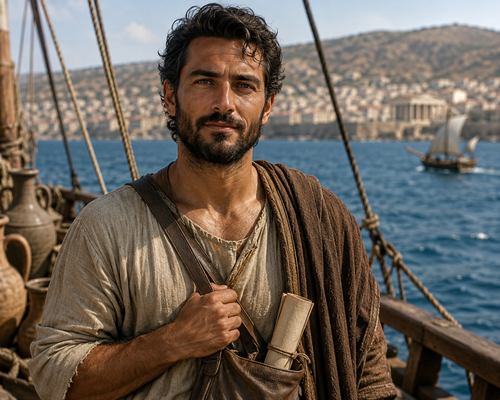
At dawn, Nicanor rolled the scroll carefully, wrapped it against the sea air, and placed it inside his leather bag. His next destination was Pergamum. As he tightened the strap, the church’s elder, a gray-bearded man named Justus, handed him bread, dried figs, and a small flask of water.

“John wrote that we will have tribulation,” Nicanor said. “Some in the room looked frightened. Do they believe something worse is coming?”

Justus glanced toward the street. “Something worse is always coming when men worship power. But tribulation is already here.”

He picked up an olive from the morning meal and pressed it between his fingers. “The word John used means pressure—the kind that crushes grapes or olives until what is inside comes out. Rome applies that pressure every day. Honor Caesar. Join the feast. Offer the incense. Call him lord. Most people think it is harmless. A pinch of incense, a few words, and everyone goes home happy.”

“Except those who refuse,” Nicanor said.

“Exactly. A merchant may lose his customers. A craftsman may be pushed out of his guild. A family may lose its home. Some will be imprisoned. Some may die.” Justus looked back toward the room where several believers still slept. “Tribulation reveals what is inside us. Fear—or faithfulness.”

Nicanor thought about the phrase “ten days” from Johns letter. “Does John mean their suffering will last only ten days?”

“Perhaps. Perhaps it is a symbol, like much of the vision. Daniel and his friends were tested for ten days. Whatever John means, the message is clear: the suffering has a limit. Rome does not decide how the story ends.”

Nicanor lifted the bag onto his shoulder. “Then how should they prepare?”

Justus smiled faintly. “Not by hiding in caves with baskets of grain.”

He pointed toward the believers upstairs. “We prepare by knowing who we belong to before the pressure comes. We feed the families of prisoners. We care for those who lose work. We teach our children that Caesar is not Lord. We refuse to become cruel when cruel men rule us. And when one of us becomes afraid, the others stand beside him.”

Nicanor looked north toward the road to Pergamum. Another city. Another church. Another place where Roman power demanded what belonged only to God.

Justus gripped his arm before he left. “Tell them in Pergamum what you saw here.”

“What did I see?”

“A frightened church listening to a dangerous letter,” Justus said, “and deciding to remain faithful anyway.”

Nicanor stepped into the waking street. Behind him stood Smyrna, proud, wealthy, and loyal to Rome. Ahead waited Pergamum, where John had written that Satan’s throne stood.

Tribulation, Nicanor now understood, was not merely a disaster scheduled for some later time or distant generation. It was the pressure every empire applied when it demanded the heart, mind, and obedience of God’s people.

The faithful prepared for it by deciding—before the pressure came—whom they would worship.

Armchair Apocalypse: Trouble Ahead? Tribulation Part Four

Part Four: Is a Future Great Tribulation Still Coming?

After looking at Revelation, Jewish history, and Jesus’ warning about Jerusalem, one question remains: Does the Bible predict another Great Tribulation at the end of history?

Possibly—but the popular seven-year scenario is not spelled out as clearly as many prophecy charts suggest.

The seven years come primarily from Daniel 9:24–27. Daniel describes “seventy weeks,” usually understood as seventy groups of seven. Futurist interpreters separate the final “week” from the first sixty-nine and place it at the end of history. That last week becomes a seven-year Tribulation, often divided into two three-and-a-half-year periods.

Revelation does mention 42 months, 1,260 days, and “a time, and times, and half a time”—different ways of describing approximately three and a half years. But it never directly identifies these periods as two halves of Daniel’s final week or calls their combined length the Great Tribulation.

That connection is an interpretation, not a quotation.

Christians generally approach these passages in several ways. Futurists expect a final period of worldwide suffering before Christ returns. Preterists believe most tribulation prophecies were fulfilled through first-century persecution and Jerusalem’s destruction. Idealists see tribulation as the recurring struggle between God’s kingdom and oppressive human powers. Many scholars take a blended approach: the prophecies addressed real first-century events, established patterns repeated throughout history, and may still point toward a final confrontation.

The New Testament certainly warns that evil, persecution, deception, and rebellion will continue. It also teaches that Christ will return, the dead will be raised, evil will be judged, and God’s kingdom will finally fill creation. What it does not give us is a tidy end-times spreadsheet with every event placed in an uncontested slot.

Jesus gave His followers a simpler warning:

That promise applies whether tribulation comes through Rome, religious persecution, war, dictatorship, cultural pressure, or some final crisis still ahead.

So What?

Interpretation asks what these passages meant within their original Jewish and Roman settings. Application asks how believers should live when the same pressures appear again.

The answer is not panic, date-setting, or treating every international crisis like the opening scene of Left Behind. It is faithfulness.

Perhaps a final Great Tribulation is coming. Perhaps some familiar prophecy systems have assembled the details incorrectly. Either way, Jesus never told His followers to build their lives around escaping hardship.

He told them to endure, remain awake, and trust that no empire, Beast, or tribulation gets the final word.

Armchair Apocalypse: Tribulation Part Three

What Did Jesus Mean by “Great Tribulation”?

Well before the Book of Revelation was written, Jesus warned His disciples about a coming time of terrible suffering:

This verse is often treated as a prediction about the final years before Christ returns. But Jesus did not deliver it during a lecture about twenty-first-century world politics. He was answering a question about the future of Jerusalem and its Temple.

The conversation began when the disciples admired the Temple buildings. Jesus responded that not one stone would be left upon another. Naturally, they wanted to know when this would happen.

Jesus warned them about false messiahs, wars, famines, earthquakes, persecution, and Jerusalem’s approaching destruction. When danger arrived, those living in Judea were told to flee to the mountains. They were not told to identify the Antichrist, calculate seven years, or upload an emergency prophecy podcast. They were told to get out.

Luke’s version is even more direct:

That happened in the Jewish revolt against Rome. In AD 70, Roman forces captured Jerusalem, destroyed the Temple, and inflicted enormous suffering on the people trapped inside the city. For Jesus’ disciples—and certainly for those who survived the siege—this was not a rehearsal for tribulation. It was tribulation.

Jesus also said, “This generation shall not pass, till all these things be fulfilled” (Matthew 24:34). That statement is difficult to explain if everything in the chapter refers exclusively to events thousands of years later.

Does that mean Matthew 24 has nothing to say about the future? Not necessarily. Biblical prophecy sometimes joins a near historical judgment with the larger themes of final judgment and God’s ultimate victory. Jesus’ language eventually reaches beyond Jerusalem to His coming, the gathering of His people, and the need to remain watchful.

That is why Christians read the passage differently. Some believe nearly all of it was fulfilled in the first century. Others see the fall of Jerusalem as an early fulfillment that foreshadows a greater final crisis. Futurists place most of the chapter near the end of history.

So What?

Whatever position we take, we shouldn’t skip the setting. Jesus gave this warning to real disciples about a real city, a real Temple, and a catastrophe that would occur within their historical world.

The destruction of Jerusalem shows what “great tribulation” looks like when violent empire, human rebellion, and divine judgment collide.

In Part Four, we’ll examine whether the Bible also points to a final worldwide Tribulation—and where the popular seven-year timeline actually comes from.

Armchair Apocalypse: Tribulation – Part Two

Tribulation Before Revelation

When John wrote about “great tribulation,” he wasn’t introducing a brand-new end-times idea. His Jewish readers already had centuries of history—and several biblical passages—shaping how they heard the word.

In the Hebrew Scriptures, tribulation usually means severe distress brought on by war, invasion, persecution, exile, or judgment. It wasn’t necessarily the official name of one future event. It was what happened when a nation or its people were squeezed to the breaking point.

Jeremiah described one such crisis:

“Jacob” means Israel. In context, Jeremiah is describing national disaster, captivity, and suffering—but also promising restoration. Some modern prophecy systems move “Jacob’s trouble” entirely into a future Tribulation. Others connect it primarily to Israel’s historical exile and oppression. Either way, the verse’s central movement is easy to miss: trouble is followed by rescue.

Daniel 12:1 uses similar language, predicting “a time of trouble, such as never was since there was a nation.” The passage grew out of a world in which God’s people knew exactly what violent empires could do. Jews had endured Babylon’s destruction of Jerusalem, forced exile, and later the brutal persecution associated with Antiochus IV, who outlawed Jewish practices and desecrated the Temple.

By John’s lifetime, Rome was adding another chapter. Roman armies destroyed Jerusalem and its Temple in AD 70 after a horrific siege. Ancient accounts describe starvation, bloodshed, and mass death. For Jewish families who lived through it—or lost relatives in it—that certainly qualified as great tribulation. No imagination or prophecy chart required.

Jewish teaching also came to speak of intense suffering before God’s deliverance as the “birth pains of the Messiah.” The image came from the prophets: war, fear, and upheaval were compared to a woman in labor. Labor is painful, but it moves toward something—the birth of a new reality.

So What?

That background helps us understand Revelation. John’s images of beasts, war, famine, persecution, and judgment were not random scenes from a supernatural disaster movie. They drew upon Israel’s long experience of suffering under kingdoms that acted as though they were untouchable. Yet those kingdoms always fell.

For John’s Jewish readers, tribulation meant real suffering, but it did not mean God had lost control. It was the darkness before deliverance, the labor before birth, and the pressure through which faithfulness was tested.

Next, we’ll look at what Jesus meant when He warned His disciples about “great tribulation” in Matthew 24.

Armchair Apocalypse: What Is ‘Great Tribulation’

We’ll be looking closely at questions and answers about “The Great Tribulation” in a four-part series, starting with Part One here.

Part One: Does Revelation Actually Describe a Seven-Year Tribulation?

Ask most prophecy teachers about the Great Tribulation and you’ll probably get a detailed seven-year timeline involving the Antichrist, the Beast, global war, and judgments arriving one after another.

You might even get a chart.

But if we’re going to understand Revelation, we should begin with what the book actually says—not with the chart.

The phrase “great tribulation” appears in Revelation 7:14, where John sees a huge crowd standing before God:

The Greek word translated “tribulation,” thlipsis, means pressure, distress, affliction, or suffering. It was not a special word reserved only for a future end-times disaster. In fact, John opens Revelation by calling himself his readers’ “companion in tribulation” (Revelation 1:9).

The believers in Smyrna were also experiencing tribulation and were warned that some of them would be imprisoned (Revelation 2:9–10). In Pergamum, a believer named Antipas had already been killed (Revelation 2:13).

For those Christians, tribulation wasn’t a theological theory. They lived under Roman authority in cities where emperor worship was part of public life. Refusing to honor Caesar and the Roman gods could cost them friendships, employment, freedom, or life itself.

Revelation does mention periods of 42 months, 1,260 days, and “a time, times, and half a time.” Each equals approximately three and a half years and draws from the symbolic language of Daniel. What Revelation does not do is combine two of those periods, call the result seven years, and name it “the Great Tribulation.”

The familiar seven-year scenario comes from connecting Revelation with a particular interpretation of Daniel’s seventieth week and several other passages. That may be a valid theological argument, but readers should know that the complete system is assembled from several texts. It is not plainly laid out in Revelation.

So What?

John’s first readers probably weren’t calculating how many years remained before suffering began. They were trying to remain faithful while suffering was already happening.

That changes the question. Instead of beginning with, “When will the Great Tribulation happen?” perhaps we should first ask:

What did tribulation mean within the Jewish and biblical world John’s readers already knew?

We’ll look at that in Part Two.