Armchair Apocalypse: Nicanor And The Horsemen

Nicanor is the main character in our short historical fiction episodes showing how the Book of Revelation may have first traveled from Patmos in the Aegean Sea in the first century to the churches in Asia Minor—and eventually to the whole world and people in every age since.

During this “Armchair Apocalypse” series, we’ll follow Nicanor on his travels to better understand the Book of Revelation by exploring the people and the times in which it was first revealed.


Nicanor heard the horses before he saw them. Hooves struck the hard Roman road north of Ephesus, and he instinctively moved aside. Four Roman soldiers appeared around the bend, mounted and armed, their cloaks shifting in the afternoon wind. Nicanor lowered his eyes and pulled his own cloak tighter around the leather-wrapped scroll hidden beneath it. John’s Revelation. If the wrong Roman decided to search him, his trip to Smyrna could end considerably sooner than planned. As the riders passed, however, another image flashed through his mind: four horses—white, red, black and pale.

Nicanor had lived long enough to know that armies rarely arrived alone. He remembered soldiers entering a village when he was younger—the shouting, terrified families, grain taken from storerooms, animals slaughtered, fields abandoned. Conquest came first. Then violence. Then hunger. Then death. Suddenly John’s strange vision didn’t seem strange at all. The white rider went forth conquering. The red rider took peace from the earth. The black rider carried scales while food became ruinously expensive. And the pale horse followed them all, carrying the simplest and ugliest name imaginable: Death.

People hearing Revelation in the churches of Asia Minor didn’t need a prophecy seminar to understand that sequence. Rome celebrated military conquest, while the feared Parthians beyond Rome’s eastern frontier were famous mounted archers—the sort of warriors John’s bow-carrying horseman could immediately bring to mind. War could devastate crops and disrupt grain supplies. John’s black horse described wheat costing about an entire day’s wage for a day’s food. Imagine working all day just to buy enough bread to survive until tomorrow. That wasn’t spooky symbolism to John’s audience. It was nightmare economics.

The soldiers disappeared down the road, leaving only dust behind them. Nicanor finally exhaled. He understood something modern readers sometimes miss: John wasn’t inventing monsters to scare people two thousand years later. He was taking realities his first readers already feared—conquest, bloodshed, famine and death—and turning them into four unforgettable riders. The imagery also reached deeper into Israel’s Scriptures, where sword, famine, pestilence and beasts were familiar images of judgment.

Nicanor touched the scroll beneath his cloak and continued toward Smyrna. Rome looked unstoppable. Its soldiers rode the roads. Its emperors ruled nations. Its armies conquered kingdoms. But in John’s vision, even the horsemen didn’t ride whenever they pleased. The Lamb opened the seals. That was the real message.

Nicanor smiled.

Rome wasn’t running history after all.

Armchair Apocalypse: Nicanor And The Antichrists

Nicanor is the main character in our short historical fiction episodes showing how the Book of Revelation may have first traveled from Patmos in the Aegean Sea in the first century to the churches in Asia Minor—and eventually to the whole world and people in every age since.

During this “Armchair Apocalypse” series, we’ll follow Nicanor on his travels to better understand the Book of Revelation by exploring the people and the times in which it was first revealed.


The last words of John’s Revelation still hung in the cramped upstairs room in Ephesus. Oil lamps flickered against plaster walls as perhaps twenty believers sat shoulder to shoulder—Jews, Greeks, slaves, merchants, men and women. Jacob ben Ezra, the church elder, had read John’s letter aloud in Greek, and nobody had checked the time. They had heard about beasts, Babylon, persecution, judgment—and a slain Lamb who ultimately conquers.

They knew Rome’s power firsthand. When John wrote of an arrogant empire demanding allegiance and persecuting God’s people, they didn’t need a prophecy chart. They knew what oppressive power looked like. And when they heard Christ say, “Be thou faithful unto death, and I will give thee a crown of life,” they understood that following Jeshua the Messiah might actually cost them theirs.

By sunrise, Nicanor was preparing to leave. He pulled a rough wool cloak over his knee-length tunic, tightened his leather sandals, and secured John’s precious scroll inside a leather wrapping beneath his cloak. Outside, Ephesus was waking up. Merchants shouted in Greek along its broad marble-paved streets. Carts rattled over stone. Sailors called from the harbor. Somewhere beyond the rooftops towered the magnificent Temple of Artemis—a constant reminder that Christianity was definitely not the hometown religion.

Jacob walked with Nicanor toward the road leading north. Before they separated, the elder lowered his voice. “John warned us that many antichrists have already come.” Nicanor knew the words from John’s teaching. An antichrist wasn’t merely some mysterious supervillain waiting thousands of years in the future. John had warned believers about deceivers already operating in their own world—people denying Christ and opposing the truth. “Even now are there many antichrists,” John had written (1 John 2:18 KJV). Jacob gripped Nicanor’s shoulder. “Watch whom you trust.”

Nicanor understood the danger. The scroll hidden beneath his cloak contained language about beasts, kings, Babylon, judgment, and a kingdom that would outlast every earthly empire. To believers, it was hope written in symbols they could recognize from the Hebrew Scriptures and their own world. To Roman authorities who understood its implications, it could sound dangerously subversive.

The Emperor demanded loyalty. John proclaimed Jesus Christ “King of kings, and Lord of lords.” If the letter were discovered and interpreted as defiance of imperial authority, Nicanor could find himself standing before a magistrate—and giving the authorities another excuse to investigate the churches receiving it.

Nicanor tightened his cloak and started north along the Roman road. Behind him, the noise of Ephesus slowly faded. Ahead lay miles of dusty road, roadside shrines, inns, merchants, soldiers, strangers—and plenty of opportunities for the wrong person to ask the wrong question. Beneath his cloak rested a message Rome could never completely suppress: Empires fall. In the end, every knee will bow, not to the Emperor, but to the resurrected and returning Jesus Christ. Evil loses. God wins. Somewhere farther up the road another small gathering of believers waited to hear the Revelation.

Smyrna.

Armchair Apocalypse: First Steps of Revelation

Meet Nicanor, a character in a short historical fiction story showing how the Book of Revelation may have first traveled from Patmos in the Aegean Sea in the first century to Ephesus—and eventually to the whole world and people in every age since.

During this “Armchair Apocalypse” series, we’ll follow Nicanor on his travels to better understand the Book of Revelation by exploring the people and the times in which it was first revealed.


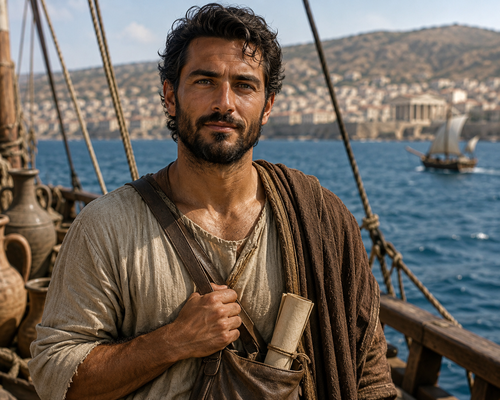
The old man carefully rolled the parchment and tied it with a simple cord. John—exiled on the rocky island of Patmos—looked across at Nicanor, a broad-shouldered Greek Christian in his early thirties whose weathered face and sun-darkened skin betrayed years spent working merchant ships across the Aegean. His short black beard was flecked with salt, and a coarse brown wool cloak hung over a simple linen tunic.

“This isn’t just a letter,” John said quietly in Greek. “It’s a revelation from Jesus Christ himself. The churches will be encouraged… and corrected. Rome won’t like either one.” Nicanor nodded, instinctively resting a hand on the leather satchel that concealed the scroll beneath spare clothing and food. If Roman officials searched him and discovered its contents, prison would be the best outcome. Execution wasn’t impossible. John placed a weathered hand on his shoulder. “Don’t rush. Don’t panic. Deliver it faithfully.” Then, with the kind of smile only someone who had seen such a vision of the glorified Christ could give, he added, “Besides… God has already handled bigger problems than bad weather and Roman soldiers.”

Nicanor boarded a small coastal merchant sailing vessel—a sturdy wooden cargo boat loaded with amphorae of olive oil, grain, and wine. Salt spray soaked his leather sandals as the ship crossed the blue waters toward Ephesus. Days later the city’s magnificent harbor appeared, crowded with fishing boats, cargo ships, and Roman patrol vessels. Merchants shouted prices in Greek while Roman soldiers barked commands in Latin. Citizens wearing bright linen tunics hurried along gleaming marble streets lined with columns, fountains, and towering temples dedicated to Artemis and the emperor. Every corner reminded people who Rome demanded they worship. Nicanor quietly smiled beneath his beard. He knew a greater King.

After sunset, he slipped through narrow stone alleys until an elderly man opened a plain wooden door. Jacob ben Ezra, one of the elders of the Ephesian church, stood slightly stooped with silver hair, deep lines around kind eyes, and a neatly trimmed white beard. Born and raised in the Jewish community of Ephesus, Jacob had spent decades studying the Law and the Prophets before becoming convinced only a few years earlier that Jesus of Nazareth was Israel’s promised Messiah. Some old friends now refused to speak to him. Others considered him a traitor. Yet his quiet joy never seemed to fade.

Inside, about thirty believers gathered in a modest courtyard lit by flickering oil lamps. Among them sat Eliab, a young Jewish craftsman who had only recently come to the same life-changing conclusion. Seeing another Jewish believer leading the gathering gave him courage.

Jacob carefully untied the scroll and began reading: “The Revelation of Jesus Christ…” The room became silent enough to hear the lamps crackle. As John’s words unfolded, the Jewish believers immediately recognized echoes of Daniel’s beasts, Ezekiel’s visions, Zechariah’s horses, and Isaiah’s promises, while the Gentile believers listened as those familiar Scriptures came alive in ways they had never imagined. This wasn’t a puzzle for clever people centuries later. It was a message for persecuted Christians living under Rome’s shadow: stay faithful, reject compromise, don’t worship Caesar, because Jesus—not the emperor—has already won and will reign. Some quietly wept. Others gripped each other’s hands. Eliab felt chills run down his spine. Following Jesus suddenly seemed both more dangerous… and more worth it than ever before.

As Nicanor carefully rolled the scroll back into its leather case, he glanced eastward. Six more churches were still waiting.