We have a function to perform and a part to play, each one of us individually and all of us together as God’s people, in God’s grand plan.
God’s Desire
God’s desire is to dwell together with his children forever in His perfect creation.
Our job in that relationship is to love and glorify our Heavenly Father and to take care of and add value to the creation He has given us.
The original creation and state of mankind was in perfect harmony and fellowship with the Creator and all was well with the universe.
The Rebellion
Then disobedience, rebellion, and sin cut mankind (Adam and Eve) off from their relationship with God.
Adam and Eve hid from God in shame. God’s perfect garden of delight was ruined, brought forth thorns and weeds, and was no longer the joyous place for Adam and Eve to tend and enjoy.
So Along Came Jesus
Then, after the fall and ruin, the whole purpose and plan of God is to restore that original relationship with His people and redeem the creation from the wreck of death and decay brought about by the rebellion.
The way He has done and is doing that is through His only begotten son, Jesus Christ, who through love and obedience has made it possible for us to once again live God’s original purpose.
We’ll continue to look into what all of that means and what it looks like in real life next week.
Catholic Bishops Pray Over Trump Just Days Before the Midterms
A group of American Catholic bishops gathered around President Donald Trump in the Oval Office on Thursday, praying for the president and the nation. Denver Archbishop James Golka led the prayer.
The meeting included discussions about religious freedom, school choice, religious visas, and abortion-related policy.
The White House shared video of the gathering, which occurred less than two weeks before the November 3 midterm elections. The United States Conference of Catholic Bishops said it did not organize the meeting.
Some Catholic commentators criticized the appearance as potentially partisan. The Denver Archdiocese emphasized that praying for elected officials is a longstanding religious practice and does not constitute a political endorsement. National Catholic Reporter
Should Christians pray for political leaders? Absolutely. Paul specifically instructs believers to pray for kings and those in authority.
“For kings, and for all that are in authority…” — 1 Timothy 2:2 (KJV)
But praying for a political leader isn’t the same thing as endorsing everything that leader does. And a photograph of religious leaders surrounding a politician shouldn’t be interpreted as evidence that God supports that politician’s policies.
Christians should pray for presidents and government leaders they support and those they oppose. The Kingdom of our Lord is not here yet, but we are supposed to be salt and light in this broken and dark age and world.
Here are four perspectives from four influential Christian thinkers on the Book of Acts, highlighting its central themes: the Holy Spirit, the growth of the early church, the mission of believers, and the spread of the Gospel.
John Stott — The Holy Spirit and the Church
“As a body without breath is a corpse, so the church without the Spirit is dead.”
John Calvin — The Kingdom and the Gospel
“His kingdom consisteth in the preaching of the gospel.”
Matthew Henry — The Early Christian Community
“They kept close to holy ordinances, and abounded in piety and devotion.”
Alexander MacLaren — The Mission of Every Believer
“The great work we have to do in the future is to be witnesses for Christ.”
Christianity began not as an elaborate religious institution, but as a movement of believers empowered by the Spirit, devoted to one another, and determined to spread the message of Jesus.
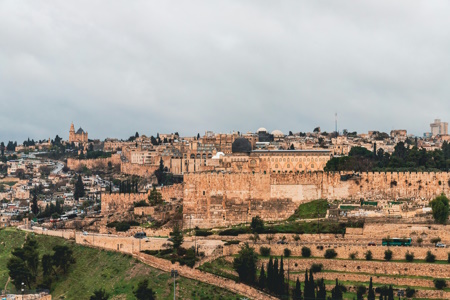
2,000-Year-Old Aqueduct to the Temple Mount Uncovered
Archaeologists have exposed a 300-meter section of Jerusalem’s Lower Aqueduct south of Ramat Rachel. The system carried spring water from the area south of Bethlehem, through Solomon’s Pools, toward Jerusalem and the Temple Mount. Researchers believe the aqueduct originated in the Hasmonean period and remained in use, with modifications, for nearly two millennia. Jewish Telegraphic Agency
This doesn’t “prove Jesus.” We don’t need archaeology to do that. It does something archaeology more and more of recently: it reconstructs the real physical world in which the Bible happened.
Jerusalem at festival times needed enormous quantities of water for residents, pilgrims and ritual activity. This aqueduct shows the infrastructure behind the biblical setting.
So What?
That makes the Gospel world less like a stained-glass picture and more like a real city filled with engineering, crowds, water systems and ordinary human life.
It gives us another substantial piece of Second Temple Jerusalem—the Jerusalem Jesus and His disciples knew.
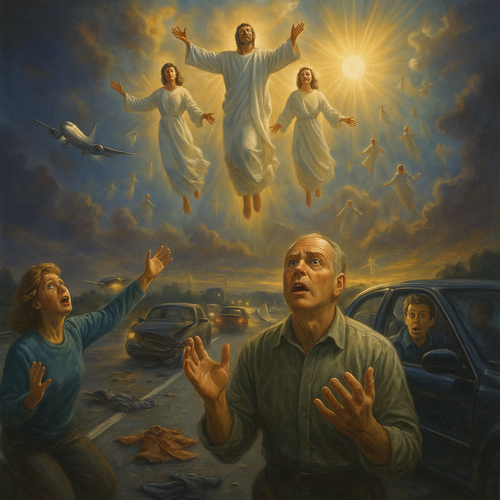
For many Christians, the Rapture goes something like this: Jesus suddenly removes every believer from Earth, clothes collapse onto sidewalks, driverless cars pile up, and everyone left behind enters seven years of Tribulation.
It makes great movie and fictional novel material. But is that what Revelation actually says?
Revelation never uses the word “rapture” and never plainly describes Christians disappearing before its judgments begin.
The biblical basis for the Rapture comes mainly from Paul:
“Then we which are alive and remain shall be caught up together with them in the clouds, to meet the Lord in the air.” — 1 Thessalonians 4:17, KJV
The Greek word translated “caught up” is harpazō, meaning to seize, snatch, or carry away. When the New Testament was translated into Latin, the word rapiemur was used. That is where our English word “rapture” comes from.
So, the idea of believers being caught up to meet Christ is biblical. The real debate is about when it happens, what it looks like, and where believers go afterward.
Paul’s description does not sound especially secret. The Lord descends with a shout, the voice of an archangel, and the trumpet of God. The dead are raised, living believers are caught up with them, and everyone meets the returning Christ. If this is supposed to happen quietly, somebody forgot to silence the trumpet.
In the ancient world, people often went outside a city to meet an arriving king or honored ruler and accompany him as he entered. That background has led many scholars to understand Paul’s scene not as believers leaving Earth permanently, but as God’s people going out to welcome Christ at His public arrival.
Paul gives a similar picture in 1 Corinthians 15:51–52. The dead are raised and believers are transformed “at the last trump.” Jesus says in Matthew 24:29–31 that He will gather His elect with a great trumpet “after the tribulation.”
Revelation certainly describes Christ’s return, resurrections of the dead, judgment, and the gathering of God’s people. What it does not clearly describe is a separate, secret return in which the Church is removed several years before Christ’s visible arrival.
That timetable has to be constructed by combining passages from several books and interpreting them in a particular way. It cannot simply be read from a paragraph in Revelation.
So What?
The question is not whether Christ will gather His people. The New Testament clearly says He will.
The question is whether Revelation teaches that believers escape the trouble before it begins—or remain faithful through it until Christ comes.
In Part Two, we’ll examine the passages most often used to argue that the Church disappears before Revelation’s Tribulation.
The Vatican has upheld the excommunication of former Louisiana Catholic deacon Scott Peyton, who left the Catholic Church after a priest sexually abused his teenage son. Church authorities ruled that Peyton’s decision to join an Anglican congregation constituted a formal break with Catholic authority. The convicted priest, Michael Guidry, remains a priest, although suspended from public ministry. Peyton intends to challenge the Vatican’s decision further.
The father who protected his family is excommunicated. The priest who abused his son remains a priest.
Catholic canon law distinguishes between leaving church communion and criminal misconduct, but that distinction raises serious questions about institutional priorities.
Jesus reserved some of His harshest criticism for religious leaders who placed institutional traditions above mercy and justice.
“But all their works they do for to be seen of men.” — Matthew 23:5 (KJV)
So, when does protecting a religious institution become more important than protecting the people it’s supposed to serve?
This decision could deepen distrust of institutional Christianity among abuse survivors and families already questioning church authority.
Now God’s grand plan is to restore His people and His creation to their original purpose. Paradise was lost; it is to be regained. Everlasting life with God was lost; it is to be regained.
But our original purpose remains the same today, even in a fallen state of sin, death, darkness, and rebellion: to glorify, God, add value to His creation, and have fellowship with the Creator.
What Does That Have To Do With My Life?
If you’ve ever been part of a team or organization, you know that once you get a basic understanding of the ‘big picture’ goals and purpose of the team or organization, your part in it begins to make more sense, and you get a clearer vision of what you need to do individually.
We’ll start to look into what all of that means and what it looks like in real life next week.
President Trump announced that the December 3 firing-squad execution of convicted Fort Hood murderer Nidal Hasan will not be livestreamed, reversing Defense Secretary Pete Hegseth’s proposal. Catholic bishops, evangelical leaders and other religious groups had criticized the broadcast plan.
A new poll found that 74% of white evangelicals and even larger shares of several other religious groups opposed the livestream. The execution itself remains scheduled. Religion News Service coverage
Scripture recognizes government authority to punish wrongdoing (Romans 13:4). But turning someone’s death into a public spectacle raises a different moral question.
So What?
Christians may disagree about capital punishment, but we should at least consider whether broadcasting an execution honors justice or simply satisfies an appetite for vengeance.
Religious opposition helped shape a consequential government decision, demonstrating that Christians can influence public policy even when they disagree on underlying doctrine.
Here are four perspectives from four different biblical scholars and Christian thinkers on the differences between the Synoptic Gospels (Matthew, Mark, and Luke) and the Gospel of John.
The central distinction is that the Synoptics emphasize Jesus’ public ministry, parables, and proclamation of God’s kingdom, while John concentrates more explicitly on Jesus’ identity, His relationship with the Father, and the meaning of believing in Him.
Clement of Alexandria — A different kind of Gospel
“John … composed a spiritual gospel.”
— Clement of Alexandria, as preserved by Eusebius, Ecclesiastical History 6.14.7 (translated excerpt).
Clement’s ancient observation captures the distinctive theological emphasis of John. The first three Gospels recount Jesus’ ministry through many shared events and teachings; John places particular emphasis on their deeper spiritual meaning.
B. F. Westcott — Two different perspectives
“The transition involves the passage from one world of thought to another.”
— Brooke Foss Westcott, An Introduction to the Study of the Gospels, p. 249.
Westcott recognizes the striking change in language, structure, and emphasis when moving from Matthew, Mark, and Luke to John. He nevertheless argues that these different presentations can be understood together.
D. A. Carson — Different presentations of Jesus
“There are obvious differences between the presentation of Jesus by the synoptists and the presentation of Jesus by John.”
— D. A. Carson, Historical Tradition in the Fourth Gospel, p. 121.
Carson cautions against assuming that these differences necessarily make the accounts historically incompatible. He argues that Jesus’ actual ministry was larger than any one Gospel’s selection of events and teachings.
Michael F. Bird — John’s distinctive approach
“John is clearly in a class of his own and is doing his own thing.”
— Michael F. Bird, quoted from his 2015 discussion of the Fourth Gospel, p. 110.
Bird emphasizes John’s distinctive literary character. Instead of the Synoptics’ many short sayings and parables, John features extended conversations, symbolic signs, and Jesus’ remarkable “I am” declarations.
Matthew, Mark, and Luke often emphasize what Jesus did and taught as He proclaimed God’s kingdom. John gives particular attention to who Jesus is and what His coming means. But the differences go beyond emphasis: the Gospels also differ in their selection, arrangement, and sometimes chronology of events.
Those distinctions deserve careful study rather than being ignored or automatically treated as contradictions.
An Estimated 80,000 Christians Gather in Texas Stadium for Prayer
While much of America’s attention is focused on politics, wars and cultural controversies, here’s what happened Saturday night in Arlington:
An estimated 80,000 Christians gathered at AT&T Stadium for an evening devoted primarily to prayer.
The event, called ACCESS — That Powerful Hour of Prayer, was organized by 2819 Church and Pastor Philip Anthony Mitchell.
According to organizers and participants, free tickets were reserved within eight hours. Unlike many large Christian gatherings, the event wasn’t built around celebrity speakers or a traditional concert.
Istead it emphasized collective prayer, worship and spiritual renewal.
The reported attendance is an estimate rather than an independently verified count. Nevertheless, the event’s scale is notable. Last year’s ACCESS gathering reportedly attracted more than 30,000 participants in Atlanta. Christian Post
Wait. Aren’t we constantly hearing that Christianity is dying in America?
Church attendance has declined in many denominations and religious affiliation has weakened, while millions of Americans identify as having no religion.
Yet tens of thousands of people gathered in a football stadium specifically to pray.
So What’s Going On?
Maybe Americans aren’t necessarily losing interest in God, but rather some are losing interest in traditional religious institutions.
While that’s not a conclusion we can draw from one stadium gathering it is a question worth investigating.
Jesus said:
“For where two or three are gathered together in my name, there am I in the midst of them.” — Matthew 18:20 (KJV)
Notice our Lord didn’t say two or three thousand, and He didn’t require a stadium.
Large gatherings like this suggest that substantial enthusiasm for collective Christian worship remains, even as traditional measures of religious participation show long-term weakness.