While American Christians argue online about worship styles and coffee flavors, believers in places like Nigeria, North Korea, and Syria are risking prison, kidnapping, and death just for owning a Bible. Recent reports estimate more than 388 million Christians worldwide face persecution or discrimination for their faith — the highest number ever recorded. – Vatican News
Should we assume we’re not persecuted like that for our Christian faith here in America because we’re such great believers? Not on your life!
In fact, we should be asking some serious questions about why our brand of Western churchianity is many times so milquetoastand inconsequential that the Adversary doesn’t waste his time trying to destroy us or even silence our too often watered down message.
Tradition and the doctrines of men disguised as God’s truth are not a threat to darkness. As the world gets darker, people start looking for actual light, not the synthetic, weak glow of religion.
Remember, Jesus never promised that following him would make us popular. He promised truth.
“If the world hate you, ye know that it hated me before it hated you.” — John 15:18
Here’s the Bible Rebel reality check: The modern world offers endless distraction but very little hope. Christians in persecuted nations know following Christ costs something. Many American Christians barely let it inconvenience their Sunday schedule. Ouch.
So What?
Today, pray for persecuted Christians by name if you can. Check your own faith – is it salty and full of light, or bland and ho-hum? Ruffle some feathers, speak the truth, and be a force for God as He moves through this time and place bringing His grand and awesome plan to it’s conclusion.
Most of us are familiar with this passage in Luke about the others crucified with Jesus:
Luke 23:40–43 (KJV) But the other answering rebuked him, saying, Dost not thou fear God, seeing thou art in the same condemnation? And we indeed justly; for we receive the due reward of our deeds: but this man hath done nothing amiss. And he said unto Jesus, Lord, remember me when thou comest into thy kingdom. And Jesus said unto him, Verily I say unto thee, today shalt thou be with me in paradise.
Many use this as a proof text that believers go immediately to heaven—or somewhere—when they die.
But is that really what this passage is about? Or is there something else going on here?
Let’s start by asking what should be some obvious questions if we are to assume the traditional theological narrative about Luke 23:40–43.
Is saying a few words, sticking up for Jesus, and asking to be remembered by him all that is required for thieves and malefactors to get into “heaven”?
Is being in “paradise” the same thing as “going to heaven”?
Did Jesus come into his kingdom on the day of the crucifixion?
Did the malefactor go immediately to “heaven” with Jesus after they died?
Did the malefactor miss Jesus for the 40 days or so that Jesus was carrying out his post‑resurrection ministry on earth?
Is the malefactor in heaven right now with Jesus?
What was the point of Jesus being raised from the dead after three days if he and the malefactor crucified with him were already alive together in paradise or heaven on the very same day they died on crosses?
We should all be asking questions like this, and many of the other things we’ve been taught from religion and churchianity, to see if they make sense and if they are actually biblical.
Stay tuned as we start examining the questions raised here in detail.
Gallup’s latest numbers show what you already feel in your bones: fewer people are showing up, tuning in, or identifying with any religious tradition. Engagement is drifting and labels are fading. The old structures don’t hold like they used to.
But here’s the twist: the hunger hasn’t gone anywhere. People aren’t rejecting God — they’re rejecting churchianity: the noise, the politics, the performance, the plastic spirituality that never delivered.
Because the doctrines of men and religious traditions are empty cisterns that hold no water. So the thirsty start going elsewhere.
If that’s you, welcome. You’re in good company. Jesus built His movement with people who didn’t fit the religious mold. Outsiders. Questioners. The spiritually allergic. The ones who said, “There has to be more than this.”
Scripture puts it simply: “Draw near to God, and He will draw near to you.” — James 4:8
Not “draw near to a denomination.” Not “draw near to a system.” Just God. That’s our mission at Bible Rebel.
Maybe the decline in religious engagement isn’t a crisis — maybe it’s a clearing. A chance to rebuild faith from the ground up, without the baggage.
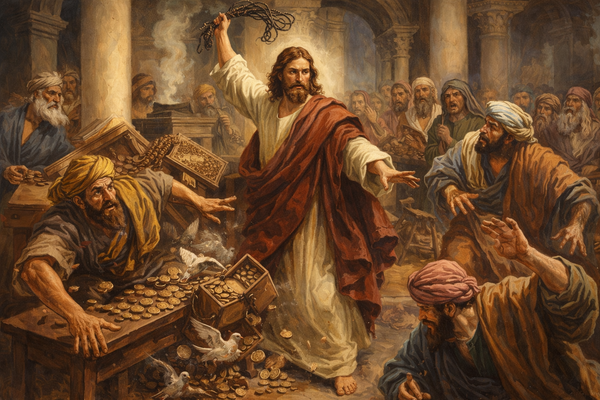
The folks who hated Jesus most, and the ones he leveled his most scathing rebukes at, were the religious leaders of his time and culture.
Followers of Yeshua the Messiah shouldn’t be surprised or discouraged by the ridicule and snarky attacks on us because of our faith, or by the tiresome and faithless virtue‑signaling and false preaching and teaching coming from the poohbahs and “leaders” of organized churchianity.
Just remember what the religious and political leaders of that time and that culture did to our Lord over 2,000 years ago, and to the faithful in subsequent generations.
There’s nothing new under the sun.
This present age is not our friend, but there is a day certain when this present age ends and the suffering Servant becomes a reigning King.
Churchianity and the theological status quo should be scrutinized by all people of faith regularly. That is exactly how we got the Reformation.
Is there a New Reformation brewing? It seems so. There is a difference between truth and tradition.
Man-made Christian creeds and doctrines are no longer being blindly accepted as biblical truth just because the Protestant clergy or the Catholic Papacy say so.
The nature of God, heaven, hell, sin, the apocalypse, predestination or free-will, the Rapture, the origins of the universe – all of these ideas and more need solid reexamination to see if the commonly accepted doctrines of men used to explain them measure up to the message of scripture.
The Bible Rebel blog is a resource for those seeking original and curated content, including news and commentary, covering faith, biblical studies and interpretation, and the intersection of politics, culture, and the Bible.
Our Mission
To monitor current news and events related to faith and culture.
To provide an alternative viewpoint to the world’s pervasive climate of darkness, nihilism, and hopelessness for those seeking truth, light, and purpose.
To examine and question the assumptions of religious tradition and provide a resource for information and inspiration for people of faith who have become dissatisfied with an increasingly lifeless and empty ‘churchianity’.
To present the Biblical truths which reveal God’s nature and purposes and proclaim the lifechanging, world-altering, radical message of Yeshua the Messiah – Jesus Christ, our risen Lord and Savior.
At Bible Rebel, this is our one and only creed: Our living God is a loving God and the Bible is His revealed word and will. Our hope and eternal salvation relies entirely on the work of God’s only begotten son, Jesus Christ, who is the way, the truth, and the life.
So, expect some controversial viewpoints and uncomfortable ideas in some of the coming content from Bible Rebel.
Bible Rebel keeps a watchdog’s eye on news and events from the world of faith and religion and brings that content to our readers.
Trump Establishes Faith Office & Religious Liberty Commission
Former President Donald Trump has inaugurated several faith-based initiatives—such as a White House Faith Office, a Religious Liberty Commission, and a task force to eradicate anti-Christian bias. While his conservative Christian base applauds the move, critics warn it risks violating the First Amendment by privileging politically aligned Christian factions over broader religious pluralism. From Milwaukee Independent
At their 2025 annual meeting in Dallas, the Southern Baptist Convention (SBC)—the largest Protestant denomination in the U.S.—voted to endorse several conservative social resolutions. These include advocating a legal ban on pornography, opposing same-sex marriage (seeking reversal of the 2015 U.S. Supreme Court decision), restricting sports betting, and encouraging childbirth. Internal debates also continue on issues like women pastors and the denomination’s policy arm. From the AP
AP-NORC Poll: U.S. Adults Embrace Religious Chaplains in Schools
A new AP–NORC poll finds about 60% of U.S. adults support allowing religious chaplains in public schools to provide support—though not teacher-led or compulsory prayer. Support is split along denominational and political lines: White evangelical and Black Protestant adults are more favorable than Catholics, mainline Protestants, and non‑religious respondents. There’s broad concern (80%+) over church–state separation and funding issues. From apnews.com
Ecumenical Christian Leaders Condemn Hate Speech in Dallas
Over 30 Christian leaders and churches—including groups from Baptist, Lutheran, Presbyterian, Anglican, United Methodist, Evangelical, and Congregational traditions—have publicly denounced a planned “Hindu supremacist” event in Dallas featuring Kajal Singhala. Organized by Hindu nationalist groups with histories of anti-Christian rhetoric, the event has drawn strong opposition from an ecumenical coalition underscoring religious freedom and the Christian gospel. From clarionindia.net
Is traditional denominational church attendance and membership an indicator of the spiritual health of a country or community?
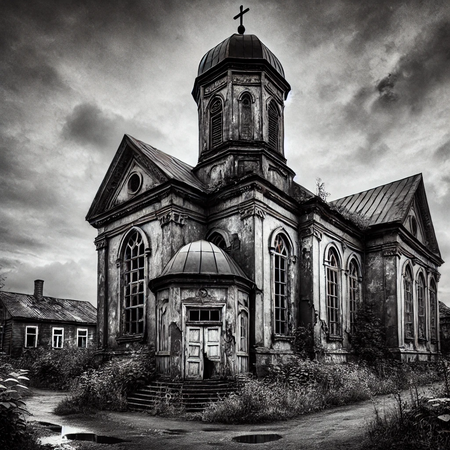
Maybe. But if it is, then America and Western Europe have been are in need of an urgent diagnosis and prognosis, because the patient hasn’t been looking so good in recent years.
According to churchtrac.com, “Church membership and attendance have been on a steady decline in the United States for almost 25 years. A recent (2021) Gallup study discovered U.S. church membership has dipped below 50% for the first time in 80 years.”
In addition, according to a recentPew Research Religious Landscape Study, “The latest RLS, fielded over seven months in 2023-24, finds that 62% of U.S. adults identify as Christians. That is a decline of 9 percentage points since 2014 and a 16-point drop since 2007.”
That study also indicates that study also found that, “…for the last five years, between 2019 and 2024, the Christian share of the adult population has been relatively stable, hovering between 60% and 64%. The 62% figure in the new Religious Landscape Study is smack in the middle of that recent range.”
So, it’s possible that the decline in traditional churchianty’s attendance and membership has leveled off in recent years, but it seems to be only getting worse in Western Europe.
Catholic Membership in Germany Falls Below 20 Million for the First Time
“For the first time in history, the number of Catholics in Germany has dipped below the 20 million mark, according to preliminary figures released by the German Bishops’ Conference in Bonn. As of 2024, the Catholic population now accounts for just 23.7% of the total German population, translating to approximately 19,769,237 members.
This significant decline comes despite a slight decrease in the number of individuals formally leaving the Church. In 2024, 321,611 Catholics exited the institution, a reduction from the previous year’s figure of 402,694.“
Why?
Well, you don’t need a weatherman to know which way the wind blows, as the saying goes.
Anyone who has been paying attention to such things knows, both statistically and anecdotally, that Americans and Europeans alike have become increasingly skeptical of, and even hostile towards, denominational Christianity.
This doesn’t mean folks aren’t interested in or craving spiritual matters less, it just means that religiosity has lost much of it’s appeal and credibility.
There are a variety of reasons for this exodus from churchianity, but here are some of the reasons I have observed and noted over the years:
Denominational and creedal doctrines are confusing and contradictory, often not even biblical, and fail to provide direct answers to direct questions about God and the Bible.
Clergy and spiritual leadership are often seen as being too focused on raising resources for new buildings, administration, and church functions.
Church and worship services are too often centered on denominational ceremonies and traditions, which are mostly devoid of spiritual power, or on emotional experiences which are short-lived.
Teachings from the pulpit that are either boring and irrelevant or are focused on cultural, political, and social issues rather than on the power of the living God and the literal resurrection and literal apocalyptic return Jesus Christ to judge the world, establish His Kingdom, and bring about the everlasting reign of God.
Bible Rebel’s Creed and Mission
The purpose of the Bible Rebel ministry and blog is to provide an alternative resource and connection point for those seeking something more than stale, powerless religion.
Here is our one and only creed: Our living God is a loving God and the Bible is His revealed word and will. Our hope and eternal salvation relies entirely on the work of God’s only begotten son, Jesus Christ, who is the way, the truth, and the life.
Bible Rebel continues to keep a watchdog’s eye on what’s happening in the world of religion and churchianity.
Evangelical Clergy and Climate Change
A recent survey revealed that nearly 80% of evangelical Protestant pastors reject the scientific consensus on human-caused climate change. This contrasts with clergy from other Christian traditions, such as Catholics and mainline Protestants, who are less skeptical. See more at Religion Unplugged
Protestant Denominations Facing Decline
Historic U.S. Protestant denominations, including the Episcopal and Presbyterian Churches, are experiencing declines in membership and funding. This has led to staff cuts and efforts to explore new strategies to adapt to changing social contexts. See more at Baptist News
Combating Anti-Christian Bias
Discussions around anti-Christian bias have emerged, with debates on whether certain actions represent genuine concerns or reactions from specific ideological perspectives. This topic has been highlighted in the context of faith-based initiatives and their evolution over different U.S. administrations. See more at Atlanta Daily World
Episcopal Bishop Mariann Edgar Budde is getting both criticism and praise for the political lecture, disguised as a sermon, that she aimed at President Trump, Vice President Vance, and both of their families during the National Prayer Service at the Washington National Cathedral the day after Trump’s inauguration.
Was that really an appropriate time and place for a minister to deliver a political speech designed to publicly criticize a newly inaugurated POTUS?
Some say that the pulpit is a perfectly appropriate platform from which to speak truth to power, you know, like Jesus did, right?
But to whom did Jesus direct his most withering truth bombs? To the Roman government officials occupying Judea? To Caesar, mighty Emperor of the known civilized world?
Nope. Jesus spoke truth to the power of the religious leaders of his people, because they were the corrupt and wicked ones, whom Jesus called children of Satan.
Maybe Bishop Budde should focus on speaking truth to the high powers of the Episcopal Church who have presided over several sexual abuse and other scandals involving staff and clergy over the years. Just Google “Episcopal church scandals”.
Or maybe her time would be better spent exploring the reasons why the Episcopal Church continues to lose members and adherents. She could then speak truth to the power of the causes of a dying, empty church with no answers for spiritual hungry people.
Here’s a truth that Jesus spoke and which is relevant to us all, including those like Bishop Budde who treat the pulpit as a self-serving political tool, rather than a moral and spiritual responsibility – “Thou hypocrite, first cast out the beam out of thine own eye; and then shalt thou see clearly to cast out the mote out of thy brother’s eye.”
The article goes on to say, “A religious schism has turned deadly in Nigeria, with a church member fatally shot and two young children killed as homes were set ablaze, according to United Methodist News Service. The news service said the reported violence on Sunday stemmed from a schism in the worldwide United Methodist Church over its decision to repeal LGBTQ bans — and the ensuing formation of the new Global Methodist Church by breakaway conservative churches.”
Catholic Movement Dissolved Over Abuses
Also from the AP, Dissolution of Sodalitium Christianae Vitae: Pope Francis has dissolved the Peru-based conservative Catholic movement, Sodalitium Christianae Vitae, following a comprehensive investigation that uncovered extensive sexual, financial, and spiritual abuses by its founder and leaders. This action reflects the Vatican’s ongoing efforts to address and rectify abuses within Church-affiliated organizations.
Across The Pond: Archbishop of Canterbury Resigns in Wake of Abuse Scandal
From The Times – It is right that Justin Welby resigned after the publication of the Makin review into the Church of England’s most prolific abuser, John Smyth. If the former Archbishop of Canterbury, and others, had acted with more resolution when they were made aware of the scale of Smyth’s offending then some boys he victimized might have been spared.
What’s Going On?
Do you notice a pattern in these three stories? I do – abuse and division. No wonder folks are fleeing religion in droves.
The words of Jesus come to mind. Abuse:“It were better for him that a millstone were hanged about his neck, and he cast into the sea, than that he should offend one of these little ones.” Luke 17:2 Division:“And if a house is divided against itself, that house cannot stand.” Mark 3:25
And no wonder the chief enemies of Jesus were the religious leaders of the time. He exposed them.
What are we as followers of Jesus doing to expose the ‘whited sepulchers’ of our day and time?