Peter Thiel Connects AI Regulation to the Antichrist
Technology investor Peter Thiel is making headlines following the release of recordings from his private Nashville lectures on the Antichrist.
According to reporting published October 8, Thiel argues that fears surrounding artificial intelligence could help justify the creation of an authoritarian world government. – October 8 report on Thiel’s Nashville lectures
He has criticized Pope Leo XIV and former President Barack Obama for their concerns about AI.
Thiel’s argument connects technological regulation, global political authority and his interpretation of biblical end-times prophecy. His lectures also discuss the mysterious restraining force described in 2 Thessalonians 2. Gizmodo
Apparently, the Antichrist now works in AI regulation.
We’ve all heard similar predictions before.
The Antichrist has supposedly been a pope, Napoleon, Hitler, various American presidents and just about every powerful European politician.
Now we’re adding people who want to regulate artificial intelligence. But, the word antichrist never appears in Revelation. John uses it in his letters, including this remarkable statement:
“Even now are there many antichrists.” — 1 John 2:18 (KJV)
John wasn’t describing a single futuristic technology regulator, he was warning about people already active in his own time.
Thiel’s arguments demonstrate how biblical prophecy is being incorporated into modern debates about technology, political authority and global governance.
Why don’t we first consider how the Book of Revelation would have been understood by the people it was first written to about 2000 years ago?
Well before the Book of Revelation was written, Jesus warned His disciples about a coming time of terrible suffering:
“For then shall be great tribulation, such as was not since the beginning of the world to this time, no, nor ever shall be.” — Matthew 24:21, KJV
This verse is often treated as a prediction about the final years before Christ returns. But Jesus did not deliver it during a lecture about twenty-first-century world politics. He was answering a question about the future of Jerusalem and its Temple.
The conversation began when the disciples admired the Temple buildings. Jesus responded that not one stone would be left upon another. Naturally, they wanted to know when this would happen.
Jesus warned them about false messiahs, wars, famines, earthquakes, persecution, and Jerusalem’s approaching destruction. When danger arrived, those living in Judea were told to flee to the mountains. They were not told to identify the Antichrist, calculate seven years, or upload an emergency prophecy podcast. They were told to get out.
Luke’s version is even more direct:
“And when ye shall see Jerusalem compassed with armies, then know that the desolation thereof is nigh.” — Luke 21:20, KJV
That happened in the Jewish revolt against Rome. In AD 70, Roman forces captured Jerusalem, destroyed the Temple, and inflicted enormous suffering on the people trapped inside the city. For Jesus’ disciples—and certainly for those who survived the siege—this was not a rehearsal for tribulation. It was tribulation.
Jesus also said, “This generation shall not pass, till all these things be fulfilled” (Matthew 24:34). That statement is difficult to explain if everything in the chapter refers exclusively to events thousands of years later.
Does that mean Matthew 24 has nothing to say about the future? Not necessarily. Biblical prophecy sometimes joins a near historical judgment with the larger themes of final judgment and God’s ultimate victory. Jesus’ language eventually reaches beyond Jerusalem to His coming, the gathering of His people, and the need to remain watchful.
That is why Christians read the passage differently. Some believe nearly all of it was fulfilled in the first century. Others see the fall of Jerusalem as an early fulfillment that foreshadows a greater final crisis. Futurists place most of the chapter near the end of history.
So What?
Whatever position we take, we shouldn’t skip the setting. Jesus gave this warning to real disciples about a real city, a real Temple, and a catastrophe that would occur within their historical world.
The destruction of Jerusalem shows what “great tribulation” looks like when violent empire, human rebellion, and divine judgment collide.
In Part Four, we’ll examine whether the Bible also points to a final worldwide Tribulation—and where the popular seven-year timeline actually comes from.
We’ll be looking closely at questions and answers about “The Great Tribulation” in a four-part series, starting with Part One here.
Part One: Does Revelation Actually Describe a Seven-Year Tribulation?
Ask most prophecy teachers about the Great Tribulation and you’ll probably get a detailed seven-year timeline involving the Antichrist, the Beast, global war, and judgments arriving one after another.
You might even get a chart.
But if we’re going to understand Revelation, we should begin with what the book actually says—not with the chart.
The phrase “great tribulation” appears in Revelation 7:14, where John sees a huge crowd standing before God:
“These are they which came out of great tribulation, and have washed their robes, and made them white in the blood of the Lamb.” — Revelation 7:14, KJV
The Greek word translated “tribulation,” thlipsis, means pressure, distress, affliction, or suffering. It was not a special word reserved only for a future end-times disaster. In fact, John opens Revelation by calling himself his readers’ “companion in tribulation” (Revelation 1:9).
The believers in Smyrna were also experiencing tribulation and were warned that some of them would be imprisoned (Revelation 2:9–10). In Pergamum, a believer named Antipas had already been killed (Revelation 2:13).
For those Christians, tribulation wasn’t a theological theory. They lived under Roman authority in cities where emperor worship was part of public life. Refusing to honor Caesar and the Roman gods could cost them friendships, employment, freedom, or life itself.
Revelation does mention periods of 42 months, 1,260 days, and “a time, times, and half a time.” Each equals approximately three and a half years and draws from the symbolic language of Daniel. What Revelation does not do is combine two of those periods, call the result seven years, and name it “the Great Tribulation.”
The familiar seven-year scenario comes from connecting Revelation with a particular interpretation of Daniel’s seventieth week and several other passages. That may be a valid theological argument, but readers should know that the complete system is assembled from several texts. It is not plainly laid out in Revelation.
So What?
John’s first readers probably weren’t calculating how many years remained before suffering began. They were trying to remain faithful while suffering was already happening.
That changes the question. Instead of beginning with, “When will the Great Tribulation happen?” perhaps we should first ask:
What did tribulation mean within the Jewish and biblical world John’s readers already knew?
Mention “the Antichrist,” and most people picture a slick global dictator, the son of Satan, running the United Nations while plotting world domination. Throw in a creepy kid named Damien, a barcode or implanted microchip, and dramatic background music, and you’ve basically got pop culture’s version of the end times.
But come on, that’s not actually what the Bible says.
Much of our modern picture comes from movies like The Omen (1976), Rosemary’s Baby (1968), Hal Lindsey’s Late Great Planet Earth, and later the Left Behind novels and films, where the charismatic politician Nicolae Carpathia became the Antichrist for an entire generation. These stories are entertaining, but they blend together different biblical characters and centuries of theological tradition into one supervillain. (Wikipedia)
As I outlined previously, though, the word “antichrist” never appears in the Book of Revelation. Not even once.
Instead, John uses the word only in his letters (1 John 2:18, 22; 4:3; 2 John 7), where he says that “many antichrists” were already present in his own day. He describes people who denied that Jesus is the Christ—not a future global emperor waiting for his movie trailer.
A Little History
So where did the famous end-times Antichrist come from?
Over the centuries, Christian writers gradually combined several different biblical figures into one character:
John’s antichrists (false teachers).
Paul’s “man of lawlessness” (2 Thessalonians 2).
Daniel’s little horn (Daniel 7).
Revelation’s Beast from the sea (Revelation 13).
By the Middle Ages, this blended figure had become a detailed legend. Modern prophecy books, novels, and films later turned that legend into the polished villain many people know today.
The Bible certainly speaks of wicked rulers. Pharaoh opposed God. Nebuchadnezzar exalted himself. Antiochus IV Epiphanes persecuted God’s people. Nero brutally attacked Christians.
Revelation also portrays the Beast as a blasphemous, persecuting political power, which many scholars understand primarily as an empire or imperial system rather than a single individual. But Scripture doesn’t simply hand us Hollywood’s single, all-in-one Antichrist character. It presents several different figures serving different purposes in different books.
So What?
The Bible’s main message isn’t, “Pin the tail on the Antichrist.” It’s, “Patiently wait for the King and the Kingdom.”
Remain faithful and watchful. Remain unafraid.
The Hollywood and pop-culture bogey man called the Antichrist is a manufactured, unbiblical creation that gets far too much attention. Don’t let it have yours.
Scroll social media for five minutes and you’ll find someone announcing they’ve finally cracked the prophetic code. Look, a red moon! Wow, another war in the Middle East. Did you hear about that earthquake? A politician whose name could be a 666 code. Is AI the Beast of Revelation?
Apparently, every headline is the headline that proves Jesus is coming back next Tuesday at 3:17 p.m.
Yes, Jesus absolutely told His followers to watch the signs. He pointed to wars, earthquakes, persecution, deception, and upheaval as reminders that history is moving according to God’s grand plan and toward His appointed conclusion. But He never told us to become prophecy detectives obsessed with predicting dates or identifying every newsmaker as the Antichrist.
Instead, He said, “So likewise ye, when ye shall see all these things, know that it is near, even at the doors.” (Matthew 24:33, KJV)
Watch the signs, but don’t worship or obsess over the signs. They are road markers, not the destination. Their purpose isn’t to make us fearful, distracted, or addicted to doom-scrolling. Their purpose is to remind us that God keeps His promises and that His Kingdom is drawing nearer every day.
So What?
The real question isn’t, “Can I predict the day?” Jesus already answered that: Nope. The better question is, “If He returned today, would He find me faithfully following Him?”
It’s good to stay informed. It’s wise to think about and try to understand what biblical prophecy means for us today. But if we spend more time refreshing the news than reading God’s Word, we’ve probably started watching the wrong thing.
So yes, we’ll keep one eye on the headlines—but we’ll keep busy and focused on the work God is calling us to.
Love God. Love your neighbor. Speak the truth. Be an example and blessing to others. Pray and manifest power and healing by the spirit God has given you. That’s what watching looks like.
Because when the King does return, He isn’t looking for people who guessed the date. He’s looking for people who were faithful while they waited.
Say the word “Antichrist” and people picture a global supervillain, a smooth-talking dictator with a sinister smile, or the guy from every end-times movie ever made.
But what does the Bible say? The word “Antichrist” appears only FIVE times in the entire Bible.
The term “Antichrist” doesn’t appear anywhere at all in the books of Revelation or Daniel. Nada. Zilch. Zero. Surprised?
It’s only used in John’s letters. Here’s where:
1 John 2:18 – Little children, it is the last time: and as ye have heard that antichrist shall come, even now are there many antichrists; whereby we know that it is the last time. (KJV)
John tells believers that many antichrists had already appeared and says that they were living in the “last time” back in the first century. He also mentions that they had heard that an “Antichrist” was coming, but his emphasis is on the many antichrists already active in his own day.
1 John 2:22 – Who is a liar but he that denieth that Jesus is the Christ? He is antichrist, that denieth the Father and the Son. (KJV)
An antichrist is anyone who denies that Jesus is the Christ, the Messiah, and rejects him as the only begotten son of the Father. There were lots of Jews and Gentiles at the time who would have fallen into that category, right? Of course, that has also been true ever since then, including in our own day and age.
1 John 4:3 – And every spirit that confesseth not that Jesus Christ is come in the flesh is not of God: and this is that spirit of antichrist, whereof ye have heard that it should come; and even now already is it in the world. (KJV)
The “spirit of antichrist” is any teaching that refuses to confess that Jesus Christ came in the flesh, is who he claimed to be. And that spirit of antichrist was already present in the world over 2,000 years ago.
2 John 1:7 – For many deceivers are entered into the world, who confess not that Jesus Christ is come in the flesh. This is a deceiver and an antichrist. KJV
Those are the only four passages in the entire Bible that use the word “antichrist”, and only five occurrences of the word itself.
Notice that John isn’t describing a politician taking over the United Nations. He’s talking about false teachers denying the Messiah and spreading lies about Jesus.
What Does “Antichrist” Actually Mean?
The Greek word is ἀντίχριστος (antichristos).
It’s made from two parts:
anti (ἀντί) — against, opposed to, or in place of.
christos (Χριστός) — Christ, the Anointed One, the Messiah.
So an antichrist is someone or something that opposes Christ or tries to replace Him.
That could be a false teacher or a counterfeit gospel. It could also refer to a movement that offers salvation without a Savior or to anyone pointing people away from the real Messiah.
John says that many antichrists already existed in the first century because deception didn’t start in the future—it started almost immediately after Jesus’ resurrection.
That doesn’t mean there won’t be powerful opponents of Christ in the future. Scripture certainly speaks about rebellion, lawlessness, and evil rulers. But we shouldn’t force every scary end-times passage to mean “the Antichrist.”
The Bible is only correctly understood when the historical context is understood and we should never read movie scripts, popular novels, or modern-day, ear-tickling preachers and prophecy peddlers into it.
So What?
Instead of letting Hollywood define your theology, let Scripture do it. This week, read 1 John from start to finish. It takes about 20 minutes, and you’ll learn more about the Antichrist from the apostle who actually used the word than from a dozen conspiracy videos.
As we continue, just a reminder that this isn’t going to be another verse-by-verse commentary on the Book of Revelation. There are already shelves full of those.
Instead, Armchair Apocalypse is about tackling the questions everyone actually asks when they discuss, hear about, or open Revelation and wonder, “What in the world is going on here?”
We’ll dig into topics that include:
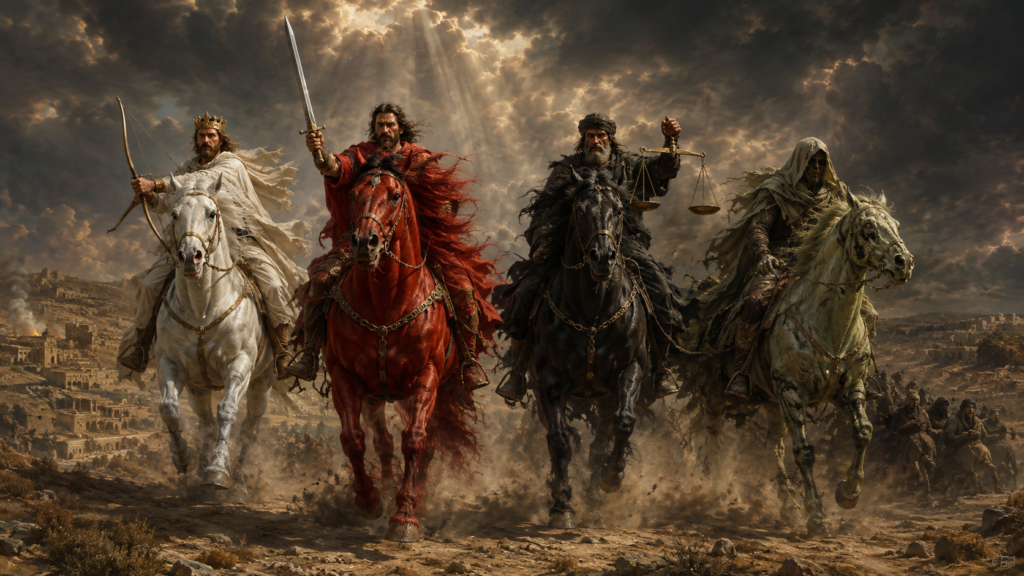
The Four Horsemen
The Antichrist
The Mark of the Beast
The Great Tribulation
The Rapture Debate
The 144,000
The Two Witnesses
Armageddon
The Millennium
The Final Judgment
The New Heaven and New Earth
Why Revelation Is Ultimately a Book of Hope
We’re not going to sketch out prophecy timetables or prediction charts and we won’t be trying to identify every politician or global figure as the Beast or Anti Christ.
Here’s what we will be doing.
First, we’ll ask a simple question: How would the first Christians who received this letter have understood it?
Revelation wasn’t originally written to twenty-first-century Americans with social media and a well-fed comfortable church on every corner. It was written to real people in the first century facing pressure, persecution, false teaching, and the overwhelming power of the Roman Empire. Before we ask what Revelation means to us, we should understand what it meant to them.
Second, we’ll explore how Revelation has encouraged and challenged believers in every generation since. God’s new creation people, made up of both Jews and Gentiles, have faced, and still face tyrants, wars, persecution, deception, and suffering for nearly two thousand years. Revelation has never belonged to just one century.
Finally, we’ll consider what these visions may teach the generation that will actually witness the return of Jesus Christ. Whether that’s ours or one still far in the future isn’t something we’ll pretend to know. Jesus Himself warned against date-setting. But He also told His followers to stay awake, stay faithful, and stay hopeful.
The goal of Armchair Apocalypse is to help you understand one of the Bible’s most fascinating books without needing a PhD or even a long theological background.
So What?
Open your Bible. Bring a curious mind and forget about what you may have heard third or fourth hand about Revelation.
Let’s read Revelation the way its first readers would have heard it—and discover why its message is intended to give courage, hope, and endurance, rather than fear and confusion, to believers for nearly two thousand years… and will continue to do so until He comes.