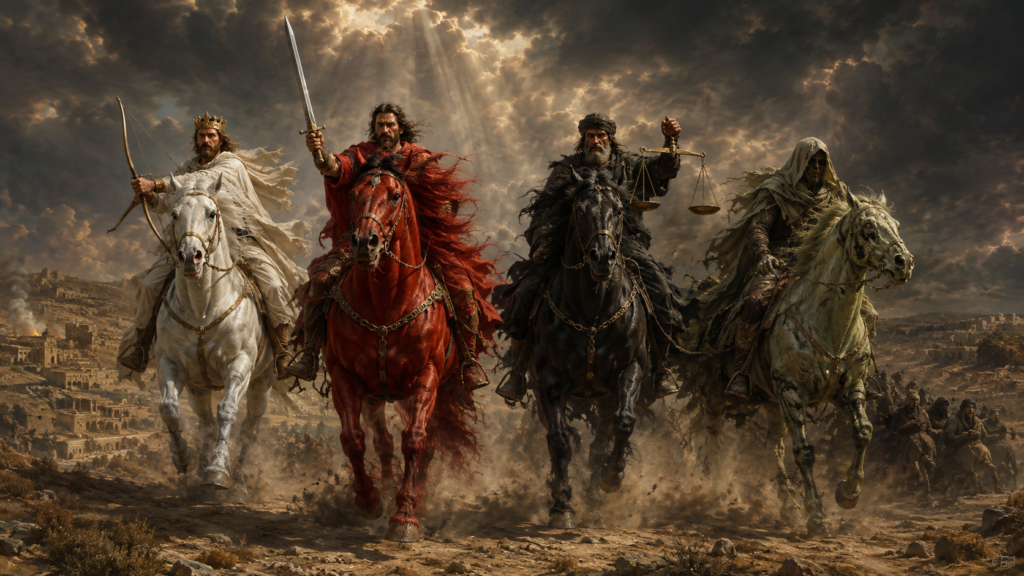
The Four Horsemen Weren’t a First-Century Marvel Movie
When John’s original readers heard “Four Horsemen,” they probably didn’t imagine four supernatural cowboys waiting to invade the twenty-first century. They recognized an ancient warning: empire, war, famine, and death travel together.
The Four Horsemen appear in Revelation 6, after John is taken up in a vision, sees God upon His throne, and watches the Lamb—Jesus Christ—receive the sealed scroll containing God’s purposes for judgment and redemption. As the Lamb opens the first four seals, the horsemen ride out in sequence: conquest leads to war, war produces famine, and famine ends in death. Their appearance shows what happens when human rebellion, violent empire, and the lust for power are allowed to run their course. But the horsemen are not running the show. Each rider is summoned only after the Lamb opens a seal.
This scene moves John’s vision from heavenly worship to earthly suffering and sets up Revelation’s central conflict: corrupt kingdoms may bring devastation for a time, but the slain and risen Lamb will judge evil, vindicate His people, and ultimately establish God’s kingdom.
John drew the imagery from Zechariah 1:8–11 and 6:1–8, where colored horses and chariots are sent throughout the earth. Revelation reshapes that Old Testament imagery into a terrifying procession of conquest, war, famine, and death.
The white horse carries a bow and receives a victor’s crown. Many scholars interpret him as military conquest—possibly evoking the Parthians, Rome’s feared bow-carrying enemies.
The red horse removes peace and carries a machaira—a short sword commonly associated with violence and bloodshed. This isn’t merely two nations politely declaring war. It includes rebellion, civil conflict, and people slaughtering one another.
Then comes the black horse, carrying scales:
“A measure of wheat for a penny, and three measures of barley for a penny.” — Revelation 6:6, KJV
The Greek choinix—translated “measure”—was roughly one person’s daily grain ration. A denarius—the KJV’s “penny”—was an entire day’s wage. Translation: work all day, buy enough wheat to feed yourself, and watch your family go hungry. Barley was cheaper, lower-quality survival food.
Then comes the puzzling command: “Hurt not the oil and the wine.” Oil and wine were not simply rich-people luxuries; ordinary people used them too. The line may picture selective or limited scarcity: grain is devastated while longer-lasting olive trees and grapevines survive. Either way, the economy is badly broken—and suffering isn’t evenly distributed. Sound familiar?
Finally, the pale horse is actually chloros—a sickly green-gray, like a corpse. Its rider is explicitly named Death, with Hades—the realm of the dead—following behind.
The broad interpretive consensus is that the riders symbolize the repeating chain of conquest, violence, scarcity, and death—realities John’s readers knew under Roman power. Realities that nearly every generation in human history have known, or will know.
That is interpretation: what the vision communicated to them.
Application asks what it says to us. The horsemen still ride whenever fallen human nature produces war, economic misery, and graves. Revelation isn’t giving us four celebrity villains to identify in some distant future. It is exposing the brutal machinery of a rebellious world—and reminding us that the Lamb, not the horsemen, opens the seals and will ultimately rule.

Read the Book
Your Life And What Comes After
Discover God’s plan from Genesis to eternity — and where your life fits into it.
Get It on Amazon
Child of God, husband, father, grandfather, rabblerouser, songwriter, pot stirrer, waiting for the King.