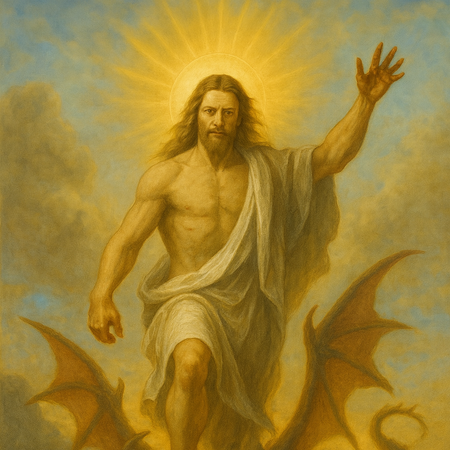
Stumbles, victories, mortality, miracles – it’s all one glorious package.
bible rebel
They Said It: Four Quotes On The Books Of Samuel

Here are four insightful quotes about the Old Testament Books of I and II Samuel.
On the overarching purpose of Samuel
“The First Book of Samuel was written to show who the true Shepherd‑King of Israel must be: the Son of David, a man ‘after the Lord’s own heart’; Second Samuel was written to show that this true King of Israel will finally establish God’s forever kingdom.”
The Gospel Coalition
On what Samuel teaches about God and obedience
“In 1 and 2 Samuel what you really see is how God operates, what He requires of His people, and what He does when His people fail… Hope is never found in a human king; hope is found in the King of kings.”
Paul Tripp
On God’s sovereignty in the narrative
“The books of 1 & 2 Samuel reveal God’s sovereignty in history: God humbles the proud and exalts the humble, and He sovereignly works through the rise and fall of kings to accomplish His purposes.”
Randy McCracken
On the theological significance of Samuel’s leadership and the kingship theme
“Samuel’s story and the monarchy narratives show that God providentially draws His people back into right relationship with Himself by choosing and exalting leaders according to His will, even amid human failure.”
Jonathan Anderson
Your Life And What Comes After (24): See All The People

What is the Church Age?
Have you ever heard the nursery rhyme that goes like this—‘Here’s the church, here’s the steeple, open the doors and see all the people’?
Is the Church Age about church buildings, or is it about people? In the Bible’s New Testament books after the Gospels of Matthew, Mark, Luke, and John, the ‘Church’ always refers to the people who believe that Jesus Christ is the Savior and Son of God.
Just as the Old Testament was instruction for the people who lived back in those times on how to walk in God’s purposes, and the Gospels of Matthew, Mark, Luke, and John show us how Jesus lived according to God’s plan, the New Testament books after the Gospels now instruct us today on how to do the same.
Seek God First
Colossians 3:1–2
If ye then be risen with Christ, seek those things which are above, where Christ sitteth on the right hand of God. Set your affection on things above, not on things on the earth.
Spend some time every morning praying and just enjoying the presence of God, speaking to Him and letting Him speak to you.
Add Value to the World Around You
Galatians 6:9-10
And let us not be weary in well doing: for in due season we shall reap, if we faint not. As we have therefore opportunity, let us do good unto all men, especially unto them who are of the household of faith.
Do meaningful work. Gain knowledge and learn valuable skills. Help and serve others around you in real ways that meet real needs.
Do Hard Things Without Fear
2 Timothy 1:7
For God hath not given us the spirit of fear; but of power, and of love, and of a sound mind.
Don’t ever be afraid of hard work or of doing hard things. God loves you and has already given you great strength and courage.
Fight Darkness with Light
Romans 13:12
The night is far spent, the day is at hand: let us therefore cast off the works of darkness, and let us put on the armour of light.
Stand up, speak up, and show up. Dispel the darkness around you by shining forth God’s love and light.
The You Miracle
Always remember that you are a miracle, and that God’s plan includes you in His family and household. See yourself as God sees you: His beautiful child.
Plug into God’s purposes and plan, and your life will be an exciting adventure as a co-worker with the Creator of the universe!
Next, we’ll start our journey into understanding heaven, hell, and the end of the world.
What The Hell: Eternal Conscious Torment

Bible Rebel is exploring the three major Christian doctrines concerning the theology of hell.
- Annihilationism (often called “conditional immortality”) see Bible Rebel post here
- Infernalism (eternal conscious torment)
- Universalism (everyone winds up in “heaven” eventually)
Here are some quotes from three prominent theologians/scholars who hold the eternal conscious torment view of hell.
Charles H. Spurgeon (Baptist preacher)
“When thou diest, thy soul will be tormented alone; that will be a hell for it, but at the day of judgment thy body will join thy soul, and then thou wilt have twin hells… every nerve a string on which the devil shall forever play his diabolical tune of ‘Hell’s Unutterable Lament.’”
— Spurgeon vividly affirms conscious, ongoing torment in hell after death, consistent with traditional teaching on eternal punishment.
Denny Burk (Theologian; The Gospel Coalition essay)
“Hell is a place of eternal, conscious torment for everyone who does not trust in Jesus Christ…I t describes unending experience of divine judgment and just retribution for sin.”
— This reflects a contemporary evangelical articulation of the historic doctrine of ECT, emphasizing unending conscious punishment for the unrepentant.
John Piper (Reformed theologian; quoted in public domain margin)
“No one can hide from the Lord… God’s power is present in hell as the One who… maintains suffering…†…† (paraphrased summary of his emphasis that torment in hell is real and ongoing).
Watchdog Alert: Recent Biblical Archaeology News

Bible Rebel keeps a watchdog’s eye on discoveries and news from the world of biblical archaeology and brings it to our readers.
First Assyrian Cuneiform Inscription Found in Jerusalem (2025)
Archaeologists uncovered a small Akkadian cuneiform inscription sherd in Jerusalem dated to the First Temple period (about 2,700 years old). The text appears to be an official notice from an Assyrian king to the king of Judah regarding tribute, marking the first known Assyrian inscription discovered within Jerusalem itself. This find provides direct extra-biblical evidence for the political and diplomatic realities of Judah’s relationship with Assyria described in biblical books like 2 Kings and Isaiah. Bible Archaeology Report
Temple Mount Sifting Project: Bulla with a Biblical Name (2025)
Excavations associated with the Temple Mount Sifting Project yielded a clay bulla (seal impression) inscribed with the name “Yed[a‛]yah, son of Asayahu”, dating to the 7th–6th century BC. The name matches a figure mentioned in the Bible during the reign of King Josiah (2 Kings 22:12; 2 Chronicles 34:20). This supports the historicity of individuals in the biblical narrative and helps tie archaeological material culture to known biblical figures. Bible Archaeology Report
Grape and Olive Remains Under the Church of the Holy Sepulchre (2025)
Archaeologists working beneath the Church of the Holy Sepulchre in Jerusalem uncovered 2,000-year-old remains of grape seeds and olive pits in soil layers dated to the time of Jesus. These botanical finds match descriptions of the Garden of Gethsemane / Golgotha landscape in the Gospels and contribute to identifying the setting of pivotal events in the life and death of Jesus as recorded in the New Testament. New Life
Your Life And What Comes After (23): A Town-Sized House

A wise king once chose a quiet stretch of countryside and there he built a house so vast it was the size of a town, with countless rooms, wide halls, and courtyards. When it was finished, he sent his loyal servants to live inside it. Their work was to prepare every room—sweeping floors, setting tables, lighting lamps, and making each place ready for life. Yet the king gave one puzzling command: the doors were to remain locked. The servants obeyed, working faithfully day after day, hearing the sounds of people passing by outside but never opening the doors to them.
At the right time, the king sent his son, the prince, to the great house. Unlike the servants, the prince carried the keys. He walked through the halls, threw open the doors, and called out to the people from every road and field, inviting them to come in. Families, strangers, and wanderers entered together, filling the rooms with laughter and conversation.
The prince welcomed them to live with him, not as guests but as family, alongside the servants who had prepared the house. And at last the king’s house became what it was always meant to be—a living home where many shared one life under the care of the king’s son.
That Sign at Football Games
In the Old Testament, God worked through Israel to carry out His plan. Then came Jesus, who completed that plan through His life, His death on the cross, and His resurrection from the grave.
Because of what Jesus did, we are now in the Church Age, where all people—not just the people of Israel—are invited into the household of God.
Have you ever seen the signs people hold up at football games for the TV cameras that say, “John 3:16”? That verse tells us what God’s plan was all along and why Jesus is the most important part of that grand plan.
John 3:16
For God so loved the world, that he gave his only begotten Son, that whosoever believeth in him should not perish, but have everlasting life.
Whosoever. Not just some, but everyone is invited to take part in the goal of God’s plan through Jesus Christ—everlasting life.
Next, we’ll look at how we plug into God’s plan in this new Church Age. Hint: it’s not different from the ways we’ve already talked about.
What The Hell: Conditional Immortality

In upcoming posts we’ll be exploring the three major Christian doctrines concerning the theology of hell.
- Annihilationism (often called “conditional immortality”)
- Infernalism (eternal conscious torment)
- Universalism (everyone winds up in “heaven” eventually)
We start with annihilationism and some quotes from three prominent theologians/scholars who hold the conditional immortality view.
John Stott (Anglican theologian, pastor)
“Emotionally, I find the concept of hell intolerable and do not understand how people can live with it without either cauterizing their feelings or cracking under the strain. … My question must be—and is—not what does my heart tell me, but what does God’s word say? And it seems to me that the annihilation of the wicked is more consistent with the biblical emphasis on the finality of judgment and the gift of immortality to the redeemed alone.”
John Stott & David Edwards, Evangelical Essentials (InterVarsity Press, 1988)
Edward Fudge (biblical scholar, author of The Fire That Consumes)
“The wicked will finally perish. They will be no more. This conclusion rests on the consistent testimony of Scripture that immortality is a gift God gives only to the redeemed, and that the lost suffer punishment ending in death, not everlasting life in misery.”
Edward Fudge, The Fire That Consumes (3rd ed., Cascade Books, 2011)
Clark H. Pinnock (theologian, professor)
“Hell is not torture forever but the final destruction of the wicked. God does not sustain the wicked in endless conscious agony; rather, they are finally and completely destroyed, which better reflects both biblical language and the justice of God.”
Clark H. Pinnock, “The Destruction of the Finally Impenitent,” in Criswell Theological Review (1990)
Question Everything

Churchianity and the theological status quo should be scrutinized by all people of faith regularly. That is exactly how we got the Reformation.
Is there a New Reformation brewing? It seems so. There is a difference between truth and tradition.
Man-made Christian creeds and doctrines are no longer being blindly accepted as biblical truth just because the Protestant clergy or the Catholic Papacy say so.
The nature of God, heaven, hell, sin, the apocalypse, predestination or free-will, the Rapture, the origins of the universe – all of these ideas and more need solid reexamination to see if the commonly accepted doctrines of men used to explain them measure up to the message of scripture.
The Bible Rebel blog is a resource for those seeking original and curated content, including news and commentary, covering faith, biblical studies and interpretation, and the intersection of politics, culture, and the Bible.
Our Mission
- To monitor current news and events related to faith and culture.
- To provide an alternative viewpoint to the world’s pervasive climate of darkness, nihilism, and hopelessness for those seeking truth, light, and purpose.
- To examine and question the assumptions of religious tradition and provide a resource for information and inspiration for people of faith who have become dissatisfied with an increasingly lifeless and empty ‘churchianity’.
- To present the Biblical truths which reveal God’s nature and purposes and proclaim the lifechanging, world-altering, radical message of Yeshua the Messiah – Jesus Christ, our risen Lord and Savior.
At Bible Rebel, this is our one and only creed:
Our living God is a loving God and the Bible is His revealed word and will.
Our hope and eternal salvation relies entirely on the work of God’s only begotten son, Jesus Christ, who is the way, the truth, and the life.
So, expect some controversial viewpoints and uncomfortable ideas in some of the coming content from Bible Rebel.
You can find all of the current Bible 101 episodes and One-Minute Mini Messages here on our YouTube Channel, and you can subscribe to our YouTube channel here.
Give us a follow on Facebook and X (formerly Twitter) and subscribe to our monthly newsletter here.
Your Life And What Comes After (21): Jesus, The Golden Spike

The plan to connect the United States by rail began in 1862, but it took years of hard work and danger to build tracks across mountains and deserts. For a long time, it wasn’t clear when everything would finally come together and the Transcontinental Railroad would be completed.
Then, in 1869, the last rail was connected at Promontory Summit, Utah, with the driving of the Golden Spike. In that moment, the long plan was complete, and the country was finally linked from coast to coast.
Jesus is the Golden Spike in God’s Plan
After Adam and Eve messed up, God promised to rescue humanity, and Jesus came as the fulfillment of that plan. Through His life, death, and resurrection, Jesus completed God’s long-promised work and rescue plan, opening the way for everyone in all ages to be restored to God and receive everlasting life with Him.
God’s plan started with a promise (Genesis 3:15), was carried through history by people like Abraham and David, and was fully revealed in Jesus, who came to save the world.
Jesus Announces His Mission
Luke 4:16-21
And he came to Nazareth, where he had been brought up: and, as his custom was, he went into the synagogue on the sabbath day, and stood up for to read.
And there was delivered unto him the book of the prophet Esaias. And when he had opened the book, he found the place where it was written,
The Spirit of the Lord is upon me, because he hath anointed me to preach the gospel to the poor; he hath sent me to heal the brokenhearted, to preach deliverance to the captives, and recovering of sight to the blind, to set at liberty them that are bruised,
To preach the acceptable year of the Lord.
And he closed the book, and he gave it again to the minister, and sat down. And the eyes of all them that were in the synagogue were fastened on him.
And he began to say unto them, This day is this scripture fulfilled in your ears.
Jesus wasn’t just teaching good ideas—He was the fulfillment of God’s long-promised plan, set in motion all the way back in the Old Testament.
John 19:28 & 30
After this, Jesus knowing that all things were now accomplished, that the scripture might be fulfilled, saith, I thirst…
When Jesus therefore had received the vinegar, he said, It is finished: and he bowed his head, and gave up the ghost.
God’s plan was accomplished, the Old Testament scripture was fulfilled, and Jesus said, “It is finished”.
How Did Jesus Do It?
How did Jesus carry out God’s plan?
- By perfect obedience in His life, cancelling the disobedience of Adam and Eve.
- By carrying out that obedience all the way to His death by crucifixion.
- By His being raised by God from the dead to eternal life.
Did Jesus show us by example any of the four ways to plug into God’s grand plan that we looked at earlier? We’ll talk about that next.
Watchdog Alert: Trouble In Iran As Israel Waits

“After months of publicly threatening Iran, Israel has gone quiet, waiting to see how the protest movement develops and giving US President Donald Trump space to make his own decision on whether to take action.” From CNN
Here’s a brief reminder on the importance of Iran (Persia) in the Bible in relation to Israel in the Old Testament.
In the Bible, the land and people of ancient Persia (roughly corresponding to modern-day Iran) play a significant role in the history of Israel, especially after the Babylonian Exile.
The Persian Empire rose to power in the 6th century BC when Cyrus the Great conquered Babylon and issued a decree allowing the Jewish exiles to return to Jerusalem and rebuild the temple, fulfilling earlier prophetic promises (Isaiah 45:1–2; Cyrus is even called God’s “anointed”) and recorded in Ezra 1:1–4.
Later Persian rulers such as Darius I and Artaxerxes continued to support the restoration of Jerusalem’s worship and governance (Ezra 6; Nehemiah 2). The Book of Esther is set in the Persian royal court at Susa and tells of Jewish deliverance under King Ahasuerus (often identified as Xerxes) and his queen Esther, illustrating Jewish life and providence under Persian rule (Esther 1:1–2).
Persian figures and encounters also appear in prophetic visions (e.g., Daniel 8’s ram symbolizing Media-Persia) and later biblical prophecy (Ezekiel 38:5), showing both its historical influence and ongoing theological significance.