Watchdog Alert: Christianity In Iran

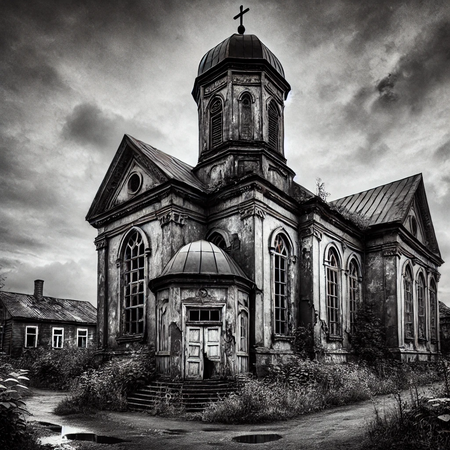
Christianity in Iran today is both difficult to measure and impossible to ignore. Estimates vary widely because many believers worship in secret, but most credible sources agree that the Christian population numbers in the hundreds of thousands, with some estimates reaching close to one million when including underground house churches. Iran officially recognizes certain historic Christian communities—primarily Armenian and Assyrian churches—but conversion from Islam to Christianity is not legally protected and can result in serious consequences. This makes accurate data challenging, as many converts do not publicly identify themselves.

Despite the risks, numerous observers describe Christianity in Iran as one of the fastest-growing expressions of the faith in the world. Much of this growth appears to be among Muslim-background converts, particularly younger Iranians who are searching spiritually or expressing quiet discontent with the religious-political establishment. Because registered churches are restricted and monitored, many believers gather in informal house churches, small groups, or private settings. These networks are decentralized and largely invisible, contributing to both their resilience and the uncertainty surrounding population estimates.

At the same time, the environment for Christian converts remains highly restrictive. International religious freedom reports and advocacy organizations document arrests, interrogations, church raids, and prison sentences under national security charges. While historic ethnic Christian communities are allowed limited public worship, converts often face harsher scrutiny. Reports in recent years indicate an increase in arrests and prison sentences tied to alleged “security” concerns related to religious activity. Pressure can come not only from authorities but also from families and local communities.

The overall picture is complex: Christianity in Iran exists in a space of both growth and hardship. Public recognition is limited, legal protections are narrow, and many believers practice their faith quietly. Yet multiple monitoring organizations note that the church continues to expand despite these constraints. Whether viewed through demographic surveys, ministry reports, or human rights documentation, the story of Christianity in Iran today is one of persistence—marked by both significant challenges and surprising resilience.

Your Life And What Comes After (40): Moving Day

Culley’s family was in that strange in-between time where the old house didn’t feel like home anymore, but the new one wasn’t home yet either. Boxes lined the hallway like a cardboard parade. Everyone knew their job. Dad handled the heavy stuff and kept a checklist on the fridge. Mom sorted and labeled boxes. Culley’s sister wrapped dishes in newspaper and stacked them in the right bins. Even Culley had a role: he carried lighter boxes to the garage and taped the bottoms so they wouldn’t bust. Nobody had to guess what to do, because they weren’t just “cleaning up”—they were moving toward a new place, together.

Two days before moving day, Culley’s friend Tim stopped by after school. He stepped over a row of boxes and stared at the half-empty living room like it had been robbed. “What happened in here?” Tim asked, confused. Culley shrugged and kept taping.

Tim wandered from room to room, picking up a roll of tape, putting it down, then lifting a marker like it was a strange tool from another planet. “Do you want me to help?” he asked, but his voice sounded unsure—like he didn’t know what “help” even meant in a house that looked like it was coming apart. Culley pointed toward the garage and said, “We’re moving across town. This all makes sense if you know what it is we’re doing.” Tim blinked, and Culley saw it click—without the big picture, you don’t know your part. But once you see the purpose, even a little box in your hands suddenly matters.

“…without the big picture, you don’t know your part. But once you see the purpose, even a little box in your hands suddenly matters.”

Now that we understand God’s grand plan a little better, we’re going to start exploring how the things we do in our daily lives help plug us into that plan. Because what you do matters, and when you see how you fit into the big picture and discover your part, your life becomes an exciting, meaningful adventure.

Coming Attractions

So, moving ahead in our quest we’ll be exploring some of the ways you can plug into God’s grand plan and pursue your own dreams while doing it.

Here’s where we’re going:

  • Does God have a plan for your life? Hmmmmm…
  • How do you know what you’re “supposed” to be doing?
  • Does what you do now matter in God’s heaven on earth forever?
  • Some common sense tips and life recipes for living the dream!

And remember—moving day will be here before you know it.

Your Life And What Comes After (39): What Does God Look Like?

Wells sat at the kitchen table while his mom stirred a pot of soup, watching the steam curl into the air. He had been thinking hard about something all afternoon. “Mom,” he finally asked, resting his chin in his hands, “what color is love?” His mother smiled at the question and turned off the stove, pulling out a chair beside him. She told him love wasn’t just one color—it was all kinds of colors depending on how you see it. “Love can be red when it’s strong and brave,” she said, “like when someone protects you. It can be warm gold like sunshine when someone makes you feel safe. It can be soft blue when someone listens to you, and gentle green when someone helps you grow.”

Wells thought about this quietly, imagining love as a bright painting made of many shades blending together. His mom brushed his hair back and added, “But if I had to choose one color, I’d say love looks like whatever color your heart needs most at the moment.” Wells looked at her, noticing the warmth in her eyes and the comfort of her smile, and decided that love, at least right then, looked like the warm amber glow of the kitchen light and the feeling of his mother’s hand holding his.

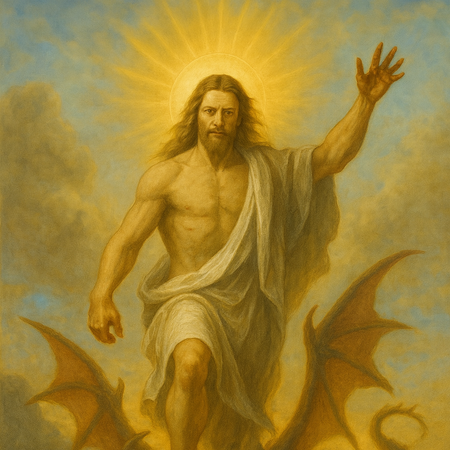
What does God look like?

Well first of all, God isn’t an old man with a white beard up in the sky tossing lightning bolts down on us.

God is Spirit—not a body, not a face, and not a shape. You can’t take a picture of Him. But remember, “spirit” doesn’t mean ghost or wispy fog. It means a reality beyond what we can see with our eyes.

We can’t see God with our eyes but Jesus shows us exactly what God is like, and we can see that with our hearts and with the Spirit that God has put inside us.

If you want to know what God is like, look at Jesus in the Bible – not what he may have looked like physically, but what kind of person He was, and is — His love and compassion, His power and His mercy.

When God Comes To Live With Us

One day, God will once again live with us on earth. It’s possible that then we will be able to see more of His glory—more of what He “looks like.”

Until then, we look at Jesus… and we see the heart of God.

Until then, we should be busy finding ways to plug into God’s grand plan right now, today. That means doing things and living our daily lives in ways that make our own dreams come true and God’s dream for us a reality.

That’s what we’ll start digging into next.

Your Life And What Comes After (38): Why Does God Let People Do Evil Things?

George Washington at Valley Forge

During the brutal winter of 1777–1778, George Washington and the Continental Army were encamped at Valley Forge. His troops were freezing, starving, and discouraged. The American fight for freedom itself seemed close to failure. Washington faced a tough choice: continue the struggle despite the hardship, or quit and give up the fight.

Washington privately prayed, asking God for wisdom, strength, and guidance in the decision before him. He chose to stay and fight—trusting that God would sustain their efforts. The army endured the winter, came out stronger, and eventually won the victory in the American Revolutionary War.

No Robots, Please

God doesn’t want robots who are forced to obey Him – He wants a family, individuals who love Him freely. God doesn’t make us do the right thing or the wrong thing, He gives us the free will to choose

Washington freely chose a course of action, asked for God’s help, and acted in faith. His decision—made with God’s help—shaped history and shows how our choices and God’s guidance can work together.

But along with the freedom to make good choices comes the freedom to make terrible choices. It’s not really freedom if you don’t have the freedom to make the wrong choice.

And sometimes when people make terrible choices, other people get hurt and valuable things get destroyed. God allows people to do bad things, and that means sometimes those bad things happen to good people.

Three Things to Remember

First, you can’t blame God for the bad things people do—that’s on them, not God. The good will be rewarded and the bad will have to face consequences, now and/or in the time to come.

Second, God can and does shield His people, those who seek His divine protection from harm as they ask in faith. Everyone else is on their own, and if they live outside God’s promise of protection, it’s because they choose to be on their own.

There are times when people of faith will voluntarily go against human evil knowing that they may be harmed or even killed. Their reasons for doing that are between God and them.

There are also times when people of faith wander outside the King’s protection through disobedience, ignoring warnings, or plain old rebellion. Bad things can happen when that occurs.

Third, all suffering and evil will be redeemed by God in the future, so trust in the ultimate purpose and plan of God to make things right.

While it’s sometimes hard to understand why bad things happen and why good people suffer—whether by the evil things other people do or by natural disaster or disease—the things suffered now, no matter how long they last, will seem like a tiny mosquito bite compared to the marvelous eternity God has planned for us.

More Than Conquerors

God doesn’t force anyone to do the right thing any more than he forces anyone to believe on Jesus Christ as Savior. We each have complete free-will and we all live with the benefits, and the consequences of that amazing freedom, now and forever.

Let’s use our free will to do some good—to do some conquering—through our Lord, Jesus Christ.

Replacement Theology? Nope

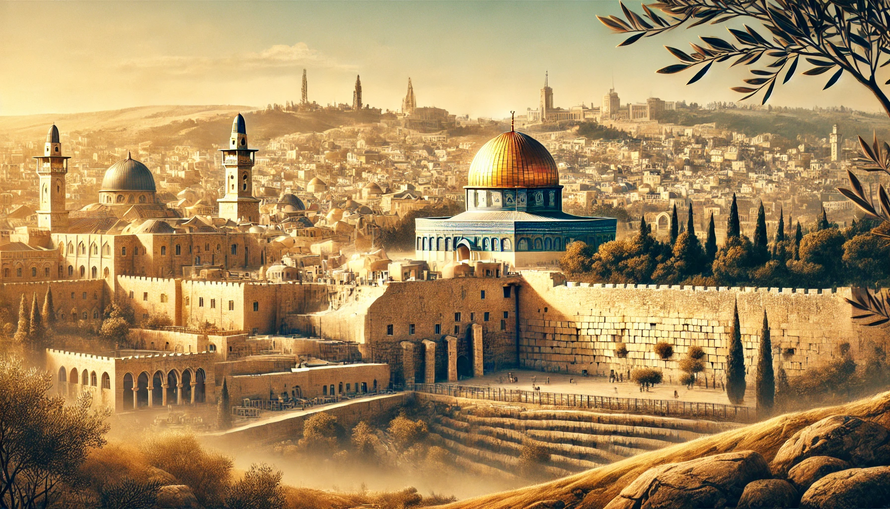
Replacement theology is just another one of the many doctrines of men. The “mystery” that Paul taught was that the Church—which includes Gentiles—would be partakers (Colossians 1:12) of the promise and inheritance, not replacers of the original heirs, Israel.

The Gentiles are grafted into the tree God already planted and nurtured—the Jewish people (Romans 11:24).

The Church is an awesome and marvelous realization of the eternal plan of God, but it is not a replacement for Israel, nor does its existence or purpose supersede God’s intention to fulfill His promise to His covenant people: a King and a Kingdom in their promised land.

They Said It: Four Quotes On The Books Of Chronicles

Four quotes from well-known religious figures about the Old Testament Books of I and II Chronicles:

Jerome (Early Church Father)

Martin Luther

Matthew Henry

F. F. Bruce (Modern biblical scholar)

Your Life And What Comes After (37): Why Does God Let Bad Things Happen?

So everything will be hunky dory after Jesus returns and we live together in heaven on earth forever. Great. But what about now?

Why does God allow death and disease, earthquakes, fires, and floods, and horrible things to happen?

Special Connection

When God first set up His creation He gave Adam and Eve the job of taking care of it and of ruling “over all the earth.” God gave them power and wisdom, through their special connection with Him by way of His Spirit, to have control over the world and nature.

But there was one condition God set:

Well, they disobeyed God and broke the condition He set. Although they didn’t die physically, the special connection with God that gave them the wisdom and power to be good rulers over creation died and was broken.

And so the world was broken as well, and still is. Without the special connection of God’s Spirit to give people the wisdom and power to take authority over the forces of nature, nature can and will cause harm and death, by everything from earthquakes to microscopic diseases.

God put the fate of His creation into human hands, and because humans broke it would take human hands to repair it. That’s where Jesus comes in, but we’ll get to that a bit later.

Authority

When Adam and Eve gave up their special connection with the Creator by their own choice they also gave up their rulership of the world. So the one who talked them into disobeying God was the one who took over that rulership—the “serpent,” the Devil.

The Devil is the ruler of this world. He is the one who causes evil, death, and bad things to happen. To put it in legal terms, God is perfectly fair, He gave Adam and Eve rulership over the world, it was theirs to do with as they wished and God honored that. In turn, Adam and Eve gave their rulership to the Serpent and because it was theirs to give, God must honor that as well.

But God has also planned a way to get the rulership of the world back into the right hands, and that is through Jesus Christ.

For believers in Christ, the Spirit, power, and wisdom of God have been given back to us and we can once again overcome the powers of evil through the name of Jesus Christ and by His work, because He has reclaimed what Adam lost.

The Devil’s authority over the world is only for a short time, and soon it will be completely gone forever. For now, we claim what Jesus has won back for us and wait patiently for the final victory.

Next, we’ll talk about how human free will works and why that’s important in understanding why sometimes bad things happen to good people.

Your Life And What Comes After (36): Our New Bodies

God promises that when Jesus returns, we will receive new, changed physical bodies. What will they be like? Scripture gives us some hints and clues.

First, our new bodies will be like Jesus in some ways.

Here are some examples of what Jesus’ new body was like after God raised him from the dead:

Jesus’ resurrected body was real, solid, and touchable—not a ghost or spirit‑form.

Jesus could enter locked rooms, appear and disappear, and move effortlessly—yet still remain fully physical.

In his resurrected body Jesus joined some of his followers and enjoyed a meal of real food with them.

What About Us?

Our new bodies will be like Jesus’ new body in other ways as well.

We will be raised in a glorious new condition that can never break down, die, get tired or sick again. The frailty of our present bodies will be gone forever.

Our new bodies will reflect, like a mirror, the brightness and radiance of Christ in His glory—“like unto his glorious body”—which is described in part in Revelation.

Our new spiritual bodies will be powerful and strong, full of energy and able to do many, many things we can’t do in our current physical bodies. And remember, “Spiritual” does not mean non‑physical; it means fully Spirit‑powered, perfectly suited for the wonders God has in store for us in eternity because the life God promises us in the resurrection will never end.

Faith Isn’t Blind

Curious Fearless Faith

Faith isn’t blind. Faith is curious and goes searching with eyes wide open.

Faith doesn’t just meekly accept whatever doctrines of men the bishops, evangelists, or street preachers claim to be the gospel truth. Faith examines each bit, turns it over and over again, and measures it against an informed understanding of Scripture, common sense, and reason.

Faith understands that the whole being we are to love our God with includes our minds as well as our hearts and souls. Faith recognizes that the human mind is designed to be skeptical and to question everything — even long‑held church traditions being spoon‑fed to Sunday congregations and Wednesday Bible study groups by pastors, lay ministers, and priests.

Faith never fears being outside the denominational doctrinal box if that is where the truth is. Faith cares little for titles or academic credentials in the pursuit of understanding God’s grand plan for His creation.

Faith continues, never satisfied with what people say about the Word of God, only with what the Word says about itself and the purposes of our Creator.

Faith is curious. Faith is fearless. The confidence of faith is not in blind acceptance, but in full assurance that there is One who holds all the answers and that our calling is to Him, seeking as we go.