The folks who hated Jesus most, and the ones he leveled his most scathing rebukes at, were the religious leaders of his time and culture.
Followers of Yeshua the Messiah shouldn’t be surprised or discouraged by the ridicule and snarky attacks on us because of our faith, or by the tiresome and faithless virtue‑signaling and false preaching and teaching coming from the poohbahs and “leaders” of organized churchianity.
Just remember what the religious and political leaders of that time and that culture did to our Lord over 2,000 years ago, and to the faithful in subsequent generations.
There’s nothing new under the sun.
This present age is not our friend, but there is a day certain when this present age ends and the suffering Servant becomes a reigning King.
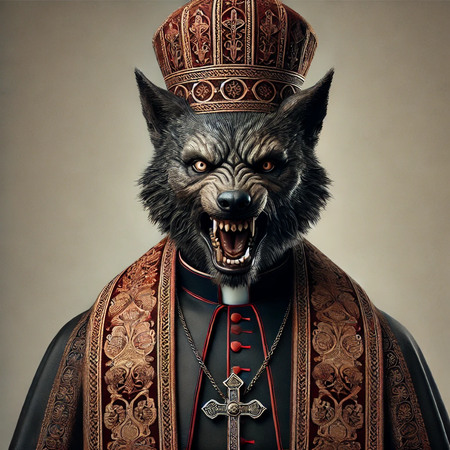
In a recent post, I pointed out that the current Pope was wrong about God not answering prayers from those engaged in war. Today we have another example of the Pontiff making erroneous claims.
On April 16, 2026, during his peace meeting at Saint Joseph’s Cathedral in Bamenda, Cameroon, Pope Leo XIV said the following:
“Jesus told us, ‘Blessed are the peacemakers, but woe to those who manipulate religion in the very name of God for their own military, economic, or political gain, dragging that which is sacred into darkness and filth.’”
Jesus didn’t say that.
The only part of what the Pope claimed — “Jesus told us…” — that Jesus actually told us is “Blessed are the peacemakers.” The other stuff about “political gain, dragging that which is sacred into darkness and filth”, was not something Jesus said.
In other words, the Pope is either lying about what our Lord said, intentionally trying to deceive people in order to make a political point, or he simply doesn’t know what Jesus actually said according to the Bible.
According to this doctrine, the Twelfth Imam entered ghaybah (occultation) — a state of divine concealment — in the 9th century. He is considered to be still alive and will one day return as the Mahdi, a messianic figure who will establish global justice.
There is only one man who has died and been resurrected to live forevermore — Jesus Christ.
There is only one man who will one day return as King of kings and Lord of lords to “establish global justice” — Jesus Christ.
Those making similar claims about any other person who has ever lived are dealing in counterfeit spiritual currency.
In his Palm Sunday homily, Pope Leo XIV explicitly that God “does not listen to the prayers of those who wage war,” quoting Isaiah 1:15: “Even though you make many prayers, I will not listen: your hands are full of blood.”
The Pope is counting on the biblical illiteracy of Christians when he isolates this verse from Isaiah without regard to its context and uses it as a universal proclamation against all war for all time.
Isaiah chapter one is specifically referring to the idolatrous and exceedingly sinful nation and people of Judah and Jerusalem.
Isaiah 1:4 (KJV) – Ah sinful nation, a people laden with iniquity, a seed of evildoers, children that are corrupters: they have forsaken the Lord, they have provoked the Holy One of Israel unto anger, they are gone away backward.
Of course God heard and answered the prayers of His prophets, kings and others during their wars and delivered victory into their hands. Just read the Bible.
Moses & Joshua — Israel defeated Amalek when Moses interceded (Exodus 17).
Joshua at Jericho — Victory came and God commanded the battle (Joshua 6).
David — Before fighting the Philistines, David repeatedly asked, “Shall I go up?” and God answered (2 Samuel 5:19).
Jehoshaphat — God delivered Judah miraculously when they prayed and worshiped (2 Chronicles 20).
Twelver Shi‘ism (the dominant Shia branch in Iran, Iraq, Lebanon, and elsewhere) teaches that there are twelve divinely appointed Imams. The line ends with the Twelfth Imam, also called the Hidden Imam or al‑Mahdi, who is believed to be alive but concealed by God until the appointed time.
What Twelver Shi‘ism Actually Teaches
Twelver Shia Muslims believe that God appointed a line of twelve Imams, beginning with Ali and ending with Muhammad ibn al‑Hasan al‑Mahdi, born around 870 CE. According to this doctrine, the Twelfth Imam entered ghaybah (occultation) — a state of divine concealment — in the 9th century. He is considered still alive and will one day return as the Mahdi, a messianic figure who will establish global justice.
For many people, the difference between Sunni and Shia Muslims can feel confusing, but it actually begins with a very simple historical question: Who should have led the Muslim community after the Prophet Muhammad died in 632 CE?
Sunni Muslims believed leadership should be chosen by the community, and they supported Abu Bakr, a close companion of Muhammad. Shia Muslims believed leadership should stay within the Prophet’s family, beginning with Ali, his cousin and son‑in‑law. What started as a political disagreement eventually grew into two distinct traditions with their own practices, scholarship, and spiritual leadership structures.
Over time, Sunnis developed a system where no single leader holds divine authority. Instead, religious understanding comes from scholars and four major schools of interpretation. Shia Muslims, especially the Twelver branch, believe in a line of Imams—descendants of Ali—who carry spiritual guidance and authority. These differences shape how each community approaches religious leadership, law, and devotion, even though both share the same core beliefs about God, the Qur’an, and the Prophet Muhammad.
Today, Sunni Muslims make up the vast majority of the global Muslim population—about 85 to 90 percent. Shia Muslims represent roughly 10 to 15 percent worldwide, forming significant communities in places like Iraq, Lebanon, Bahrain, and Pakistan.
The most notable Shia‑majority nation is Iran, where about 90 percent of the population follows Twelver Shi’ism. This identity became central to Iran’s culture and religious life beginning in the 16th century under the Safavid dynasty.
Prayer is a wrestling match with the Almighty, not a friend request on Facebook. It’s not about getting something, it’s about being something. Prayer is a hard admission made to your Maker about the deeply wicked condition of your heart and a request for Him to help correct that situation daily.
It’s not a wish list thrown up into space. It’s not a lunch order off a menu given to your waiter, Jesus, expecting Him to ask, “Would you like fries or cottage cheese with that?”
Prayer is asking God to turn you inside out and upside down. It’s opening the door to your heart and allowing your Heavenly Father to illuminate the dark corners there and fill the empty spaces with substance.
Prayer is having the honesty to ask the Creator of the universe for a resurrected heart and a majestic character, not for a pile of money, a new car, a better job, or a cuter girlfriend/boyfriend.
Prayer is earnestly asking for the wisdom to know what’s right and the courage and strength to carry it out. Prayer is seeking to do God’s will, not whining for Him to do yours.
It is praise and thanksgiving.
Pray with the tongues of men and of angels. Pray for others.
On Monday I posed a simple question: What is the point and purpose of the resurrection of Jesus Christ if believers go immediately to heaven when they die?
Now let’s ask a similar question which also deserves a logical, biblical answer: What is the purpose of the so-called “Rapture” if believers who have died are already in heaven shouting, “Hallelujah!”, flying around playing harps, and dancing on streets of gold with previously deceased loved ones?
If your answer is that the soul has to be reunited with the physical body, then I would love to see the plain, definitive scriptural basis for that theory. Plain and definitive proof texts, not theological and logical contortions invented to make the Bible say what you want it to say.