Rethinking The Rapture: Matthew 24:40-42

Let’s return to an earlier post in this Rethinking the Rapture series, where I raised a question concerning the words of Jesus in Matthew 24: “One will be taken and one left.”

Matthew 24:40–42 (KJV):

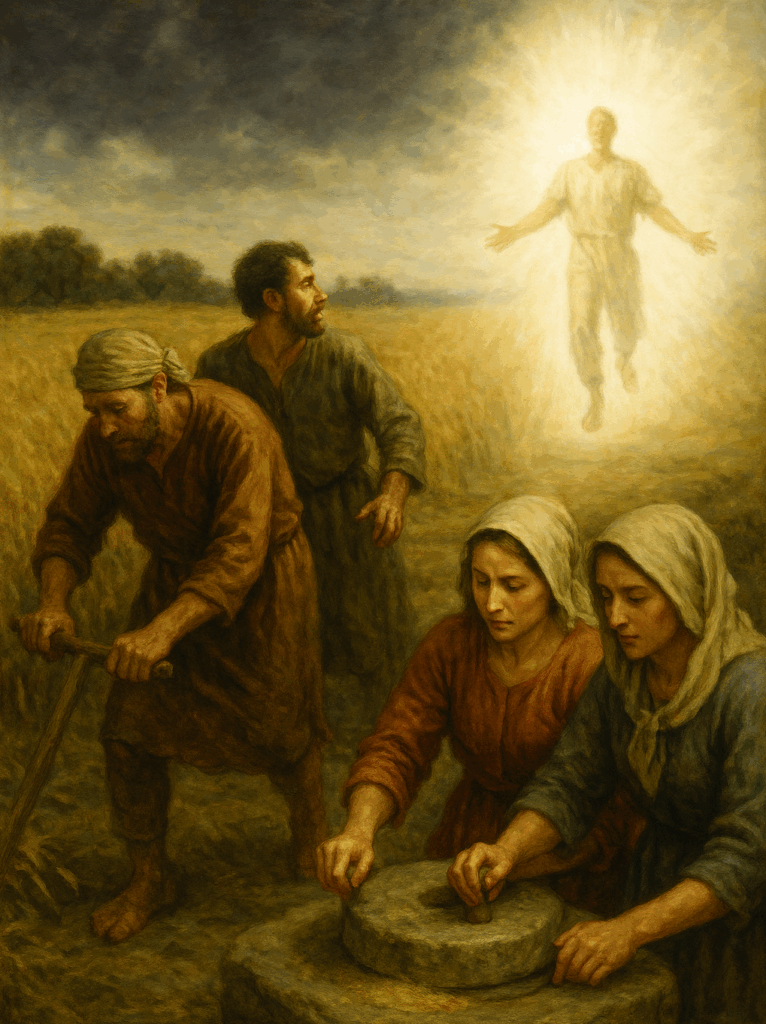
“Then shall two be in the field; the one shall be taken, and the other left.
Two women shall be grinding at the mill; the one shall be taken, and the other left.
Watch therefore: for ye know not what hour your Lord doth come.”

Would the disciples, to whom Jesus was speaking those words at that time and in that place, have understood Him to be referring to a future Rapture of the Church—where some people would disappear into the sky in a secret event, while their walking or working companions would be left behind on earth?

The context strongly suggests that they would not have understood His words to mean a future Rapture.

The immediately preceding verses, 37–39, compare the coming of the Son of Man to the days of Noah, when people were eating, drinking, and marrying—until the flood came and took them all away.

Plainly, the ones who were “taken” were those swept away in the flood in judgment. The ones left behind were Noah and his family, who were spared and remained on the earth to begin anew after the flood judgment.

Understanding this context should make it crystal clear who Jesus was referring to in Matthew 24:40–42 when He said, “One will be taken and one left.” The one taken is taken in judgment, not in a Rapture. And the one left remains to experience the blessings of the Kingdom—not the punishment of woe and tribulation.

Rethinking The Rapture: Introduction

Rethinking The Rapture: Questions

Rethinking The Rapture: More Questions

Rethinking The Rapture: N.T. Wright’s ‘Farewell to the Rapture’

Rethinking The Rapture: What 1 Thessalonians 4:16-17 Doesn’t Say

Rethinking The Rapture: Millions Of Christians Were Not Delivered From Wrath

Rethinking The Rapture: What Does ‘Delivered From Wrath’ Mean?

Rethinking The Rapture: What Does ‘Delivered From Wrath’ Mean? Part 2

Historical Facts And Background Of American Independence Day

Independence Day in the United States, commonly known as the Fourth of July, commemorates the adoption of the Declaration of Independence on July 4, 1776. On that day, the thirteen American colonies formally declared their independence from Great Britain, marking the birth of the United States of America.

Colonial Tensions with Britain

  • In the 1700s, the American colonies were governed by Great Britain, which imposed increasing taxes and trade restrictions.
  • Key grievances included:
    • The Stamp Act (1765) and Townshend Acts (1767) taxing colonists without representation in Parliament.
    • The Boston Massacre (1770) and Boston Tea Party (1773) intensified colonial resistance.
    • Britain’s harsh response to colonial protests further fueled revolutionary sentiment.

Move Toward Independence

  • In 1774, the First Continental Congress met to protest British policies.
  • Fighting began in April 1775 with the Battles of Lexington and Concord—the start of the Revolutionary War.
  • In 1776, momentum grew for a complete break from Britain.

Declaration of Independence

  • Drafted primarily by Thomas Jefferson, the Declaration was debated and revised by the Continental Congress.
  • It was officially adopted on July 4, 1776, in Philadelphia, Pennsylvania.
  • The document declared the colonies free and independent states and outlined Enlightenment ideals of liberty, equality, and the right to self-government.

Why July 4th?

  • July 4 is the date the final version of the Declaration was formally approved by Congress.
  • However, the actual signing occurred over the next few weeks and months.
  • John Adams, who advocated for independence, expected July 2 (when Congress voted for independence) to be the celebrated date, but July 4 became the tradition.

Early Celebrations

  • The first Independence Day celebrations included:
    • Public readings of the Declaration.
    • Parades, bonfires, and cannon fire.
    • Celebrations symbolized unity and defiance against tyranny.
  • By the early 1800s, July 4 had become the most important secular holiday in the U.S.

Becoming a National Holiday

  • Independence Day was declared a federal holiday in 1870.
  • It became a paid holiday for federal employees in 1938.

Rethinking The Rapture: In The Twinkling Of An Eye

Along with 1 Thessalonians 4:17, 1 Corinthians 15:52 is often uses as a ‘proof text’ for the Rapture.

1 Corinthians 15:52 – “In a moment, in the twinkling of an eye, at the last trump: for the trumpet shall sound, and the dead shall be raised incorruptible, and we shall be changed.” (KJV)

Let’s consider what this verse doesn’t say (a consideration I will continue to use often).
1 Corinthians 15:52 doesn’t say, “Believers will be instantaneously caught up into heaven in a secret Rapture which will be invisible and inexplicable to those left behind.”

The verse simply says and simply means that at Christ’s Second Coming all the dead will rise and all believers will be changed into immortal, glorified bodies in a nearly imperceptible moment of time.

There’s nothing in there about being secretly taken away for seven years and then coming back with Jesus for a Third Coming. There’s nothing in 1 Corinthians 15:52 that even remotely indicates that millions of Christians will suddenly simply disappear from the earth leaving the folks that are left behind to wonder what the hell just happened.

While the transformation of our mortal bodies to immortality will be miraculous and instantaneous, it will not be a secret event – on the contrary, it will be a glorious manifestation of Almighty God’s power and purpose for all of creation to behold.

Rethinking The Rapture: Introduction

Rethinking The Rapture: Questions

Rethinking The Rapture: More Questions

Rethinking The Rapture: N.T. Wright’s ‘Farewell to the Rapture’

Rethinking The Rapture: What 1 Thessalonians 4:16-17 Doesn’t Say

Rethinking The Rapture: Millions Of Christians Were Not Delivered From Wrath

Rethinking The Rapture: What Does ‘Delivered From Wrath’ Mean?

Rethinking The Rapture: What Does ‘Delivered From Wrath’ Mean? Part 2

Faith And The Founders

The overwhelming majority of the signers of the Declaration of Independence in 1776 were Christians. About half (roughly 32 to 34 signers) were affiliated with the Anglican Church, including George Washington.

A few key signers—most notably Thomas Jefferson, Benjamin Franklin, and John Adams—are often associated with Deism or Enlightenment rationalism. However, they still operated within a broadly Christian cultural framework. For instance:

  • Jefferson believed in God and moral teachings of Jesus but rejected the Trinity and miracles.
  • Franklin described himself as a Deist but often spoke positively about religion’s role in public virtue.
  • Adams was a devout Christian, though critical of Calvinist doctrines.

Providence in the Revolutionary War

“The hand of Providence has been so conspicuous in all this, that he must be worse than an infidel that lacks faith.”
— George Washington in a letter to Thomas Nelson, August 20, 1778

General Washington frequently spoke of “Providence” in his writings, referring to seemingly miraculous events which benefitted the American cause and led to the extremely improbable result of thirteen little colonies defeating the world’s most powerful empire.

A few examples:

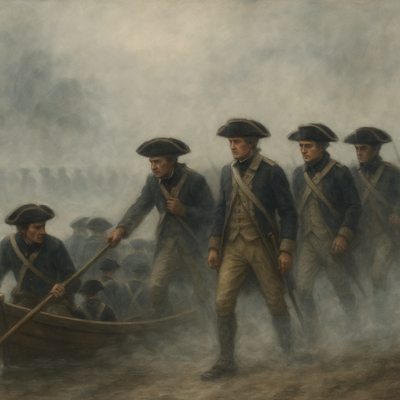
The Fog at Brooklyn Heights (1776)

After the Battle of Long Island, Washington’s army was trapped by British forces. A thick fog descended unexpectedly, allowing his troops to retreat safely across the East River without British interference.

  • Many viewed this fog as a miraculous act of divine intervention.
  • Even British officers later admitted they were baffled by the escape.

The Storm That Saved Washington at Dorchester Heights (1776)

Washington fortified Dorchester Heights to threaten British-held Boston. A storm delayed British attacks long enough for the Americans to finish fortifications.

  • The British decided against assaulting the position.
  • Many patriots saw this as an act of God protecting the Continental Army.

The Victory at Saratoga (1777)

The American victory at Saratoga convinced France to join the war on the American side.

  • Clergy and political leaders interpreted this as a sign that God was guiding the cause of liberty.
  • Congress declared national days of thanksgiving in response.

Happy Independence Day, America!

Watchdog Alert: Churchianity News

Bible Rebel keeps a watchdog’s eye on news and events from the world of faith and religion and brings that content to our readers.

Trump Establishes Faith Office & Religious Liberty Commission

Former President Donald Trump has inaugurated several faith-based initiatives—such as a White House Faith Office, a Religious Liberty Commission, and a task force to eradicate anti-Christian bias. While his conservative Christian base applauds the move, critics warn it risks violating the First Amendment by privileging politically aligned Christian factions over broader religious pluralism. From Milwaukee Independent


Southern Baptist Convention Advances Conservative Resolutions

At their 2025 annual meeting in Dallas, the Southern Baptist Convention (SBC)—the largest Protestant denomination in the U.S.—voted to endorse several conservative social resolutions. These include advocating a legal ban on pornography, opposing same-sex marriage (seeking reversal of the 2015 U.S. Supreme Court decision), restricting sports betting, and encouraging childbirth. Internal debates also continue on issues like women pastors and the denomination’s policy arm. From the AP


AP-NORC Poll: U.S. Adults Embrace Religious Chaplains in Schools

A new AP–NORC poll finds about 60% of U.S. adults support allowing religious chaplains in public schools to provide support—though not teacher-led or compulsory prayer. Support is split along denominational and political lines: White evangelical and Black Protestant adults are more favorable than Catholics, mainline Protestants, and non‑religious respondents. There’s broad concern (80%+) over church–state separation and funding issues. From apnews.com


Ecumenical Christian Leaders Condemn Hate Speech in Dallas

Over 30 Christian leaders and churches—including groups from Baptist, Lutheran, Presbyterian, Anglican, United Methodist, Evangelical, and Congregational traditions—have publicly denounced a planned “Hindu supremacist” event in Dallas featuring Kajal Singhala. Organized by Hindu nationalist groups with histories of anti-Christian rhetoric, the event has drawn strong opposition from an ecumenical coalition underscoring religious freedom and the Christian gospel. From clarionindia.net

Rethinking The Rapture: What Does ‘Delivered From Wrath’ Mean? Part 2
In this post I want to wrap up our brief discussion on what the phrase “delivered from the wrath to come” in 1 Thessalonians 1:10 means.

1 Thessalonians 1:10 – “And to wait for his Son from heaven, whom he raised from the dead, even Jesus, which delivered us from the wrath to come.” (KJV)

Notice what this verse doesn’t say. It doesn’t say, “Jesus will come from heaven and pull us into the sky with him, then take us away so that we won’t have to suffer a seven-year tribulation period.”

Paul certainly had the vocabulary to say that if that is what God had wanted him to write to the Thessalonians.

Notice also that the tense of the verb “delivered” (rhuomenon) in the Greek is the present participle form which implies ongoing or continuous action: “the one who is delivering” or “who delivers.” It suggests a current, ongoing protection from wrath, not a specific future time period of seven years or some other period of time.

Believers can be, are being, and will be delivered from wrath without being taken up into heaven. In other words, God is more than able to protect and shield His people in all circumstances and places, even great tribulation on earth, through the mercy and grace provided in Jesus Christ.

My personal rule in reading the Bible is to first consider how the original readers for whom the words were written would understand the text in its broader historical, biblical, and cultural context, as well as it’s more immediate textual context.

So, do you suppose the First Century Thessalonians would have understood this verse to mean, “Hey, y’all, don’t worry about the seven years of wrath coming in the Great Tribulation period, you won’t have to go through that because Jesus will scoop us up and out of here before that happens.”?

I think that one can only come to that interpretation by reading a great deal of pre-conceived pop theology into the scripture, rather than just reading what’s plainly written.

More on “Rethinking The Rapture” coming soon.


Rethinking The Rapture: Introduction

Rethinking The Rapture: Questions

Rethinking The Rapture: More Questions

Rethinking The Rapture: N.T. Wright’s ‘Farewell to the Rapture’

Rethinking The Rapture: What 1 Thessalonians 4:16-17 Doesn’t Say

Rethinking The Rapture: Millions Of Christians Were Not Delivered From Wrath

Rethinking The Rapture: What Does ‘Delivered From Wrath’ Mean?

Watchdog Alert: Latest From The Middle East

Bible Rebel keeps a watchdog’s eye on events from around the world of interest to people of faith and brings that content to our readers.

Military briefing: Israel and Iran size up war damage

After 12 days of intense missile and drone exchanges, Israel’s precision airstrikes devastated Iran’s military and nuclear facilities — reportedly destroying over 120 buildings in Tehran, killing 627 Iranians and injuring nearly 4,900. Iran’s missile barrage (550 launches) mostly misfired, striking civilian zones in Israel, resulting in 28 deaths and 1,400 injuries. Analysts say Iran’s nuclear program is set back by months, though Israeli claims suggest delays could span years. From The Financial Times


Ceasefire holds — Khamenei claims “heavy slap” and warns further strikes

Iran’s Supreme Leader Ayatollah Khamenei declared the U.S.–led strikes “achieved nothing” while warning of future U.S. base attacks. He also framed the ceasefire as a regional victory, saying Iran “delivered a heavy slap to America’s face” and hinted at further military action if provoked. From Barron’s


Pope criticizes “diabolical intensity” and humanitarian plight

Pope Leo spoke out on the “diabolical intensity” of the region’s conflict, urging more humanitarian aid for Gaza and a return to international law. His remarks highlight the growing concern over civilian suffering in Gaza amid ongoing hostilities. From reuters.com


Israel halts northern Gaza aid amid theft allegations

Israel has paused humanitarian aid into northern Gaza after video surfaced of masked men on aid trucks. While Israeli officials allege Hamas diversion, clan leaders dispute this, stating they were providing security. From reuters.com

Watchdog Alert: Biblical Archaeology News

Bible Rebel keeps a watchdog’s eye on discoveries and news from the world of biblical archaeology and brings it to our readers.

Excavators evacuated from Shiloh amid Middle East tensions

Biblical archaeologists working at Shiloh in Israel were recently evacuated after regional escalation involving Iran. Despite the security threats, the team remains committed to continuing their excavation when conditions stabilize. From the Jerusalem Post


‘Salome Cave’ may be Herodian royal burial, not midwife’s tomb

Archaeologists re-examined a cave once believed to belong to Salome, the “midwife of Jesus.” Now they suggest it may instead be adorned as a royal tomb—possibly for Salome, sister of King Herod the Great (1st century B.C.). From livescience.com


Grapes & olives uncovered under Church of the Holy Sepulchre

Sapienza University researchers have unearthed 2,000‑year‑old grape pips and olive stones beneath the Church of the Holy Sepulchre, aligning with Gospel descriptions of a garden at the crucifixion site (John 19:41). The dig, involving multiple Christian denominations and the Israel Antiquities Authority, temporarily paused during Easter for pilgrims. From The Times


Evidence emerges for ancient Battle of Megiddo (Armageddon)

Egyptian pottery fragments discovered at Tel Megiddo strongly suggest Egyptian military presence during the biblical Battle of Megiddo (c. 609 B.C.), when Pharaoh Neco II defeated King Josiah of Judah. Researchers believe the pottery likely belonged to Egyptian soldiers rather than merchants. From wikipedia