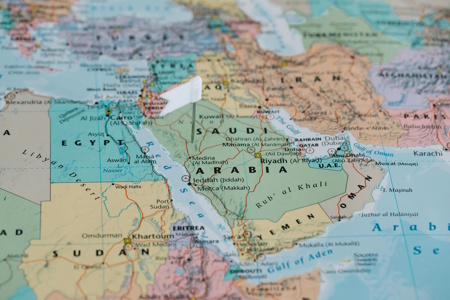
Bible Rebel continues to keep a watchdog’s eye on events in the Middle East. That is not to say that we are watching for any fulfillment of biblical prophecy there, we keep our eyes and ears open to news that affects people of faith from every region around the world.
The Holy Land is of particular interest for three reasons:
It is a geographical crossroads, referred to by some the “Center of the Earth”.
It is also the historical birthplace of the two largest religions of the world; Christianity and Islam, as well as the ‘Father’ of both those religions – Judaism.
It is of major military and strategic importance because of oil production and logistics.
Are the biblical prophecies focusing on geographical locations in the Middle East, especially in and around current-day Israel, relevant to the Church in our times today?
Or will those prophecies only come to pass and be revealed in some future time after the destiny of the Church has been realized? This is a subject Bible Rebel will be exploring in some depth going forward. Stay tuned.
For now, here’s the latest from the Middle East.
Israel Strikes Near Syrian Presidential Palace
Israel conducted an airstrike near Syria’s presidential palace in Damascus, targeting the new Islamist-led government under interim President Ahmed al-Sharaa. The strike aimed to signal Israel’s commitment to defending the Druze minority amid escalating sectarian violence in Syria. From Reuters
US attacks Yemen port again; Houthis launch missiles at Israel
The Houthi-affiliated Al Masirah TV media outlet has reported that seven US strikes hit the Ras Isa oil port in al-Salif district in Hodeidah in the last few hours, where a US strike at the same port last month killed at least 80 people and wounded 150 in one of the deadliest attacks on the country by US forces.
Earlier Friday, the Houthis claimed responsibility for launching two missiles towards northern Israel, targeting the Ramat David military airbase and the Tel Aviv area, as the group continues its military pressure in solidarity with Palestinians under Israeli fire. From Al Jazeera
U.S.-Iran Talks Postponed
A fourth round of talks between the United States and Iran, scheduled to take place in Rome, has been postponed. An Iranian official stated that the new date depends on the U.S. approach, citing contradictory behavior and provocative statements from Washington. From Reuters
Netanyahu calls defeating Israel’s enemies the ‘supreme objective,’ not freeing hostages
Israeli Prime Minister Benjamin Netanyahu said Thursday that defeating Israel’s enemies is more important than securing the release of the remaining hostages in Gaza.
While the prime minister acknowledged that freeing the 59 remaining hostages is a “very important goal,” he described Israel’s fight against its enemies as the “supreme objective” of the war.
“We have many objectives, many goals in this war. We want to bring back all of our hostages,” Netanyahu said. “That is a very important goal. In war, there is a supreme objective. And that supreme objective is victory over our enemies. And that is what we will achieve.” From CNN
Atlanta Pastor Apologizes for Remarks on Police Killings
A pastor in Atlanta issued an apology after controversial remarks blaming police killings on disobedience sparked backlash within his congregation and the broader Christian community. From Christianity Today
Aaron Renn’s ‘Three Worlds’ Theory Sparks Debate
Conservative commentator Aaron Renn’s framework for understanding Christianity’s transition from a socially desirable faith to one facing cultural opposition has ignited discussions among evangelicals and critics alike. From Baptist News
Islamic State claims pope’s burial is ‘marketing tool in theological war’ as it gains renewed strength
“The Islamic State has declared Pope Francis’ burial a “marketing tool in a theological war,” asserting that tributes paid to the late pope undermine Islamic beliefs. The terror group is concurrently experiencing a resurgence, raising concerns about its growing strength and influence in the Middle East.” From The Christian Post
Religious ‘nones’ outnumber Catholics and Protestants in Germany
For the first time in modern German history, more Germans identify as religiously unaffiliated than as Roman Catholics or Protestants, according to a new survey. From the Christian Post
Bible Rebel continues to keep a watchdog’s eye on news and events from the world of churchianity. In this article, we take a look at the process of choosing a new Pope, which is based on Roman Catholic ceremony and tradition – not scripture.
Papal Ceremonies and Biblical Doctrine
While the Catholic Church bases its teachings on scripture, many papal ceremonies are rooted in tradition rather than biblical doctrine. The conclave, the papal coronation, and the rituals surrounding the election are not explicitly found in the Bible. Instead, they evolved over centuries as part of the Church’s governance structure.
Critics argue that certain practices—such as the vesting of the Pope in elaborate robes and the use of Latin in official ceremonies—reflect historical customs rather than biblical mandates. However, the Church maintains that these traditions uphold continuity and reverence within Catholicism.
The selection of a new Pope is a momentous event, steeped in history and ritual. While the process is not biblically mandated, it remains a defining aspect of Catholic tradition.
The Conclave Process
The election of a new Pope follows a centuries-old tradition rooted in secrecy and ritual. When a Pope passes away or resigns, the College of Cardinals—a body of senior Catholic officials—gathers in Vatican City to elect his successor in a process known as a conclave.
The conclave typically begins 15 to 20 days after the Pope’s death. Cardinals under the age of 80 are eligible to vote, with the number of electors capped at 120. The process takes place in the Sistine Chapel, where the cardinals swear an oath of secrecy before casting their votes.
Each cardinal writes the name of their chosen candidate on a ballot, which is then placed in a ceremonial urn. The votes are counted, and if no candidate secures a two-thirds majority, the process repeats until a consensus is reached. After each round, the ballots are burned, producing either black smoke (indicating no decision) or white smoke (signaling the election of a new Pope).
Once elected, the new Pope is introduced to the world from the balcony of St. Peter’s Basilica, where he delivers his first blessing.
1 Peter 5:8 – Be sober, be vigilant; because your adversary the devil, as a roaring lion, walketh about, seeking whom he may devour. (KJV)
The roaring lion is loose in Nigeria.
The situation in Nigeria remains deeply troubling. Recent reports highlight ongoing violence against Christians, particularly in Plateau State. On Palm Sunday, suspected Islamist Fulani militias attacked Christian villages, killing at least 51 people.
“The coordinated assault targeted two predominantly Christian villages, with the worst carnage reported in Zikke village, Bassa County. Witnesses described a night of horror as gunmen stormed homes, setting them ablaze and killing entire families — including women, children, and the elderly — in what local leaders are calling a deliberate act of religious persecution.” From The Herald
The Continuing Violence, No End In Sight
This follows a series of brutal incidents, including the slaughter of over 60 Christians and the destruction of 383 homes earlier this month.
It’s going to be a wretched and fearful Easter for Christians in Nigeria. The killing and persecution of Christians by Islamist militants intent on creating a Muslim caliphate in this West African country is continuing apparently unchecked despite the population being 46% Christian. “Nigeria’s Christians are being wiped out; we need to call it what it is — genocide,” Jeff King, president of International Christian Concern (ICC), a persecution watchdog, told Fox News Digital. “Let’s start with the horrible attacks on April 2-3, 2025, in (Nigeria’s) Plateau State’s Bokkos County. Over 60 Christians (were) slaughtered, and 383 homes torched” King said. “Families were burned alive, and kids were left homeless. It’s gut-wrenching. The worst thing is that there’s nothing truly “special” about this attack. This has gone on for 20 years and has only expanded.” From Fox News
A Dark And Broken World
Why does God allow this kind of butchery to happen? Part of the answer is in 1 Peter 5:8, referenced at the beginning of this post. He expects us to be “sober and vigilant”.
We should always be aware that the roaring lion is seeking to devour us, so that we can be prepared, and so that we can cover ourselves and our brothers and sisters in prayer and intercession – and so that we can walk in wisdom and strength to avoid the lion, or destroy him and his attempts to devour us.
Someone recently told me that they hope I “find peace” someday.
How presumptuous.
I found peace a long time ago when I accepted the Prince of Peace.
To walk in faith doesn’t mean you’re supposed to be a door mat for others to walk on. And it doesn’t mean that you walk in fear of speaking up for your principles or doing what’s right according to those principles, even if that stirs the pot and ruffles some slippery feathers.
And let’s never forget our Lord’s words in Matthew 10:34, “Think not that I am come to send peace on earth: I came not to send peace, but a sword.”
Yes, our battles are spiritual, but they manifest in the real world of flesh and blood.
We are not only light, but also salt. And salt can sting when put on a wound, and this world is wounded.
So, my peace is in Him – not in bending the knee for the sake of comfort, acceptance, and convenience to the wicked god of this age.
Ukrainian forces have reportedly targeted a Russian brigade responsible for a recent missile strike that killed civilians. Meanwhile, diplomatic efforts between Russia and the U.S. continue, though peace talks remain challenging. – From Sky News
As Anti-Hamas Protests Gather, Christians Stay Away
“In a rare show of defiance, thousands of Gazans took to the streets of the northern city of Beit Lahia and other cities in the past few weeks, demanding Hamas step down and end the war. Videos from the protests, which started two weeks ago, show protesters chanting, “Out, out, out! Hamas get out!” and carrying banners with the words “Hamas does not represent us.” Demonstrations lasted three days before scattered protests resumed last week.“ From Christianity Today
Ukraine’s Zelenskyy Warns of Global Security Threat Amid Russia’s War
Ukrainian President Volodymyr Zelenskyy has expressed concerns that Russia’s ongoing invasion could escalate into a broader global conflict. He emphasized that the security of the entire world is at stake if Ukraine and its allies do not stand firm against Russian aggression. From CBS News
In Part 2 of this series we discussed some of what Jesus taught concerning the ‘Prosperity Gospel’, I and concluded with this:
Does he teach that you can’t or shouldn’t have more than the necessities? No, but our Lord’s message is clear that the desire for God’s righteousness is muddied and distorted when we focus on the riches of this age instead of His kingdom.
It’s impossible to have total reliance on God when one has lots of cash and cars and jets and Swiss bank accounts to fall back on, right?
Now, in Part 3, the final part in this series, we’ll look at Paul’s message in the epistles regarding how we are to view real wealth and success.
What did the Apostle Paul teach?
Paul’s teaching is an unambiguous refutation of the prosperity gospel. The Apostle Paul’s message was contentment in all circumstances, not a focus on seeking material wealth as a sign of divine favor.
Philippians 4:11-13 11 Not that I speak in respect of want: for I have learned, in whatsoever state I am, therewith to be content. 12 I know both how to be abased, and I know how to abound: every where and in all things I am instructed both to be full and to be hungry, both to abound and to suffer need. 13 I can do all things through Christ which strengtheneth me.
Christ’s strength is sufficient, whether we are wealthy or poor, and contentment in that strength alone is the true mark of godliness, not health and wealth.
Paul also warned us about false teacherswho equated godliness and divine favor with worldly wealth.
1 Timothy 6:5-10 5Perverse disputings of men of corrupt minds, and destitute of the truth, supposing that gain is godliness: from such withdraw thyself. 6 But godliness with contentment is great gain. 7 For we brought nothing into this world, and it is certain we can carry nothing out. 8 And having food and raiment let us be therewith content. 9 But they that will be rich fall into temptation and a snare, and into many foolish and hurtful lusts, which drown men in destruction and perdition. 10 For the love of money is the root of all evil: which while some coveted after, they have erred from the faith, and pierced themselves through with many sorrows
It’s very clear that Paul taught that equating faith with worldly success, fame, and wealth is spiritual error. And when ministers of the gospel choose personal gain over obedience, which may result in sacrifice, it is spiritual error doubled.
The bottom line, as I see it, regarding the prosperity gospel is simply this – faith and godliness cannot be measured by outward appearances like worldly wealth. A rich person is often spiritually poor, and a poor person is often spiritually rich.
Both Jesus and Paul taught that our focus is to be on the Kingdom of God and the restoration of all things in the coming age, regardless of our current status in this age. Period.
Bible Rebel continues to keep a watchdog’s eye on what’s happening in the world of religion and churchianity.
Evangelical Clergy and Climate Change
A recent survey revealed that nearly 80% of evangelical Protestant pastors reject the scientific consensus on human-caused climate change. This contrasts with clergy from other Christian traditions, such as Catholics and mainline Protestants, who are less skeptical. See more at Religion Unplugged
Protestant Denominations Facing Decline
Historic U.S. Protestant denominations, including the Episcopal and Presbyterian Churches, are experiencing declines in membership and funding. This has led to staff cuts and efforts to explore new strategies to adapt to changing social contexts. See more at Baptist News
Combating Anti-Christian Bias
Discussions around anti-Christian bias have emerged, with debates on whether certain actions represent genuine concerns or reactions from specific ideological perspectives. This topic has been highlighted in the context of faith-based initiatives and their evolution over different U.S. administrations. See more at Atlanta Daily World
Editors note: the guest article appearing here does not necessarily reflect the views of Bible Rebel editors or other guest authors and contributors. Bible Rebel seeks to present a wide range of ideas and viewpoints in order to fulfill our mission to provide resources for “Curious Fearless Faith”.
Did Israel’s founding in 1948 fulfill Old Testament prophecy, thereby inevitably setting modern Israel on the path to conflict in the Middle East?
As we explore this question, Part I examined five key passages often cited to support this claim—passages fundamental to Christian Zionism. We asked: When these and other prophecies are read in their proper context, do they truly describe 1948, or do they instead point to The Day of the Lord?
In Part II, we examined the Day of the Lord—the most anticipated and most misinterpreted event in Israel’s prophetic history. ‘In that Day,’ God, under the reign of the Messiah, will resurrect the remnant of Israel—those who lived by faith in the Christ-line, just as their father Abraham instructed.
Now, in Part III, we will examine these five disputed passages to determine where they truly belong in the prophetic timeline of world history.
1. Isaiah 66:8-9
“Who has ever heard of such things? Who has ever seen things like this? Can a country be born in a day or a nation be brought forth in a moment?” (NIV)
Some claim this verse refers to Israel’s declaration of statehood in 1948. However, Isaiah 66 is the final chapter of the book, describing the New Heavens and New Earth—the ultimate restoration of Israel, not a political event.
Verses 15-16 speak of cosmic upheaval and divine judgment, placing this prophecy in the Day of the Lord. The “nation born in a moment” refers to the instantaneous resurrection of Israel at Christ’s return, not the gradual formation of a modern state through political processes.
2. Ezekiel 37:21-22
“Thus says the Lord God: Behold, I will take the people of Israel from the nations…and will gather them to their own land. And I will make them one nation in the land, on the mountains of Israel. And one king shall be king over them all.” (ESV)
This passage is often used to support 1948, but the prophecy explicitly connects Israel’s gathering with a resurrection and the reign of one king—Christ.
Verse 13 makes this clear: “Then you shall know that I am the Lord, when I have opened yourgraves…and brought you up from your graves.”
Since this resurrection has not yet occurred, this prophecy remains future and is tied to Christ’s return, not 1948.
3. Isaiah 11:11-12
“In that day the Lord shall set his hand again the second time to recover the remnant of his people… and shall assemble the outcasts of Israel.” (KJV)
The phrase “in that day” is a prophetic marker for the Day of the Lord. The chapter describes a world where “the earth shall be full of the knowledge of God” and Christ reigns in peace.
This has not happened, as 1948 was strictly a political event. This passage speaks of a supernatural gathering under the Messiah.
4. Zechariah 14:2-3
“I will gather all the nations against Jerusalem to battle, and the city shall be taken… Then the Lord will go out and fight against those nations as when he fights on a day of battle.” (ESV)
Some link this to Israel’s modern wars, but the context reveals that this battle occurs at Christ’sreturn.
Verse 4 removes all doubt: “On that day his feet shall stand on the Mount of Olives.”
Modern Israel’s wars are not this final battle. The Day of the Lord is a supernatural event where Christ Himself fights for Israel. This has not happened yet.
5. Zephaniah 3:19-20
“At that time I will gather you; at that time I will bring you home. I will give you honor and praise among all the peoples of the earth.” (NIV)
The phrase “at that time” points to The Day of the Lord—when God gathers His faithful remnant.
Verse 12 clarifies: “They will trust in the name of the Lord.”
This gathering is spiritual and global, taking place at the final resurrection. Modern Israel remains politically contested and far from receiving the global “honor and praise” described here. This prophecy awaits its full fulfillment.
1948: Not a Fulfillment
When read in context, these scriptures do not refer to 1948. Instead, they describe the future Day of the Lord, when:
Christ returns.
Israel is resurrected and spiritually restored.
Peace and righteousness fill the earth.
None of this occurred in 1948. While that event may have set the stage for the world-altering events described in the Book of Revelation, it was by no means the fulfillment of these Old Testament prophecies.
In fact, there is no mention of 1948—or even recent centuries—anywhere in the Bible. Any attempt to link these passages to modern political events is mere speculation.
The Want of War
When examined in their contexts, these popular Christian Zionist scriptures appear to describe—not the founding of Israel in 1948—but rather the end-times Day of the Lord, still future. While 1948 may have laid the groundwork for the rebuilding of the Temple and its occupancy by the Antichrist (2 Thes. 2:3-4), the obvious lack of resurrection and renewal, lasting peace, and the Messianic reign precludes it from being the fulfillment of these prophecies. These prophecies describe events that can only be realized at the Second Coming of Christ to the earth.
As one can imagine, a plethora of Old Testament verses can be leveraged to justify war in the Middle East and beyond.
Our endless wars in the Middle East are fueled not only by diplomatic failures, but just as much by doctrinal distortions—scriptural misinterpretations used to manipulate public sentiment. The neoconservatives, governments, and industries that profiteer from these never-ending wars rely heavily on Christian Zionism to rally the troops back home and secure financial and political backing.
While we as pastors may not agree on every interpretation of scripture, one thing we should agree on is that entering a world war based on doctrinal error would be both tragic—and the devil’s greatest triumph. We as Christian ministers must stand against any further global conflicts justified by Old Testament prophecies, to prevent the bloodshed of our children and proclaim the pathway of peace.
In Part 1 of this series we asked whether Jesus and Paul taught the prosperity gospel and we listed some examples of current ‘health and wealth’ preachers.
Let’s start by taking a closer look at some of those prosperity gospel teachers’ own prosperity.
Joel Osteen
Joel Osteen, the senior pastor of Lakewood Church in Houston, Texas, has an estimated net worth that varies across sources. Some reports suggest his net worth is around $100 million (Celebrity Net Worth), while others estimate it to be approximately $40 million to $60 million (Wikipedia).
Additionally, some sources claim his net worth is as high as $180 million (CA Club India).
Osteen resides in a 17,000-square-foot mansion valued at $10.5 million in the River Oaks neighborhood of Houston. He has stated that he does not receive a salary from Lakewood Church, which has an annual budget of $70 million, relying instead on income from his best-selling books and related products (Wikipedia).
Kenneth Copeland
Kenneth Copeland, a prominent American televangelist and founder of Kenneth Copeland Ministries, has amassed significant wealth throughout his career. Estimates of his net worth vary widely:
$300 million:
As of 2024, his net worth was estimated at $300 million ( scmp.com).
Celebrity Net Worth also reports his net worth to be $300 million (Celebrity Net Worth).
$750 million:
In 2021, the Houston Chronicle referred to him as the wealthiest pastor in America, allegedly having a net worth of $750 million (Wikipedia).
$760 million:
The New York Post reported his net worth to be $760 million (nypost.com).
These discrepancies highlight the challenges in accurately assessing the net worth of high-profile individuals, especially those with diverse income streams and private financial dealings. Copeland’s wealth primarily stems from his extensive ministry operations, including television broadcasts
It’s important to note that net worth estimates for both Osteen and Copeland can vary based on different sources and may not always reflect the most current information. You’ll find similar net worth data for some of the other prosperity gurus online.
What did Jesus teach?
Well, it seems pretty clear to me, or anyone else with a lick of common sense, that when Jesus said in Matthew 6:33, “But seek first the kingdom of God and His righteousness, and all these things shall be added to you…” he didn’t have $10 million mansions, private luxury jets, and massive piles of cash in mind.
But what did he have in mind? Read the context:
Matthew 6:25-34 (NKJV) “Therefore I say to you, do not worry about your life, what you will eat or what you will drink; nor about your body, what you will put on. Is not life more than food and the body more than clothing? 26 Look at the birds of the air, for they neither sow nor reap nor gather into barns; yet your heavenly Father feeds them. Are you not of more value than they? 27 Which of you by worrying can add one cubit to his stature?
28 So why do you worry about clothing? Consider the lilies of the field, how they grow: they neither toil nor spin; 29 and yet I say to you that even Solomon in all his glory was not arrayed like one of these. 30 Now if God so clothes the grass of the field, which today is, and tomorrow is thrown into the oven, will He not much more clothe you, O you of little faith?
31 Therefore do not worry, saying, ‘What shall we eat?’ or ‘What shall we drink?’ or ‘What shall we wear?’ 32 For after all these things the Gentiles seek. For your heavenly Father knows that you need all these things. 33 But seek first the kingdom of God and His righteousness, and all these things shall be added to you. 34 Therefore do not worry about tomorrow, for tomorrow will worry about its own things. Sufficient for the day is its own trouble.”
You don’t need an advanced degree in theology or philosophy to understand the plain words spoken by our Lord here. All you need is basic reading comprehension.
What things “shall be added to you”? Mansions? A fleet of luxury fishing boats? A hoard of gold coins? No, the “things” are the necessities of life like food and clothing.
Does he teach that you can’t or shouldn’t have more than the necessities? No, but our Lord’s message is clear that the desire for God’s righteousness is muddied and distorted when we focus on the riches of this age instead of His kingdom.
It’s impossible to have total reliance on God when one has lots of cash and cars and jets and Swiss bank accounts to fall back on, right?
We’ll look at the Apostle Paul’s teaching to the Church regarding this topic in Part 3.