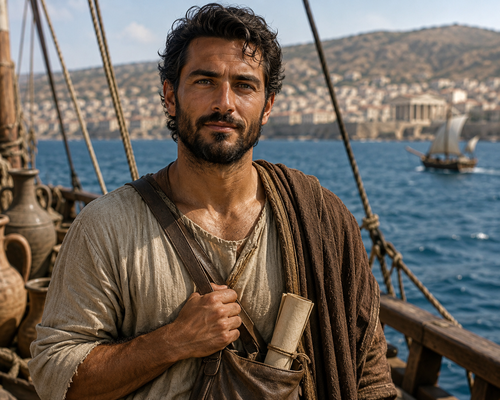
Meet Nicanor, a character in a short historical fiction story showing how the Book of Revelation may have first traveled from Patmos in the Aegean Sea in the first century to Ephesus—and eventually to the whole world and people in every age since.
During this “Armchair Apocalypse” series, we’ll follow Nicanor on his travels to better understand the Book of Revelation by exploring the people and the times in which it was first revealed.
The old man carefully rolled the parchment and tied it with a simple cord. John—exiled on the rocky island of Patmos—looked across at Nicanor, a broad-shouldered Greek Christian in his early thirties whose weathered face and sun-darkened skin betrayed years spent working merchant ships across the Aegean. His short black beard was flecked with salt, and a coarse brown wool cloak hung over a simple linen tunic.
“This isn’t just a letter,” John said quietly in Greek. “It’s a revelation from Jesus Christ himself. The churches will be encouraged… and corrected. Rome won’t like either one.” Nicanor nodded, instinctively resting a hand on the leather satchel that concealed the scroll beneath spare clothing and food. If Roman officials searched him and discovered its contents, prison would be the best outcome. Execution wasn’t impossible. John placed a weathered hand on his shoulder. “Don’t rush. Don’t panic. Deliver it faithfully.” Then, with the kind of smile only someone who had seen such a vision of the glorified Christ could give, he added, “Besides… God has already handled bigger problems than bad weather and Roman soldiers.”
Nicanor boarded a small coastal merchant sailing vessel—a sturdy wooden cargo boat loaded with amphorae of olive oil, grain, and wine. Salt spray soaked his leather sandals as the ship crossed the blue waters toward Ephesus. Days later the city’s magnificent harbor appeared, crowded with fishing boats, cargo ships, and Roman patrol vessels. Merchants shouted prices in Greek while Roman soldiers barked commands in Latin. Citizens wearing bright linen tunics hurried along gleaming marble streets lined with columns, fountains, and towering temples dedicated to Artemis and the emperor. Every corner reminded people who Rome demanded they worship. Nicanor quietly smiled beneath his beard. He knew a greater King.
After sunset, he slipped through narrow stone alleys until an elderly man opened a plain wooden door. Jacob ben Ezra, one of the elders of the Ephesian church, stood slightly stooped with silver hair, deep lines around kind eyes, and a neatly trimmed white beard. Born and raised in the Jewish community of Ephesus, Jacob had spent decades studying the Law and the Prophets before becoming convinced only a few years earlier that Jesus of Nazareth was Israel’s promised Messiah. Some old friends now refused to speak to him. Others considered him a traitor. Yet his quiet joy never seemed to fade.
Inside, about thirty believers gathered in a modest courtyard lit by flickering oil lamps. Among them sat Eliab, a young Jewish craftsman who had only recently come to the same life-changing conclusion. Seeing another Jewish believer leading the gathering gave him courage.
Jacob carefully untied the scroll and began reading: “The Revelation of Jesus Christ…” The room became silent enough to hear the lamps crackle. As John’s words unfolded, the Jewish believers immediately recognized echoes of Daniel’s beasts, Ezekiel’s visions, Zechariah’s horses, and Isaiah’s promises, while the Gentile believers listened as those familiar Scriptures came alive in ways they had never imagined. This wasn’t a puzzle for clever people centuries later. It was a message for persecuted Christians living under Rome’s shadow: stay faithful, reject compromise, don’t worship Caesar, because Jesus—not the emperor—has already won and will reign. Some quietly wept. Others gripped each other’s hands. Eliab felt chills run down his spine. Following Jesus suddenly seemed both more dangerous… and more worth it than ever before.
As Nicanor carefully rolled the scroll back into its leather case, he glanced eastward. Six more churches were still waiting.

Read the Book
Your Life And What Comes After
Discover God’s plan from Genesis to eternity — and where your life fits into it.
Get It on Amazon
Child of God, husband, father, grandfather, rabblerouser, songwriter, pot stirrer, waiting for the King.
- Rick Tryon
- Rick Tryon
- Rick Tryon
- Rick Tryon
- Rick Tryon
- Rick Tryon
- Rick Tryon
- Rick Tryon
- Rick Tryon
- Rick Tryon
- Rick Tryon
- Rick Tryon
- Rick Tryon
- Rick Tryon
- Rick Tryon
- Rick Tryon
- Rick Tryon
- Rick Tryon
- Rick Tryon
- Rick Tryon
- Rick Tryon
- Rick Tryon
- Rick Tryon
- Rick Tryon
- Rick Tryon
- Rick Tryon
- Rick Tryon
- Rick Tryon
- Rick Tryon
- Rick Tryon
- Rick Tryon
- Rick Tryon
- Rick Tryon
- Rick Tryon
- Rick Tryon
- Rick Tryon
- Rick Tryon
- Rick Tryon
- Rick Tryon
- Rick Tryon
- Rick Tryon
- Rick Tryon
- Rick Tryon
- Rick Tryon
- Rick Tryon
- Rick Tryon
- Rick Tryon
- Rick Tryon
- Rick Tryon
- Rick Tryon
- Rick Tryon
- Rick Tryon
- Rick Tryon
- Rick Tryon
- Rick Tryon
- Rick Tryon
- Rick Tryon
- Rick Tryon
- Rick Tryon
- Rick Tryon
- Rick Tryon
- Rick Tryon
- Rick Tryon
- Rick Tryon
- Rick Tryon
- Rick Tryon
- Rick Tryon
- Rick Tryon
- Rick Tryon
- Rick Tryon
- Rick Tryon
- Rick Tryon
- Rick Tryon
- Rick Tryon
- Rick Tryon
- Rick Tryon
- Rick Tryon
- Rick Tryon
- Rick Tryon
- Rick Tryon
- Rick Tryon
- Rick Tryon
- Rick Tryon
- Rick Tryon
- Rick Tryon
- Rick Tryon
- Rick Tryon
- Rick Tryon
- Rick Tryon
- Rick Tryon
- Rick Tryon
- Rick Tryon
- Rick Tryon
- Rick Tryon
- Rick Tryon
- Rick Tryon
- Rick Tryon
- Rick Tryon
- Rick Tryon
- Rick Tryon
- Rick Tryon
- Rick Tryon
- Rick Tryon
- Rick Tryon
- Rick Tryon
- Rick Tryon
- Rick Tryon
- Rick Tryon
- Rick Tryon
- Rick Tryon
- Rick Tryon
- Rick Tryon
- Rick Tryon
- Rick Tryon
- Rick Tryon
- Rick Tryon
- Rick Tryon
- Rick Tryon
- Rick Tryon
- Rick Tryon
- Rick Tryon
- Rick Tryon
- Rick Tryon
- Rick Tryon
- Rick Tryon
- Rick Tryon
- Rick Tryon
- Rick Tryon
- Rick Tryon
- Rick Tryon
- Rick Tryon
- Rick Tryon
- Rick Tryon
- Rick Tryon
- Rick Tryon
- Rick Tryon
- Rick Tryon
- Rick Tryon
- Rick Tryon
- Rick Tryon
- Rick Tryon
- Rick Tryon
- Rick Tryon
- Rick Tryon
- Rick Tryon
- Rick Tryon
- Rick Tryon
- Rick Tryon
- Rick Tryon
- Rick Tryon
- Rick Tryon
- Rick Tryon
- Rick Tryon
- Rick Tryon
- Rick Tryon
- Rick Tryon
- Rick Tryon
- Rick Tryon
- Rick Tryon
- Rick Tryon
- Rick Tryon
- Rick Tryon
- Rick Tryon
- Rick Tryon
- Rick Tryon
- Rick Tryon
- Rick Tryon
- Rick Tryon
- Rick Tryon
- Rick Tryon
- Rick Tryon
- Rick Tryon
- Rick Tryon
- Rick Tryon
- Rick Tryon
- Rick Tryon
- Rick Tryon
- Rick Tryon
- Rick Tryon
- Rick Tryon
- Rick Tryon
- Rick Tryon
- Rick Tryon
- Rick Tryon
- Rick Tryon
- Rick Tryon
- Rick Tryon
- Rick Tryon
- Rick Tryon
- Rick Tryon
- Rick Tryon
- Rick Tryon
- Rick Tryon
- Rick Tryon
- Rick Tryon
- Rick Tryon
- Rick Tryon
- Rick Tryon
- Rick Tryon
- Rick Tryon
- Rick Tryon
- Rick Tryon
- Rick Tryon
- Rick Tryon
- Rick Tryon
- Rick Tryon
- Rick Tryon
- Rick Tryon
- Rick Tryon
- Rick Tryon
- Rick Tryon
- Rick Tryon
- Rick Tryon
- Rick Tryon
- Rick Tryon
- Rick Tryon
- Rick Tryon
- Rick Tryon
- Rick Tryon
- Rick Tryon
- Rick Tryon
- Rick Tryon
- Rick Tryon
- Rick Tryon
- Rick Tryon
- Rick Tryon