October 3, 1863
In the midst of the American Civil War, President Abraham Lincoln issued a proclamation establishing the last Thursday of November as a national day of Thanksgiving.
Written primarily by Secretary of State William H. Seward, the proclamation is remarkable for its explicit acknowledgment of God’s providence, its call for national repentance, and its prayer for healing a divided nation.
The Full Proclamation
By the President of the United States of America.
A Proclamation.
The year that is drawing towards its close, has been filled with the blessings of fruitful fields and healthful skies. To these bounties, which are so constantly enjoyed that we are prone to forget the source from which they come, others have been added, which are of so extraordinary a nature, that they cannot fail to penetrate and soften even the heart which is habitually insensible to the ever watchful providence of Almighty God.
In the midst of a civil war of unequalled magnitude and severity, which has sometimes seemed to foreign States to invite and to provoke their aggression, peace has been preserved with all nations, order has been maintained, the laws have been respected and obeyed, and harmony has prevailed everywhere except in the theatre of military conflict; while that theatre has been greatly contracted by the advancing armies and navies of the Union.
Needful diversions of wealth and of strength from the fields of peaceful industry to the national defence, have not arrested the plough, the shuttle or the ship; the axe has enlarged the borders of our settlements, and the mines, as well of iron and coal as of the precious metals, have yielded even more abundantly than heretofore.
Population has steadily increased, notwithstanding the waste that has been made in the camp, the siege and the battle-field; and the country, rejoicing in the consciousness of augmented strength and vigor, is permitted to expect continuance of years with large increase of freedom.
No human counsel hath devised nor hath any mortal hand worked out these great things. They are the gracious gifts of the Most High God, who, while dealing with us in anger for our sins, hath nevertheless remembered mercy.
It has seemed to me fit and proper that they should be solemnly, reverently and gratefully acknowledged as with one heart and one voice by the whole American People.
I do therefore invite my fellow citizens in every part of the United States, and also those who are at sea and those who are sojourning in foreign lands, to set apart and observe the last Thursday of November next, as a day of Thanksgiving and Praise to our beneficent Father who dwelleth in the Heavens.
And I recommend to them that while offering up the ascriptions justly due to Him for such singular deliverances and blessings, they do also, with humble penitence for our national perverseness and disobedience, commend to His tender care all those who have become widows, orphans, mourners or sufferers in the lamentable civil strife in which we are unavoidably engaged, and fervently implore the interposition of the Almighty Hand to heal the wounds of the nation and to restore it as soon as may be consistent with the Divine purposes to the full enjoyment of peace, harmony, tranquillity and Union.
In testimony whereof, I have hereunto set my hand and caused the Seal of the United States to be affixed.
Done at the City of Washington, this Third day of October, in the year of our Lord one thousand eight hundred and sixty-three, and of the Independence of the United States the Eighty-eighth.
Abraham Lincoln
By the President:
William H. Seward, Secretary of State.
United States National Archives — Original Thanksgiving Proclamation of 1863.
What is particularly striking is that Lincoln called for thanksgiving not during a time of national prosperity and peace, but during one of the darkest periods in American history.
Thanksgiving was not an invitation to ignore suffering. It was an invitation to recognize God’s blessings in spite of it.
A Little Thanksgiving History
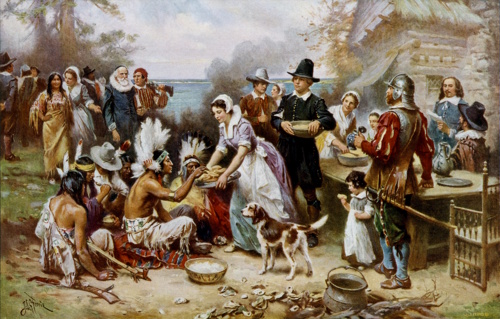
1621 — The Pilgrims’ harvest celebration
After surviving a devastating first winter in Plymouth, Massachusetts, the Pilgrims held a three-day harvest celebration attended by approximately 90 Wampanoag people.
Although the Pilgrims were deeply religious, the surviving account does not explicitly describe the gathering as a formal religious day of thanksgiving. Nor did it establish an annual holiday.
1789 — George Washington’s Thanksgiving Proclamation
Washington issued the first presidential Thanksgiving proclamation, designating November 26, 1789, as a day of public thanksgiving and prayer:
“To acknowledge the providence of Almighty God, to obey his will, to be grateful for his benefits, and humbly to implore his protection and favor.”
Washington’s proclamation made no mention of the Pilgrims.
1863 — Abraham Lincoln’s Thanksgiving Proclamation
During the Civil War, Lincoln established the last Thursday of November as a national day of Thanksgiving and praise to God.
Sarah Josepha Hale, a prominent American writer and magazine editor, had campaigned for years to establish a regular national Thanksgiving observance.
Lincoln’s proclamation also made no mention whatsoever of the Pilgrims or their 1621 celebration.
1941 — Thanksgiving becomes a fixed federal holiday
Congress passed legislation, signed by President Franklin D. Roosevelt, officially establishing the fourth Thursday of November as Thanksgiving Day.
So why all the emphasis on the Pilgrims?
In 1841, historian Alexander Young published an account of the 1621 Plymouth celebration and included a footnote identifying it as the first Thanksgiving.
During the late nineteenth and early twentieth centuries, school textbooks, popular illustrations, children’s stories and public celebrations increasingly promoted the Pilgrim story as the origin of Thanksgiving. It became a national founding narrative, emphasizing cooperation, perseverance and gratitude.