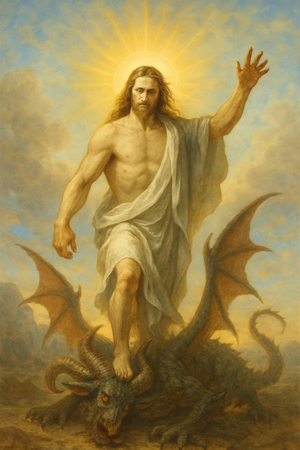
When a horrific, inexplicable act of intentional evil is carried out by someone, should we always blame it on ‘mental illness’? I think we need to examine the reality more closely in many cases and acknowledge that we are engaged in a battle with spiritual wickedness in high places.
1 Peter 5:8 – “Be sober, be vigilant; because your adversary the devil, as a roaring lion, walketh about, seeking whom he may devour.” (KJV)
Here are four famous quotes on the subject.
C.S. Lewis (The Screwtape Letters, 1942): “There is no neutral ground in the universe: every square inch, every split second, is claimed by God and counterclaimed by Satan.”
John Piper (Desiring God): “Life is war. That’s not all it is. But it is always that. Our weakness in prayer is owing largely to our neglect of this truth.”
Charles Spurgeon (sermon on The Christian Soldier): “Satan always hates Christian fellowship; it is his policy to keep Christians apart. Anything which can divide saints from one another he delights in. Since union is strength, he does his best to promote separation.”
A.W. Tozer (This World: Playground or Battleground?): “People think of the world not as a battleground, but as a playground. We are not here to fight; we are here to frolic. We are not in a foreign land; we are at home. We are not getting ready to live; we are already living. And the idea that this world is a battleground has now been rejected by the great majority of Christians.”
To monitor current news and events related to faith and culture.
To provide an alternative viewpoint to the world’s pervasive climate of darkness, nihilism, and hopelessness for those seeking truth, light, and purpose.
To examine and question the assumptions of religious tradition and provide a resource for information and inspiration for people of faith who have become dissatisfied with an increasingly lifeless and empty ‘churchianity’.
To present the Biblical truths which reveal God’s nature and purposes and proclaim the lifechanging, world-altering, radical message of Yeshua the Messiah – Jesus Christ, our risen Lord and Savior.
At Bible Rebel, this is our one and only creed: Our living God is a loving God and the Bible is His revealed word and will. Our hope and eternal salvation relies entirely on the work of God’s only begotten son, Jesus Christ, who is the way, the truth, and the life.
So, expect some controversial viewpoints and uncomfortable ideas in some of the coming content from Bible Rebel.
Here, Wright addresses the image of believers being suctioned up into the air and taken away to heaven at the return of Christ, as popularized in modern novels and movies:
“…Paul conjures up images of an emperor visiting a colony or province. The citizens go out to meet him in open country and then escort him into the city. Paul’s image of the people “meeting the Lord in the air” should be read with the assumption that the people will immediately turn around and lead the Lord back to the newly remade world.
Paul’s mixed metaphors of trumpets blowing and the living being snatched into heaven to meet the Lord are not to be understood as literal truth, as the Left Behind series suggests, but as a vivid and biblically allusive description of the great transformation of the present world of which he speaks elsewhere.”
Wright makes another very poignant observation about the current worldview of some Christians who believe, wrongly in my opinion, that scripture teaches that believers will be scooped up to avoid a ‘Great Tribulation’, then return seven years later with Jesus to dish out the final portion of God’s wrath on the world.
“Paul’s misunderstood metaphors present a challenge for us: How can we reuse biblical imagery, including Paul’s, so as to clarify the truth, not distort it? And how can we do so, as he did, in such a way as to subvert the political imagery of the dominant and dehumanizing empires of our world? We might begin by asking, What view of the world is sustained, even legitimized, by the Left Behind ideology? How might it be confronted and subverted by genuinely biblical thinking? For a start, is not the Left Behind mentality in thrall to a dualistic view of reality that allows people to pollute God’s world on the grounds that it’s all going to be destroyed soon? Wouldn’t this be overturned if we recaptured Paul’s wholistic vision of God’s whole creation?“
Let’s allow the whole Word of God to speak to us and teach us rather than magnifying pet verses out of context and being seduced by pop theology – like Left Behind.
Editors note: the guest article appearing here does not necessarily reflect the views of Bible Rebel editors or other guest authors and contributors. Bible Rebel seeks to present a wide range of ideas and viewpoints in order to fulfill our mission to provide resources for “Curious Fearless Faith”.This is the second part in a new series on prayer called ‘Supplication In The Spirit’ by Steve Sann.
1 Timothy 2:1: Therefore I exhort first of all that supplications, prayers, intercessions, and giving of thanks be made for all men.
This commandment is clear. And, notably, supplication heads the list of the first of four critically needed types of prayer. Why are four different types of prayer listed in this exhortation? Because all four are different, all four must be practiced.
Generally, when a person speaks to God, we call that “prayer.” However, prayer comes in a variety of forms. Prayer that centers on the needs rather than on God Himself is called a supplication. In contrast, when we emphasize God, glorifying Him as the giver, that is prayer. Intercession is to stand before God in prayer in place of another. And, giving of thanks returns to the Father much deserved gratitude and recognition. All four of these forms of prayer are to be practiced in our private prayer life.
“Supplications,” as used in the Old Testament scriptures and even in the secular literature of that day, are literally this: the written requests and petitions— humbly, yet earnestly—brought before one of higher authority, as one would when making a plea before a ruler, a court or a judge. When the word “supplication” is used, it is to emphasize the person’s need for help, rather than accentuating God’s great ability to provide. When the scripture orders us to pray with supplications, it is telling us to call attention to our needs before God. God wants this. It enables Him to provide for us. So, supplications are those specific requests we claim before God to supply, whether for ourselves or for others.
God wants us to offer these supplications “in the spirit”—aka: tongues. How is this to be accomplished? By focusing individually on the people and the needs from our prayer list, we simultaneously pray with the spirit. While speaking in tongues, we center our mind’s attention on each issue of prayer at hand. Like we do when we “pray with our understanding,” we mentally picture the subject or issue of prayer; only now we speak in tongues simultaneously. The spirit then prays to God the details for each of the issues, the specifics of which we are usually unaware.
For example, I know to pray for my family. Nonetheless, I have little idea of the needed details. So, I make supplication via the spirit. In this way, specific prayer is offered for specific people. Supplication in the spirit is truly a blend of praying with your understanding and praying in the spirit—simultaneously: “I will pray with the spirit, and I will also pray with the understanding.” As Ephesians 6 emphasizes, we are to be, “watchful to this end with all perseverance”—not only for ourselves, but for “all the saints.” But, most importantly, He wants us to do this “always”—and He desires it via “in the spirit”; that is, praying in tongues. Day after day, He wants us passing the needs of the saints before Him via tongues.
For those “watching”, so becoming spiritually sensitive, often God will stir our hearts with an “awareness” to pray. Some call this a “burden of prayer.” At the time, the details are often not known, only that a certain someone or something somewhere requires prayer. Directing our thoughts to the subject of alert, we pray in the spirit covering the details, allowing God to intervene.
To develop this sensitivity, when praying with others, occasionally pray as God directs your hearts by revelation. Each can call out and describe the need as God guides. You will find that God graciously gives revelation to those who are willing to serve Him in prayer. Often God will make known only the topic, expecting that your prayer by the spirit will handle the details.
When God calls on us unexpectedly to make supplication, it is our responsibility to focus with faith. If you need to, pull your car over or excuse yourself from the room. Just like Jesus requested the urgent prayers of his disciples in his last hours at Gethsemane, we likewise are to “be watchful” and “persevere” during these critical moments, Matthew 26:40-41.
In an excerpt from The Crown, Season 3 Episode 7 (“Moondust”) – a monologue delivered in the show by Prince Phillip the during his moment of mid-life crisis, speaking to a gathering of priests at St. George’s House, the writer and actor capture the essence of a meaningless existence as opposed to the wonder and ecstasy of knowing God.
“My mother died recently. She saw something was amiss. She saw that something was missing in her youngest child, her only son. Faith. ‘How’s your faith’, she asked me.
I am here to admit to you that I’ve lost it. And without it, what is there? The loneliness and emptiness and anticlimax of going all the way to the moon and finding nothing but haunting desolation, ghostly silence, gloom. That is what faithlessness is.
As opposed to finding wonder, ecstasy, the miracle of divine creation, God’s design and purpose.”
Editors note: the guest article appearing here does not necessarily reflect the views of Bible Rebel editors or other guest authors and contributors. Bible Rebel seeks to present a wide range of ideas and viewpoints in order to fulfill our mission to provide resources for “Curious Fearless Faith”.This is the first part in a new series on prayer called ‘Supplication In The Spirit’ by Steve Sann.
Praying for the Specifics
While working at home late one evening, in my early ministry years, I picked up the phone to be startled by the panicked voice of one of our youth leaders. In the background were the uncontrollable screams of his wife. Whatever launched her into hysterics, it was clear she was beyond reasoning, incommunicative.
Staggered and dazed, I didn’t know what to do. The man was pleading with me to take charge, “cast out the spirits or whatever,” and then thrust the phone to his wife. On the other end was the voice of a young woman in unreserved confusion. Trying to calm the situation was futile, as she would have none of that! Yet, through the melee that followed, a half-hour later, we were able to finally disconnect in some semblance of peace. I fell back into my office, shaken and perplexed.
Not long afterward, my wife appeared at the door, returning home from an event across state. Foregoing the usual courtesies, studying my face, she quizzed me: “Is there something strange going on here?” She explained: “While on the highway home, a picture of our house flashed into my mind. Suddenly I saw up on the side of the house the reflection of flashing red emergency lights! I began praying in the spirit like ‘a house-a-fire’ for whatever the situation was here at home!” She sighed, “I didn’t stop until a half-hour later when I sensed the emergency had passed.”
“Supplication” is exactly that: coming before God with a specific list of needs for ourselves and others. It may be that God gives you the specifics, expecting you to pray for another. Or, you may be listing to God for the needs of which you are already aware. Either way, when we bring specific needs before God in tongues, we are fulfilling, by definition, “supplication in the spirit.”
In today’s prayer publications, seldom a word is mentioned regarding supplication in tongues. Yet, as you may recall, in Ephesians 6, it was reinforced to make unfailing supplication in the spirit: Ephesians 6:18: Praying always with all prayer and supplication in the Spirit, being watchful to this end with all perseverance and supplication for all the saints. Twice in this one verse are we told to supplicate, always and with all perseverance, for all the saints. If supplication is this important, God confirming it with repeated absolutes, we can be confident we know what and how to carry it out effectively.
I’ve recently read ‘The Call’ by Os Guinness, and I highly recommend it. Guinness has a remarkable ability to communicate profound truths in a very understandable and beautiful way.
Here are some of my favorite Guinness quotes.
“Calling is a ‘yes’ to God that carries a ‘no’ to the chaos of modern demands. Calling is the key to tracing the story line of our lives and unriddling the meaning of our existence in a chaotic world.”
Emphasizing the transformative power of responding to God’s call over worldly distractions, this quote captures Guinness’s central theme of purpose amid chaos.
“We are not primarily called to do something or go somewhere; we are called to Someone. We are not called first to special work but to God. The key to answering the call is to be devoted to no one and to nothing above God himself.”
This profound line shifts the focus from vocation or activity to relationship—underscoring devotion to God as the ultimate calling.
“Freedom is not the permission to do what you like. It’s the power to do what you ought.”
Guinness masterfully reframes freedom—not as license, but as responsible empowerment to do what’s right.
“I live before the audience of One—before others I have nothing to gain, nothing to lose, nothing to prove.”
A succinct, soulful declaration of living for divine approval alone. It reflects deep humility and singular devotion.
Bible Rebel continues to keep a watchdog’s eye on wars and conflicts around the globe, bringing the latest news summaries to our readers.
Israel Declares Plan to Reoccupy Gaza
On August 7, 2025, Israeli Prime Minister Benjamin Netanyahu announced intentions for Israel to take full military control of the Gaza Strip—marking a potential reoccupation since the 2005 withdrawal—pending Security Cabinet approval. The shift comes amid failed ceasefire efforts and escalating civilian casualties, with over 61,000 Palestinians reportedly killed since the conflict’s onset. From The AP
U.S.-Brokered Peace Corridor in South Caucasus
Also on August 7, 2025, the U.S. reached a landmark peace agreement between Armenia and Azerbaijan. The deal secures exclusive U.S. development rights over a crucial transit corridor through the region, dubbed the “Trump Route for International Peace and Prosperity” (TRIPP), and signals a move toward dissolving the Minsk Group framework. From Reuters
Ukraine-Russia War: Trump–Putin Meeting Looms as Zelenskyy Excluded
Recent developments in the Ukraine–Russia war spotlight a potential meeting between President Trump and President Putin, likely hosted in the UAE. However, the Kremlin indicated that Ukrainian President Zelenskyy will not be included under current conditions—raising concerns about sidelining Kyiv in ceasefire talks. From The Guardian
U.S. Pushes Lebanon to Disarm Hezbollah—Diplomatic Tensions Rise
The U.S. is intensifying pressure on Lebanon to disarm Hezbollah, prompting doubts about its effectiveness and long-term risks. Analysts warn that pressing Lebanon too quickly could undermine the fragile state-building process and lead to dangerous political repercussions. From The Guardian