Your Life And What Comes After (27): Where Is Heaven?

Adriana pressed her forehead gently against the cool windowpane, watching the trees sway and dance as if whispering secrets to one another. She could see the branches bend, the leaves shimmer, and the grass ripple in soft waves, yet the wind itself remained invisible—always present, always felt, but never seen. As she watched the world move without a visible mover, she wondered how something so real could hide so completely, as if the wind were a shy friend who preferred to speak through the trees rather than show its face.

In the Bible, ‘heaven‘ often simply means the spiritual realm where God lives, not an actual place up in the clouds with angels, pearly gates, and such.

But where is that place where God lives actually located? I like the way N. T. Wright, a Bible teacher, puts it:

Going to Heaven?

Did you know that the Bible never uses the phrases “go to heaven” or “going to heaven” to describe what happens to people when they die? That’s because heaven isn’t a place where people are going someday; it’s a place where God is right now.

Heaven isn’t a place that we go as a reward for being good, like Disneyland. It’s not a location on a map, like Chicago or New York, that we can find directions to or roads that take us there.

So, where is that place where God lives? Well, it’s all around us. It’s next to us, above us, and below us. God lives in the unseen places that surround and fill everything.

Like the wind all around us that we can’t see, yet moving the things that we can see.

We’ve talked about heaven quite a bit; next, we’ll take a little tour of how we should think about hell. Ooooohhhhhh!

Two Questions About God’s Foreknowledge

Is biblical prophecy based on God’s meticulous foreknowledge, or on His power and ability to bend the course of history to His will and grand plan?

If God has predestined everything to happen exactly as it has and will happen, even down to the most minute molecular phenomena, then aren’t we essentially living in a kind of simulation, as some theorists have suggested?

Are You A ‘Non’?

Anyone who knows even a little bit about the Bible and the history of Christianity knows that it was the religious leaders of the time, along with their secular allies, that were responsible for the killing of the prophets, the reformers, and even the Son of God himself, Yeshua our Messiah.

The religious leaders. The wolves in sheep’s clothing. The whited sepulchers. The vipers. The religious leaders.

There is no new thing under the sun. Fallen human nature and the rot of man-made religion hasn’t changed since they murdered the prophets, burned the ‘heretics’, and tortured and crucified our Lord.

That is part of the reason why I do not subscribe to a modern denominational creed of set of doctrines. I don’t think that modern day Evangelicals, or Baptists, or Lutherans, or Catholics are going to burn anyone in the town square – it’s just that I don’t trust organized religion.

I’m non-denominational. I’m a ‘Non’. And there are a lot of others just like me, in fact more and more folks are fleeing traditional ‘churchianity’ every day. Why? More on that in future posts.

Here’s my one and only creed, which I’m happy share with my brothers and sisters in The Fellowship of the Nons:

Creed of the Fellowship of the Nons

Our living God is a loving God and the Bible is His revealed word and will.
Our hope and eternal salvation relies entirely on the work of God’s only begotten son, Jesus Christ, who is the way, the truth, and the life.

A huge part of the purpose and reason for the Bible Rebel blog is stated in our mission:

“To examine and question the assumptions of religious tradition and provide a resource for information and inspiration for people of faith who have become dissatisfied with an increasingly lifeless and empty ‘churchianity’.”

Your Life And What Comes After (24): See All The People

What is the Church Age?

Have you ever heard the nursery rhyme that goes like this—‘Here’s the church, here’s the steeple, open the doors and see all the people’?

Is the Church Age about church buildings, or is it about people? In the Bible’s New Testament books after the Gospels of Matthew, Mark, Luke, and John, the ‘Church’ always refers to the people who believe that Jesus Christ is the Savior and Son of God.

Just as the Old Testament was instruction for the people who lived back in those times on how to walk in God’s purposes, and the Gospels of Matthew, Mark, Luke, and John show us how Jesus lived according to God’s plan, the New Testament books after the Gospels now instruct us today on how to do the same.

Seek God First

Spend some time every morning praying and just enjoying the presence of God, speaking to Him and letting Him speak to you.

Add Value to the World Around You

Do meaningful work. Gain knowledge and learn valuable skills. Help and serve others around you in real ways that meet real needs.

Do Hard Things Without Fear

Don’t ever be afraid of hard work or of doing hard things. God loves you and has already given you great strength and courage.

Fight Darkness with Light

Stand up, speak up, and show up. Dispel the darkness around you by shining forth God’s love and light.

The You Miracle

Always remember that you are a miracle, and that God’s plan includes you in His family and household. See yourself as God sees you: His beautiful child.

Plug into God’s purposes and plan, and your life will be an exciting adventure as a co-worker with the Creator of the universe!

Next, we’ll start our journey into understanding heaven, hell, and the end of the world.

What The Hell: Eternal Conscious Torment

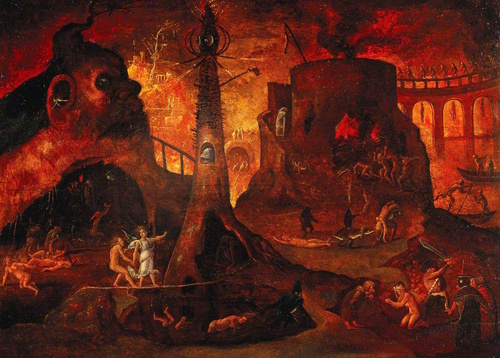
Bosch, Hieronymus; An Angel Leading a Soul into Hell; Wellcome Library; http://www.artuk.org/artworks/an-angel-leading-a-soul-into-hell-125754

Bible Rebel is exploring the three major Christian doctrines concerning the theology of hell.

  • Annihilationism (often called “conditional immortality”) see Bible Rebel post here
  • Infernalism (eternal conscious torment)
  • Universalism (everyone winds up in “heaven” eventually)

Here are some quotes from three prominent theologians/scholars who hold the eternal conscious torment view of hell.

Charles H. Spurgeon (Baptist preacher)
“When thou diest, thy soul will be tormented alone; that will be a hell for it, but at the day of judgment thy body will join thy soul, and then thou wilt have twin hells… every nerve a string on which the devil shall forever play his diabolical tune of ‘Hell’s Unutterable Lament.’”
— Spurgeon vividly affirms conscious, ongoing torment in hell after death, consistent with traditional teaching on eternal punishment.

Denny Burk (Theologian; The Gospel Coalition essay)
“Hell is a place of eternal, conscious torment for everyone who does not trust in Jesus Christ…I t describes unending experience of divine judgment and just retribution for sin.”
— This reflects a contemporary evangelical articulation of the historic doctrine of ECT, emphasizing unending conscious punishment for the unrepentant.

John Piper (Reformed theologian; quoted in public domain margin)
“No one can hide from the Lord… God’s power is present in hell as the One who… maintains suffering…†…† (paraphrased summary of his emphasis that torment in hell is real and ongoing).

Your Life And What Comes After (23): A Town-Sized House

A wise king once chose a quiet stretch of countryside and there he built a house so vast it was the size of a town, with countless rooms, wide halls, and courtyards. When it was finished, he sent his loyal servants to live inside it. Their work was to prepare every room—sweeping floors, setting tables, lighting lamps, and making each place ready for life. Yet the king gave one puzzling command: the doors were to remain locked. The servants obeyed, working faithfully day after day, hearing the sounds of people passing by outside but never opening the doors to them.

At the right time, the king sent his son, the prince, to the great house. Unlike the servants, the prince carried the keys. He walked through the halls, threw open the doors, and called out to the people from every road and field, inviting them to come in. Families, strangers, and wanderers entered together, filling the rooms with laughter and conversation.

The prince welcomed them to live with him, not as guests but as family, alongside the servants who had prepared the house. And at last the king’s house became what it was always meant to be—a living home where many shared one life under the care of the king’s son.

That Sign at Football Games

In the Old Testament, God worked through Israel to carry out His plan. Then came Jesus, who completed that plan through His life, His death on the cross, and His resurrection from the grave.

Because of what Jesus did, we are now in the Church Age, where all people—not just the people of Israel—are invited into the household of God.

Have you ever seen the signs people hold up at football games for the TV cameras that say, “John 3:16”? That verse tells us what God’s plan was all along and why Jesus is the most important part of that grand plan.

Whosoever. Not just some, but everyone is invited to take part in the goal of God’s plan through Jesus Christ—everlasting life.

Next, we’ll look at how we plug into God’s plan in this new Church Age. Hint: it’s not different from the ways we’ve already talked about.

What The Hell: Conditional Immortality

Bosch, Hieronymus; An Angel Leading a Soul into Hell; Wellcome Library; http://www.artuk.org/artworks/an-angel-leading-a-soul-into-hell-125754

In upcoming posts we’ll be exploring the three major Christian doctrines concerning the theology of hell.

  • Annihilationism (often called “conditional immortality”)
  • Infernalism (eternal conscious torment)
  • Universalism (everyone winds up in “heaven” eventually)

We start with annihilationism and some quotes from three prominent theologians/scholars who hold the conditional immortality view.


John Stott (Anglican theologian, pastor)

John Stott & David Edwards, Evangelical Essentials (InterVarsity Press, 1988)


Edward Fudge (biblical scholar, author of The Fire That Consumes)

Edward Fudge, The Fire That Consumes (3rd ed., Cascade Books, 2011)


Clark H. Pinnock (theologian, professor)

Clark H. Pinnock, “The Destruction of the Finally Impenitent,” in Criswell Theological Review (1990)

Question Everything

Churchianity and the theological status quo should be scrutinized by all people of faith regularly. That is exactly how we got the Reformation.

Is there a New Reformation brewing? It seems so. There is a difference between truth and tradition.

Man-made Christian creeds and doctrines are no longer being blindly accepted as biblical truth just because the Protestant clergy or the Catholic Papacy say so.

The nature of God, heaven, hell, sin, the apocalypse, predestination or free-will, the Rapture, the origins of the universe – all of these ideas and more need solid reexamination to see if the commonly accepted doctrines of men used to explain them measure up to the message of scripture.

The Bible Rebel blog is a resource for those seeking original and curated content, including news and commentary, covering faith, biblical studies and interpretation, and the intersection of politics, culture, and the Bible.

Our Mission

  1. To monitor current news and events related to faith and culture.
  2. To provide an alternative viewpoint to the world’s pervasive climate of darkness, nihilism, and hopelessness for those seeking truth, light, and purpose.
  3. To examine and question the assumptions of religious tradition and provide a resource for information and inspiration for people of faith who have become dissatisfied with an increasingly lifeless and empty ‘churchianity’.
  4. To present the Biblical truths which reveal God’s nature and purposes and proclaim the lifechanging, world-altering, radical message of Yeshua the Messiah – Jesus Christ, our risen Lord and Savior.

At Bible Rebel, this is our one and only creed:
Our living God is a loving God and the Bible is His revealed word and will.
Our hope and eternal salvation relies entirely on the work of God’s only begotten son, Jesus Christ, who is the way, the truth, and the life.

So, expect some controversial viewpoints and uncomfortable ideas in some of the coming content from Bible Rebel.

You can find all of the current Bible 101 episodes and One-Minute Mini Messages here on our YouTube Channel, and you can subscribe to our YouTube channel here.

Give us a follow on Facebook and X (formerly Twitter) and subscribe to our monthly newsletter here.

Your Life And What Comes After (21): Jesus, The Golden Spike

The plan to connect the United States by rail began in 1862, but it took years of hard work and danger to build tracks across mountains and deserts. For a long time, it wasn’t clear when everything would finally come together and the Transcontinental Railroad would be completed.

Then, in 1869, the last rail was connected at Promontory Summit, Utah, with the driving of the Golden Spike. In that moment, the long plan was complete, and the country was finally linked from coast to coast.

Jesus is the Golden Spike in God’s Plan

After Adam and Eve messed up, God promised to rescue humanity, and Jesus came as the fulfillment of that plan. Through His life, death, and resurrection, Jesus completed God’s long-promised work and rescue plan, opening the way for everyone in all ages to be restored to God and receive everlasting life with Him.

God’s plan started with a promise (Genesis 3:15), was carried through history by people like Abraham and David, and was fully revealed in Jesus, who came to save the world.

Jesus Announces His Mission

Jesus wasn’t just teaching good ideas—He was the fulfillment of God’s long-promised plan, set in motion all the way back in the Old Testament.

God’s plan was accomplished, the Old Testament scripture was fulfilled, and Jesus said, “It is finished”.

How Did Jesus Do It?

How did Jesus carry out God’s plan?

  • By perfect obedience in His life, cancelling the disobedience of Adam and Eve.
  • By carrying out that obedience all the way to His death by crucifixion.
  • By His being raised by God from the dead to eternal life.

Did Jesus show us by example any of the four ways to plug into God’s grand plan that we looked at earlier? We’ll talk about that next.