Watchdog Alert: Churchianity News

Bible Rebel keeps a watchdog’s eye on news and events from the world of faith and religion and brings that content to our readers.

Trump Establishes Faith Office & Religious Liberty Commission

Former President Donald Trump has inaugurated several faith-based initiatives—such as a White House Faith Office, a Religious Liberty Commission, and a task force to eradicate anti-Christian bias. While his conservative Christian base applauds the move, critics warn it risks violating the First Amendment by privileging politically aligned Christian factions over broader religious pluralism. From Milwaukee Independent


Southern Baptist Convention Advances Conservative Resolutions

At their 2025 annual meeting in Dallas, the Southern Baptist Convention (SBC)—the largest Protestant denomination in the U.S.—voted to endorse several conservative social resolutions. These include advocating a legal ban on pornography, opposing same-sex marriage (seeking reversal of the 2015 U.S. Supreme Court decision), restricting sports betting, and encouraging childbirth. Internal debates also continue on issues like women pastors and the denomination’s policy arm. From the AP


AP-NORC Poll: U.S. Adults Embrace Religious Chaplains in Schools

A new AP–NORC poll finds about 60% of U.S. adults support allowing religious chaplains in public schools to provide support—though not teacher-led or compulsory prayer. Support is split along denominational and political lines: White evangelical and Black Protestant adults are more favorable than Catholics, mainline Protestants, and non‑religious respondents. There’s broad concern (80%+) over church–state separation and funding issues. From apnews.com


Ecumenical Christian Leaders Condemn Hate Speech in Dallas

Over 30 Christian leaders and churches—including groups from Baptist, Lutheran, Presbyterian, Anglican, United Methodist, Evangelical, and Congregational traditions—have publicly denounced a planned “Hindu supremacist” event in Dallas featuring Kajal Singhala. Organized by Hindu nationalist groups with histories of anti-Christian rhetoric, the event has drawn strong opposition from an ecumenical coalition underscoring religious freedom and the Christian gospel. From clarionindia.net
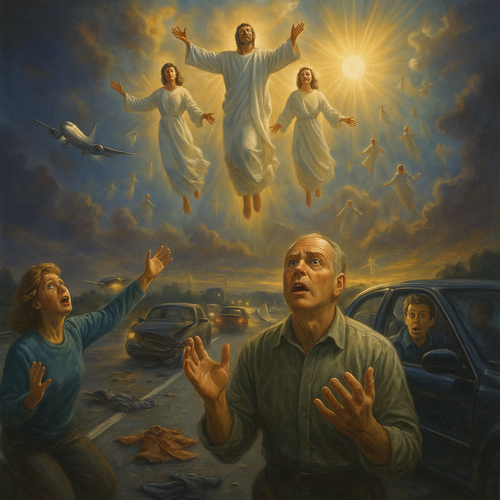
Rethinking The Rapture: What Does ‘Delivered From Wrath’ Mean?

Many Rapturists believe that 1 Thessalonians 1:10 must be interpreted to mean that God will not allow believers to go through a 7 or 3 1/2 year tribulation period and that the Rapture will rescue the saved who are alive at the time.

Here’s the thing – there are other ways of reading “delivered from the wrath to come” that, in my opinion, make way more sense and fit more accurately with the overall themes of the Bible in the context of judgement and salvation.

So, asked Mr. Art Intelligence to provide a summary of what it means, here’s what I got:

“The phrase “delivered from the wrath to come” refers to a key theme in Christian theology, particularly in relation to salvation, judgment, and the end times. It’s most directly found in 1 Thessalonians 1:10:

“…and to wait for his Son from heaven, whom he raised from the dead—Jesus, who delivers us from the wrath to come.” (ESV)

Here’s what it generally means:


1. “Wrath to Come” = God’s Future Judgment

  • In biblical context, “wrath” refers to God’s righteous anger and judgment against sin and evil.
  • “The wrath to come” is typically seen as a future event — often associated with the Day of the Lord, end-time judgment, or the Great Tribulation.

2. Deliverance Through Jesus Christ

  • Christians believe that Jesus’ death and resurrection satisfy the demands of divine justice, so those who trust in Him are not subject to God’s wrath.
  • To be “delivered from the wrath to come” means being spared from God’s judgment, whether that’s:
    • eternal separation from God (hell),
    • or specific apocalyptic judgment in the end times (depending on one’s eschatological view).

3. Different Theological Interpretations

There are several interpretations of how and when this “deliverance” happens:

  • Pre-Tribulation View (Dispensational):
    • Believers will be raptured before a time of tribulation and judgment on earth (Revelation-style wrath).
    • This is a common belief among many evangelicals and in popular media like Left Behind.
  • Historical View:
    • The “wrath” may refer to eternal condemnation, not necessarily a future earthly tribulation.
    • In this view, deliverance is more about salvation from hell than escape from earthly suffering.
  • Ongoing Deliverance:
    • Some theologians see this as a present spiritual reality: Jesus continually intercedes for believers, shielding them from God’s wrath (Romans 5:9; John 3:36).

Summary:

To be “delivered from the wrath to come” means that through faith in Jesus Christ, Christians are spared from God’s future judgment, whether that’s understood as eternal damnation or a specific time of tribulation. It underscores the Christian hope of salvation, security, and peace with God, even in the face of future judgment.”

End AI answer. I’ll be exploring these ideas in more detail in the next post on “Rethinking The Rapture”.

Rethinking The Rapture: Introduction

Rethinking The Rapture: Questions

Rethinking The Rapture: More Questions

Rethinking The Rapture: N.T. Wright’s ‘Farewell to the Rapture’

Rethinking The Rapture: What 1 Thessalonians 4:16-17 Doesn’t Say

Rethinking The Rapture: Millions Of Christians Were Not Delivered From Wrath

Why Must We Pray, Anyway: Part 3

Editors note: the guest article appearing here does not necessarily reflect the views of Bible Rebel editors or other guest authors and contributors. Bible Rebel seeks to present a wide range of ideas and viewpoints in order to fulfill our mission to provide resources for “Curious Fearless Faith”. This is Part 3 in a new series on prayer called ‘Why Must We Pray, Anyway’ by Steve Sann.

Why Must We Pray, Anyway: Part 1
Why Must We Pray, Anyway: Part 2


The newborn baby is but an heir of man’s disaster. At the moment of birth, without the freedom to choose or even to comprehend his circumstance, each child is launched headlong into a world of hurt. As good a person as he or she may try to be or should ever possibly become, at best they will remain citizens of the kingdom of darkness. Literally, each of us is conceived and born in sin, far apart from the spiritual entrée needed to walk and talk with God.

But now, as a result of Christ, mankind regains the authority to bring God back on the scene wherever we are present! We still reside within the borders of Satan’s kingdom, true, but we are no longer citizens. Sure, within his own kingdom, Satan has every legal right to rule his own subjects. However, we now, being the citizens of heaven (Philippians 3:20), as God’s people, we are released from Satan’s authority (Colossians 1:13), even while still dwelling within his kingdom. “No one is a firmer believer in the power of prayer than the devil; not that he practices it, but he suffers from it!”

Right here, while still in the Devil’s empire, we have new legal rights! But it is up to each of us to claim them. At any time, we have every right to call upon God, who then may enter into Satan’s kingdom to protect and prosper us! We are His now. God is limited only by our willingness to petition Him on our behalf.

When you call upon God in the name of Jesus Christ, you are literally delegating to Him the authority to enter into this world behind these enemy lines to fight for you. God loves it! At that very moment, God has legal authority to utilize whatever resources are at His disposal to respond to that specific need. The insight of Martin Luther in the 16th century still rings true today: “Prayer is not overcoming God’s reluctance, but laying hold of His willingness.”

God’s people are all the time making excuses for the “sovereign” God as to why He did not act, save, or bless when really it is they who did not pray. By their many excuses for God, they are, in effect, blaming God for their own lack of prayer. Those who do pray see His results, tempered only by the weakness to believe. This, then, is why we must pray. And much. The responsibility for God’s good in this troubled world falls back upon us.

Rethinking The Rapture: Millions Of Christians Were Not Delivered From Wrath

One of the arguments for a Rapture of believers is that God will not allow Christians to go through the ‘wrath to come’, as described in the book of Revelation, but will rescue them out of the world before those purportedly horrific, literal events occur.

But wait a minute, what about all of the other believers who have suffered torture, persecution, burnings, beheadings, skinning and worse throughout the history of the world since the resurrection and ascension of our Lord?

Here’s a brief and general review that barely scratches the surface:

Roman Persecutions (1st–4th centuries) – Early Christians faced brutal persecution under Roman emperors like Nero and Diocletian. Nero blamed Christians for the Great Fire of Rome in AD 64, leading to mass executions, including crucifixions and being burned alive. Diocletian’s persecution (AD 303–311) was one of the most systematic, involving the destruction of churches, scriptures, and widespread martyrdom.

Ottoman Empire Genocides (1910s–1920s) – During World War I, the Ottoman Empire carried out genocides against Christian minorities, including Armenians, Greeks, and Assyrians. These events led to the deaths of millions through massacres, forced deportations, and starvation.

Modern-Day Persecution (21st century) – In various parts of the world, Christians continue to face persecution, particularly in regions with strict religious laws. Countries in Africa and Asia have seen imprisonment, violence, and even executions of Christians.

So why are the comparatively very, very few Christians who happen to be of the generation alive at the time of the so-called Rapture the lucky ones?

Well, they say, “Nothing like the coming tribulation has ever happened before and it will be unparalleled in its awfulness for people living on the earth at that time, so God has to rescue His people out of it.”

Come on now, that is absurd, and would be especially so to those Christians who have experienced, and still do, suffering and death in various places at various times. Death and suffering are death and suffering whether it’s in a so-called tribulation period, a 10th Century Caliphate, or a 21st Century gulag.

So what is the meaning of verses like 1 Thessalonians 1:10?
And to wait for his Son from heaven, whom he raised from the dead, even Jesus, which delivered us from the wrath to come.

We’ll take a closer look in our next “Rethinking The Rapture” post.

Rethinking The Rapture: Introduction

Rethinking The Rapture: Questions

Rethinking The Rapture: More Questions

Rethinking The Rapture: N.T. Wright’s ‘Farewell to the Rapture’

Rethinking The Rapture: What 1 Thessalonians 4:16-17 Doesn’t Say

    Why Must We Pray, Anyway: Part 2

    Editors note: the guest article appearing here does not necessarily reflect the views of Bible Rebel editors or other guest authors and contributors. Bible Rebel seeks to present a wide range of ideas and viewpoints in order to fulfill our mission to provide resources for “Curious Fearless Faith”. This is Part 2 in a new series on prayer called ‘Why Must We Pray, Anyway’ by Steve Sann.

    Why Must We Pray, Anyway: Part 1


    E.M. Bounds further correlated: “If prayer puts God to work on earth, then, by the same token, prayerlessness rules God out of the world’s affairs, and prevents him from working.” Truth be told, God is regulated by the same laws of justice that He incorporated in all His creation. He cannot just interrupt the continuum, violate personal property rights, suppress dissent, and generally force His will on the lives of others. In contrast, Satan and the governments of men overstep these boundaries with reckless abandon. Nonetheless, God is constrained by the rule of law: to God, what is His property is His, and that which is Satan’s is Satan’s.

    John Wesley, the founder of the Methodist Church, observed in his day: “It seems God is limited by our prayer life – that He can do nothing for humanity unless someone asks Him.” He went on to say: “God does nothing but in answer to prayer.”

    But how could that be?

    The ugly facts are these: Adam legally transferred to Satan the authority and rulership of this world by heeding Satan’s words and rejecting God’s command in the garden. With that transaction, God’s liberty to direct the affairs of this world became restricted. At that time, the day-to-day administration of the material realm passed from man to Satan, limiting the scope of God’s involvement. Satan was instated as “the god of this world” (2 Corinthians 4:4), with mankind subjected unto him.

    Satan is now the god of this world! Clearly, ”The earth is the Lord’s, and the fullness thereof” (Psalms 24:1), but God leased out the property management to man—who summarily legally transferred that lease to Satan. Christ terminated that lease for we who believe, and the eviction notice has been sent. The sheriff will soon be arriving (1 Corinthians 15:24). Yet, now, with God’s sovereignty temporarily impaired and man ensnared in Satan’s world, man became alienated from God.

    Because many do not understand this, they are forever making excuses for why God does not save the suffering children, stop the hate and war, cure the world’s diseases, and generally make all of us wealthy! These matters are now left up to the faith and labor of the individual person.

    Creed of the Fellowship of the Nons

    Anyone who knows even a little bit about the Bible and the history of Christianity knows that it was the religious leaders of the time, along with their secular allies, that were responsible for the killing of the prophets, the reformers, and even the Son of God himself, Yeshua our Messiah.

    The religious leaders. The wolves in sheep’s clothing. The whited sepulchers. The vipers. The religious leaders.

    There is no new thing under the sun. Fallen human nature and the rot of man-made religion hasn’t changed since they murdered the prophets, burned the ‘heretics’, and tortured and crucified our Lord.

    That is part of the reason why I do not subscribe to a modern denominational creed of set of doctrines. I don’t think that modern day Evangelicals, or Baptists, or Lutherans, or Catholics are going to burn anyone in the town square – it’s just that I don’t trust organized religion.

    I’m non-denominational. I’m a ‘Non’. And there are a lot of others just like me, in fact more and more folks are fleeing traditional ‘churchianity’ every day. Why? More on that in future posts.

    Here’s my one and only creed, which I’m happy share with my brothers and sisters in The Fellowship of the Nons:

    Creed of the Fellowship of the Nons

    Our living God is a loving God and the Bible is His revealed word and will.
    Our hope and eternal salvation relies entirely on the work of God’s only begotten son, Jesus Christ, who is the way, the truth, and the life.

    A huge part of the purpose and reason for the Bible Rebel blog is stated in our mission:

    “To examine and question the assumptions of religious tradition and provide a resource for information and inspiration for people of faith who have become dissatisfied with an increasingly lifeless and empty ‘churchianity’.”

    Watchdog Alert: Biblical Archaeology

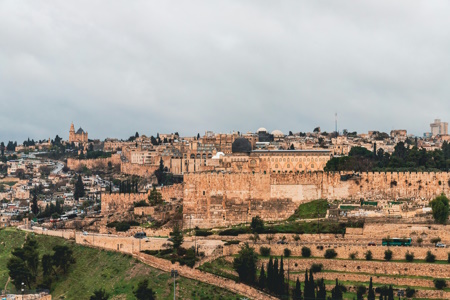
    Photo via Виктор Соломоник at pexels.com

    Ancient Cave Burial Reinterpreted as Herodian Royal Tomb

    A cave southwest of Jerusalem, long venerated as the burial site of Salome, the midwife of Jesus, is now believed by archaeologists Vladik Lifshits and Nir-Shimshon Paran to be the tomb of a Herodian royal, possibly King Herod the Great’s sister, also named Salome. The site’s monumental architecture and ornate features align with elite Herodian-era tombs. Rediscovered in the 1980s, the cave contained hundreds of oil lamps, likely sold to Byzantine Christian pilgrims. While an ossuary inscribed with the name Salome was found, the name’s commonality necessitates further evidence to confirm the tomb’s occupant. – From Live Science


    Evidence of Garden at Crucifixion Site Unearthed

    Italian archaeologists from Sapienza University have uncovered 2,000-year-old grape and olive traces beneath the Church of the Holy Sepulchre in Jerusalem, traditionally identified as the site of Jesus’s crucifixion. This discovery supports the Gospel of John’s account of a garden at the crucifixion site. Soil and pollen analyses revealed ancient grape pips and olive stones, indicating cultivation before Emperor Hadrian’s reign, aligning with the time of Christ. The excavation, part of a restoration project begun in 2022, has been conducted with sensitivity due to the site’s religious significance, involving collaboration among major Christian denominations and the Israel Antiquities Authority. – From the New York Post


    3,800-Year-Old Canaanite Scarab Found by Toddler

    At Tel Azekah in Israel’s Shephelah region, a 3-year-old named Ziv Nitzan discovered a 3,800-year-old Canaanite scarab amulet during a family outing. The artifact, shaped like a dung beetle and dating to the Middle Bronze Age, was verified by expert Daphna Ben-Tor as a seal used for religious or status purposes. Scarabs held sacred symbolism in ancient Egypt, representing life and creation. Tel Azekah is historically notable for its biblical association with the story of David and Goliath. The find underscores the site’s historical richness and provides a tangible link to the ancient past. – From the New York Post


    Subatomic Imaging Reveals Hidden Structures in Ancient Jerusalem

    A team of Israeli archaeologists and physicists has employed muon detectors—devices that utilize cosmic-ray muons—to non-invasively explore subterranean structures in ancient Jerusalem. Focusing on “Jeremiah’s cistern” near the City of David, the detectors have begun mapping hidden voids and structural anomalies beneath the surface. This innovative approach allows researchers to investigate areas that are otherwise inaccessible due to practical and political constraints, offering new insights into Jerusalem’s 5,000-year history without the need for destructive excavation methods. – From Christianity Today

    Watchdog Alert: Spiritual Awakening, Biden, And More

    Political Leaders Pray for Biden

    From Crosswalk – Former President Joe Biden has been diagnosed with an aggressive form of prostate cancer, prompting prayers from leaders across the political spectrum.

    Baptize California Movement

    From Crosswalk – A pastor in California claims the U.S. is on the verge of a spiritual awakening, with plans for a massive baptism event.

    Brazilian Evangelicals and Politics

    From Christianity Today – Evangelical supporters of former Brazilian President Jair Bolsonaro continue to back him despite accusations of an assassination plot.

    Decline of Christianity in the U.S.

    From Pew Research – Pew Research study suggests that the decline of Christianity in the U.S. has slowed and may have stabilized at around 62% of the population.

    G3 Ministries Controversy

    From Christianity Today – Pastor Josh Buice resigned after his church uncovered divisive online behavior, leading to the cancellation of an upcoming conference.

    Rethinking The Rapture: More Questions

    According to the standard Evangelical/Dispensational Rapture doctrine, the Rapture occurs before the apocalyptic events of the Book of Revelation begin to unfold.

    So why is the Rapture not explicitly mentioned in Revelation, not even once?

    Why would the most shocking, impactful, and monumental event (supposedly) in the Bible and in human history; an event that miraculously and suddenly removes millions of people from the earth triggering the beginning of a worldwide apocalypse, not be mentioned at all in the book of the Bible called the Apocalypse?

    Yes, I’m aware of the interpretations of Revelation 4:1-2, where John is called up to heaven, supposedly being a symbolic reference to the Rapture. I’m not buying it though. That kind of handling of the Word is a perfect example of reading a preconceived notion into scripture rather than letting scripture speak for itself.

    To speculate that Revelation 4:1, where John heard a voice that said, “Come up hither, and I will shew thee things which must be hereafter…” is referring to the Rapture seems to me a weak, almost desperate, argument. And the same for the ‘missing church’ argument that claims the absence of the Greek word for ‘church’, ekklesia, after Revelation chapter 3 implies a Rapture occurs somewhere between chapter 3 and 4.

    The Rapture is not mentioned at all in the Book of Revelation. Why?

    More to come in this ongoing series, “Rethinking The Rapture”.