Rethinking The Rapture: Send In The Clouds?

R.T. France’s interpretation of the “Son of Man coming in clouds”

R.T. France, who passed away in 2012, was a respected New Testament scholar and commentator who interpreted Mark 13:26 and Mark 14:62 as references not to a future, visible second coming of Jesus, but to His heavenly vindication and enthronement, drawing heavily on Daniel 7:13 and the literary/theological context of Jewish apocalyptic imagery.

Following is a summary, enhanced by Mr. AI, of France’s view.

Mark 13:26 – “Then they will see the Son of Man coming in clouds with great power and glory.”

  • France’s View: This is not a literal, visible return of Jesus to earth.
  • He argues that Jesus is drawing on Daniel 7:13, where the Son of Man comes on the clouds to God (the Ancient of Days)—not to earth.
  • Therefore, this “coming” is not about return, but about the transfer of authority and the vindication of Jesus after His suffering and death.
  • “They will see” should be understood figuratively, meaning people (particularly those who rejected Jesus) will recognize the consequences of His vindicated status, especially through:
    • The destruction of the temple (A.D. 70),
    • The spread of the gospel,
    • And the judgment upon Jerusalem.

🔹 “The ‘coming’ of the Son of Man in clouds is an enthronement scene, not a return-to-earth scene.”
— R.T. France, The Gospel of Mark, NICNT (2002)


Mark 14:62 – “…you will see the Son of Man seated at the right hand of Power, and coming with the clouds of heaven.”

  • France sees this as a prophetic declaration of vindication, spoken directly to the high priest and the Sanhedrin.
  • The phrase “seated at the right hand of Power” implies divine authority, referring to Psalm 110:1.
  • “Coming with the clouds” again echoes Daniel 7:13, but not in the sense of descending from heaven. Instead, it describes Jesus’ ascension to divine status and authority.
  • The Sanhedrin would “see” this through the events that followed: Jesus’ resurrection, the birth of the church, and the judgment on Jerusalem.

🔹 “Jesus’ response is a claim not of eventual return, but of imminent exaltation… a challenge to those who are about to condemn Him.”
— R.T. France, The Gospel of Mark, NICNT


Summary of France’s Key Points

PhraseInterpretation
“Coming on the clouds”Danielic imagery of heavenly exaltation, not return
“They will see”Figurative: people will recognize the implications of Jesus’ divine authority
Mark 13:26Public vindication of Jesus as the Son of Man, seen through judgment and gospel progress
Mark 14:62A warning to the high priest: the one they condemn will soon be exalted over them

Rethinking The Rapture: Introduction

Rethinking The Rapture: Questions

Rethinking The Rapture: More Questions

Rethinking The Rapture: N.T. Wright’s ‘Farewell to the Rapture’

Rethinking The Rapture: What 1 Thessalonians 4:16-17 Doesn’t Say

Rethinking The Rapture: Millions Of Christians Were Not Delivered From Wrath

Rethinking The Rapture: What Does ‘Delivered From Wrath’ Mean?

Rethinking The Rapture: What Does ‘Delivered From Wrath’ Mean? Part 2

Rethinking The Rapture: In The Twinkling Of An Eye

Rethinking The Rapture: Matthew 24:40-42

Rethinking The Rapture: N.T. Wright’s ‘Farewell to the Rapture’ Redux

They Said It: Quotes About The Apostle Paul

They Said It is a regular feature from Bible Rebel, highlighting quotes from various folks on various topics of interest and relevance to our readers. Here are some memorable quotes about the Apostle Paul – the one from Thomas Jefferson is especially interesting.

Martin Luther (German Reformer):
“The epistles of Paul are the clearest gospel of all. He deals with the true essentials of Christian doctrine with such simplicity, clarity, and depth that they must be treasured above all other writings.”


    John Chrysostom (4th-century Church Father):
    “Put the whole world on one side of the scale, and you will see that the soul of Paul outweighs it.”


      David Hume (Scottish Enlightenment philosopher, skeptic of religion):
      “The conversion of Paul… is a strong proof of the truth of Christianity.”
      (Paraphrased from his Essay on Miracles, where he acknowledges Paul’s radical transformation as a historical argument worth serious consideration.)


        Thomas Jefferson (3rd U.S. President):
        “Paul was the first corrupter of the doctrines of Jesus.”
        (From a letter to William Short, 1820. Jefferson admired Jesus’ moral teachings but believed Paul distorted them with dogma.)

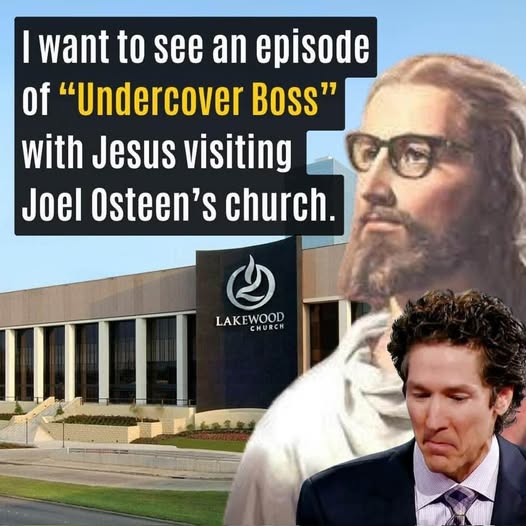
          Osteen Vs. Jesus

          The other day I came across the meme I’m using for this post and it reminded me of a previous series I did on the ‘Prosperity Gospel’ and the ‘Health And Wealth’ theology. So I want to revisit and focus on one of the subjects of that series – Joel Osteen.

          Who is Osteen?

          Joel Osteen, the senior pastor of Lakewood Church in Houston, Texas, has an estimated net worth that varies across sources. Some reports suggest his net worth is around $100 million (Celebrity Net Worth), while others estimate it to be approximately $40 million to $60 million (Wikipedia).

          Additionally, some sources claim his net worth is as high as $180 million (CA Club India).

          Osteen resides in a 17,000-square-foot mansion valued at $10.5 million in the River Oaks neighborhood of Houston. He has stated that he does not receive a salary from Lakewood Church, which has an annual budget of $70 million, relying instead on income from his best-selling books and related products (Wikipedia).

          But What did Jesus teach?

          Well, it seems pretty clear to me—or to anyone else with a lick of common sense—that when Jesus said in Matthew 6:33, “But seek first the kingdom of God and His righteousness, and all these things shall be added to you…” He didn’t have $10 million mansions, private luxury jets, and massive piles of cash in mind.

          But what did He have in mind? Read the context:

          Matthew 6:25–34 (NKJV)
          “Therefore I say to you, do not worry about your life, what you will eat or what you will drink; nor about your body, what you will put on. Is not life more than food and the body more than clothing?
          26 Look at the birds of the air, for they neither sow nor reap nor gather into barns; yet your heavenly Father feeds them. Are you not of more value than they?
          27 Which of you by worrying can add one cubit to his stature?

          28 So why do you worry about clothing? Consider the lilies of the field, how they grow: they neither toil nor spin;
          29 and yet I say to you that even Solomon in all his glory was not arrayed like one of these.
          30 Now if God so clothes the grass of the field, which today is, and tomorrow is thrown into the oven, will He not much more clothe you, O you of little faith?

          31 Therefore do not worry, saying, ‘What shall we eat?’ or ‘What shall we drink?’ or ‘What shall we wear?’
          32 For after all these things the Gentiles seek. For your heavenly Father knows that you need all these things.
          33 But seek first the kingdom of God and His righteousness, and all these things shall be added to you.
          34 Therefore do not worry about tomorrow, for tomorrow will worry about its own things. Sufficient for the day is its own trouble.”

          You don’t need an advanced degree in theology or philosophy to understand the plain words spoken by our Lord here. All you need is basic reading comprehension.

          What things “shall be added to you”? Mansions? A fleet of luxury fishing boats? A hoard of gold coins? No—the “things” are the necessities of life, like food and clothing.

          Does He teach that you can’t or shouldn’t have more than the necessities? No—but our Lord’s message is clear: the desire for God’s righteousness is muddied and distorted when we focus on the riches of this age instead of His kingdom.

          It’s impossible to have total reliance on God when one has lots of cash, cars, jets, and Swiss bank accounts to fall back on—right?

          Watchdog Alert: Wars And Rumors Of Wars

          Here is Jesus, in Matthew 24:6-7, teaching his disciples about the end times. But also encouraging them to ‘see that ye be not troubled’.

          And ye shall hear of wars and rumours of wars: see that ye be not troubled: for all these things must come to pass, but the end is not yet. For nation shall rise against nation, and kingdom against kingdom: and there shall be famines, and pestilences, and earthquakes, in divers places.” (KJV)

          Much of what our Lord was prophesying here had to do with the coming destruction of Jerusalem and the Jewish Temple, which would happen within 40 years or so of this prophesy and his imminent death and resurrection.

          However there is no reason not to consider that he was also making a double prophecy, which is fairly common in the Bible, extending the meaning here to also warn of the time immediately preceding the Final Judgement, which is still future as of this blog post.

          Let’s remember, though, that people and nations in all times and places have experienced wars, famine, earthquakes, and pestilence. This prophecy is referring to a specific people in a specific place and time(s)- the people are those disciples living in the place, Jerusalem and Judea, at the time preceding the destruction of the Temple in 70 AD and also in some future time right before The End.

          Even so, as watchdogs living in this time and place we should always keep our ears tuned ‘rumors of wars’ and be aware of the seasons of God’s plans and purposes.

          So here is a brief recap of some of the international war news happening right now.

          U.N. Security Council Calls for Peaceful Dispute Resolution

          On July 22, 2025, the U.N. Security Council adopted a Pakistan‑drafted resolution urging all member states to resolve disputes peacefully through negotiation, mediation, or arbitration under the U.N. Charter. Secretary‑General António Guterres highlighted crises in Gaza, Ukraine, Sudan, Haiti, and Myanmar, warning of record hunger and displacement. The resolution emphasized renewed trust in multilateral diplomacy.
          From The AP


          Israel Implements “Tactical Pauses” & Opens Aid Corridors in Gaza

          In response to mounting international pressure over famine in Gaza, the Israeli military has initiated daily “tactical pauses” in combat and established humanitarian corridors for aid delivery. Pauses are set from 10 a.m. to 8 p.m. in specific zones, and corridors operate from 6 a.m. to 11 p.m. each day. Aid groups welcomed the move but cautioned it may not meet critical needs.
          From Financial Times


          Israel Resumes Humanitarian Airdrops into Gaza Amid Crisis

          Also on July 26, 2025, amid worsening famine conditions, Israel and the UAE resumed airdrops of humanitarian assistance into Gaza. Aid organizations criticized the method as inadequate and urged Israel to lift its blockade and allow unrestricted ground access. Meanwhile, civilian casualties mount—with over 60,000 Palestinians reported killed and approximately 2 million displaced since October 2023.
          From The Guardian


          Cambodia–Thailand Border Conflict Escalates; U.S. Mediator Steps In

          An armed conflict between Cambodia and Thailand has escalated since late May 2025, resulting in at least 32 deaths and displacing up to 200,000 people along their shared border. On July 26, former U.S. President Trump intervened—calling both leaders and demanding a ceasefire, even threatening tariffs on trade if hostilities continue.
          From Wikipedia


          Cease Not To Pray: Part 4

          Editors note: the guest article appearing here does not necessarily reflect the views of Bible Rebel editors or other guest authors and contributors. Bible Rebel seeks to present a wide range of ideas and viewpoints in order to fulfill our mission to provide resources for “Curious Fearless Faith”. This is the fourth and final part in a new series on prayer called ‘Cease Not To Pray’ by Steve Sann.

          Cease Not To Pray: Part 1
          Cease Not To Pray: Part 2
          Cease Not To Pray: Part 3


          GLOBAL INTERCESSION: A Study of Romans 8:26-28

          Conceivably, there are countless matters around the world for which God would have us to pray, about most of which we are abysmally ignorant. Admittedly, at any time—even in our own lives—critical issues go neglected because we are woefully unaware. How could we possibly know all the events of tomorrow that yearn for prayer today? Unmistakably, this is our greatest prayer weakness. But now God has enabled us to articulate these critical prayers that we, heretofore, were powerless to utter. Bypassing the limitations of our senses, we can now lift to God the burdens that He Himself would have us pray for.

          Watch as Romans 8:26-28 unfolds these very truths: Romans 8:26: Likewise, the Spirit also helps in our weaknesses [literally, “weakness” – being singular in the text]. For we do not know what we should pray for as we ought, but the Spirit Himself [or, “itself” in KJV] makes intercession for us with groanings which cannot be uttered.

          Our weakness places us at a distinct disadvantage: we do not know what to pray for “as we ought”— or, literally “as we must.” Why must we know what to pray for? Because, if you don’t know what to pray for, you can’t pray for it—right? So, praying solely with our understanding leaves scores of specific needs unaddressed.

          For example, how would you possibly know that a financial crisis is looming only months ahead that could downsize your industry and devalue your profession, sending thousands of unemployed into the streets? Wouldn’t you want God working on your situation far in advance? Even perhaps opening the door into a more secure income stream long before?

          Or, how could you possibly know to pray today to protect your loved ones from a freeway winter storm pile-up that threatens to kill or injure dozens of motorists? They need to not be on the freeway at that moment—but who’s going to make that intercession? Or, would you like the right people at just the right time to notice your talents, elevating you to new opportunities? Who better than God knows exactly when those “right times” really are?

          These are prayers best prayed in the spirit. Romans 8: 27: Now He who searches the hearts knows what the mind of the Spirit is, because He makes intercession for the saints according to the will of God. Verse 27 hammers home that the spirit enables us to intercede not only for ourselves, but for God’s people the world over. By the spirit you will be praying for the specific needs of specific people. You may not know them, but rest assured the Father does, and He is the one giving you the words. Moreover, the spirit intercedes for the saints literally “according to God”—with God’s actual words, as the spirit’s function is to speak verbatim that which has been received, (John 16:13).

          Do you see why the centerpiece of the Church, the responsibility which is bedrock to all others, is that of the intercessor? These are the warriors upon which all church achievement is reliant. Without the intercessors calling in God’s involvement, the wheels of church advancement rumble to a standstill. Armed with SIT, a basic, critical component to the armor of God, these prayer warriors clear the way for God’s ministers to enter into the fray, (Ephesians 6:13-20).

          Do you seek to find your calling in the church? God is looking for men and women right now who can pick up the calling to become intercessors for His people. There is not a single, more vital, more urgent job within the church. Romans 8:28 follows on the heels of verse 27 continuing in this context of prayer and intercession by the spirit: Romans 8:28: And we know that all things work together for good to those who love God, to those who are the called according to His purpose.

          To obtain a promise from God that all things will work together for good would certainly be exhilarating for anybody. Yet, have we understood this promise in its actual context? The “good” received in verse 28 is a result of the “intercession” in the spirit given in verse 27! Of course—that makes perfect sense, doesn’t it? Good things just don’t happen to good people. For it is only by our intercession for all things in life do all things work together for our good. Speaking in tongues is what makes that kind of global intercession available at your fingertips.

          Furthermore, verse 28 points out that those whose love for God are those who are called—and subsequently answering the call by walking—according to His purpose. Again, in regards to intercessory prayer, the context immediately preceding clearly states God’s purpose for us.

          For those of us who live this prayer lifestyle, this verse promises that, in the end result, we will prosper. In my life, each road to success is fraught with the hazards of the unexpected. Nonetheless, in the very end, I always believe God’s good is mine to obtain. That is precisely the promise. You see if you are confident that the war is yours to win, would you let battles lost along the way discourage you? No—lost battles are often just “the cost of doing business.” And, my friend, you must be willing to pay the cost of doing business. It’s the persistent folk in life who reap the rewards—armed with prayer in the spirit, coupled with the wisdom of life and sheer determination.

          Subscribe To Our Newsletter

          Please take a minute to subscribe to the Bible Rebel monthly newsletter – it’s free and will keep you up-to-date on all our articles, videos, and features.

          Our Mission at Bible Rebel

          1. To monitor current news and events related to faith and culture.
          2. To provide an alternative viewpoint to the world’s pervasive climate of darkness, nihilism, and hopelessness for those seeking truth, light, and purpose.
          3. To examine and question the assumptions of religious tradition and provide a resource for information and inspiration for people of faith who have become dissatisfied with an increasingly lifeless and empty ‘churchianity’.
          4. To present the Biblical truths which reveal God’s nature and purposes and proclaim the lifechanging, world-altering, radical message of Yeshua the Messiah – Jesus Christ, our risen Lord and Savior.

          At Bible Rebel, this is our one and only creed:
          Our living God is a loving God and the Bible is His revealed word and will.
          Our hope and eternal salvation relies entirely on the work of God’s only begotten son, Jesus Christ, who is the way, the truth, and the life.

          So, expect some controversial viewpoints and uncomfortable ideas in some of the coming content from Bible Rebel.


          June And July Highlights

          Rethinking The Rapture: What Does Delivered From Wrath Mean?

          Rethinking The Rapture: What Does Delivered From Wrath Mean? Part 2

          They Said It: Quotes About Luther And The Reformation (A new feature from Bible Rebel)

          Who Cares: One-Minute Video Message

          Ten-episode Bible 101 video series completed

          Watchdog Alert: Biblical Archaeology News

          Why Must We Pray, Anyway: Part 4


          Coming in July and August

          Continuing the “Rethinking The Rapture” series.

          More in-depth content on deeper biblical studies and theological issues.

          You can find all of the current Bible 101 episodes and One-Minute Mini Messages here on our YouTube Channel, and you can subscribe to our YouTube channel here.

          We’ll also be continuing our regular features and guest articles and series:

          • Rethinking The Rapture
          • They Said It
          • Guest articles
          • And more…

          Watchdogs

          As always, we’ll be keeping a watchdogs eye on all of the latest political, religious, biblical archaeology, and cultural news and events from around the world and bringing to you in bite-size chunks to keep you informed.


          Finally, are you interested in contributing content to Bible Rebel?

          Bible Rebel is always looking for interesting, compatible content for our biblerebel.com website/blog. We are accepting writing and video submissions for review and possible publication on our platform.

          If you have a teaching series, opinion piece, research piece or other content that fits with the Bible Rebel mission we’d like to see it!

          If your content fits our mission and creed, included below, then email it to us at in**@********el.com. Written pieces should be no more than 500 words and video content no longer than 7 minutes – either can be submitted as part of a longer series for consideration.

          Thanks, and stay tuned for the next newsletter in August.

          Oh, and please go over and give us a follow on Facebook and X (formerly Twitter).

          Rick Tryon
          Editor/Publisher
          Bible Rebel & biblerebel.com

          Cease Not To Pray: Part 2

          Editors note: the guest article appearing here does not necessarily reflect the views of Bible Rebel editors or other guest authors and contributors. Bible Rebel seeks to present a wide range of ideas and viewpoints in order to fulfill our mission to provide resources for “Curious Fearless Faith”. This is Part 2 in a new series on prayer called ‘Cease Not To Pray’ by Steve Sann.

          Cease Not To Pray: Part 1


          THE MOUNTAIN PASS

          B.G. Leonard, one of the great 20th-century evangelists, once related the account of a woman who loyally prayed in the spirit, interceding for others. Seldom, when called upon by God to pray, would she comprehend what she was called to pray for; speaking in tongues, she was unable to understand her prayer.

          One afternoon, however, while lifting in prayer an urgent burden God had placed on her heart, she asked: “Lord, I’ve often thought of this, and it’s in my heart now and I might just as well be honest and tell you, Lord… I often wonder, what am I praying about? I know our understanding is supposed to remain unfruitful, but just this once, I’d like to know. Because sometimes the thought comes to me that maybe I’m just kidding myself.”

          On this occasion, a vision was immediately unfolded before her eyes—a scene illustrated with childlike stick-men. God began to reveal to her, in a cartoon-like depiction, a large stick man working on a funny-looking stick truck. Soon he was joined by three other stick-men donning triangle stick hats. One of them stood out, wearing a peculiar mark down his side at an angle.

          As she watched and prayed, confronted by the three, the large stick man fixing the truck stopped, turned, and began handing over his personal goods. However, an argument soon erupted among the three. But placing his hand on the peculiar stick by his side, the other two backed away. The woman was continuing to pray in the spirit when suddenly the scene around the men was filled with stick angels! The three-stick men hastily took flight. The big stick man then fell to his knees, and the woman ascertained he was thanking God. The curious vision came to an end, and many weeks went by.

          One day, the popular missionary A.B. Simpson, founder of Christian Missionary Alliance, was slated to return from his most recent work in China. The praying woman traveled to the San Francisco Bay, eagerly anticipating hearing him address the waiting crowd from aboard his ship. As A.B. Simpson recounted his exploits in China, he described a new missionary work he was opening in a village across a mountain range, which cut it off from the rest of the country. Sending his family safely ahead aboard a train routed around the mountain, he loaded up his old charcoal-burning truck with the supplies needed for the new missionary station, and headed up the most direct route—straight over the pass.

          At his very last stop before entering the pass, an innkeeper sternly warned Simpson of armed bandits ahead. Simpson swept the warning aside, declaring proudly, “God looks after me”. Venturing undaunted into the mountain pass, he found himself in a dangerous place just as his old charcoal burner cut out and the truck stalled. Struggling to relight the engine, without warning he found himself face-to-face with three bandits, one wearing a sword at his side. He handed over his watch and his wallet, thinking he was getting off quite lightly.

          That’s just about the time the armed bandit reached for his sword, prepared to kill him. But rebuffing him, the two others argued that, if he killed Simpson, who would drive the truck with the supplies? They squabbled back and forth until the armed bandit had heard enough. Brandishing his sword, he made his move to kill not only Simpson, but his companions in crime, as well. Just then A.B. Simpson looked up in astonishment—the entire mountain pass was teeming with angels! The robbers were dumbfounded at the sight of this supernatural spectacle, the men fled, scared stiff, “screaming their heads off!”

          Then Simpson recalled, “And I got down on my knees and I prayed, and I asked God to forgive me for tempting Him. I understood at last what I had done wrong.” He rejoiced, “From then on I had no trouble “

          Later, regarding that woman of prayer, B.G. Leonard observed: “She knew then what she had been praying for. And after, when she spoke in tongues, she was twice the prayer warrior she had been before. If she told somebody, ‘Look, I’ll be standing behind you in prayer,’ she didn’t just say the words. She meant it.”

          Rethinking The Rapture: Matthew 24:40-42

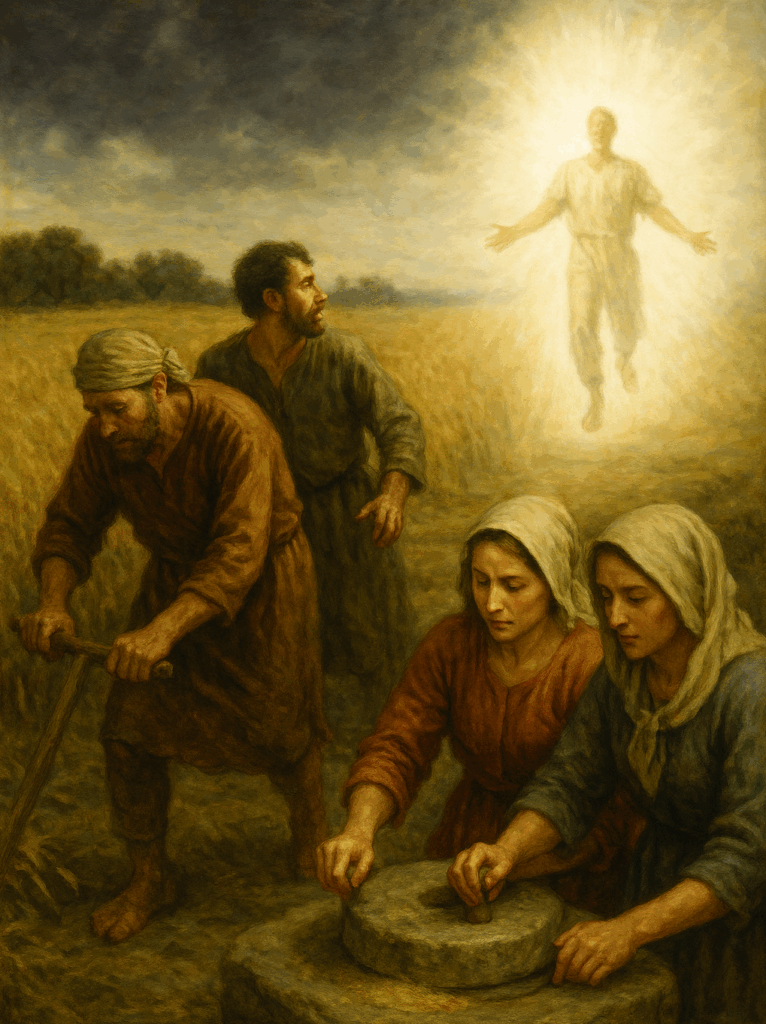
          Let’s return to an earlier post in this Rethinking the Rapture series, where I raised a question concerning the words of Jesus in Matthew 24: “One will be taken and one left.”

          Matthew 24:40–42 (KJV):

          “Then shall two be in the field; the one shall be taken, and the other left.
          Two women shall be grinding at the mill; the one shall be taken, and the other left.
          Watch therefore: for ye know not what hour your Lord doth come.”

          Would the disciples, to whom Jesus was speaking those words at that time and in that place, have understood Him to be referring to a future Rapture of the Church—where some people would disappear into the sky in a secret event, while their walking or working companions would be left behind on earth?

          The context strongly suggests that they would not have understood His words to mean a future Rapture.

          The immediately preceding verses, 37–39, compare the coming of the Son of Man to the days of Noah, when people were eating, drinking, and marrying—until the flood came and took them all away.

          Plainly, the ones who were “taken” were those swept away in the flood in judgment. The ones left behind were Noah and his family, who were spared and remained on the earth to begin anew after the flood judgment.

          Understanding this context should make it crystal clear who Jesus was referring to in Matthew 24:40–42 when He said, “One will be taken and one left.” The one taken is taken in judgment, not in a Rapture. And the one left remains to experience the blessings of the Kingdom—not the punishment of woe and tribulation.

          Rethinking The Rapture: Introduction

          Rethinking The Rapture: Questions

          Rethinking The Rapture: More Questions

          Rethinking The Rapture: N.T. Wright’s ‘Farewell to the Rapture’

          Rethinking The Rapture: What 1 Thessalonians 4:16-17 Doesn’t Say

          Rethinking The Rapture: Millions Of Christians Were Not Delivered From Wrath

          Rethinking The Rapture: What Does ‘Delivered From Wrath’ Mean?

          Rethinking The Rapture: What Does ‘Delivered From Wrath’ Mean? Part 2

          Historical Facts And Background Of American Independence Day

          Independence Day in the United States, commonly known as the Fourth of July, commemorates the adoption of the Declaration of Independence on July 4, 1776. On that day, the thirteen American colonies formally declared their independence from Great Britain, marking the birth of the United States of America.

          Colonial Tensions with Britain

          • In the 1700s, the American colonies were governed by Great Britain, which imposed increasing taxes and trade restrictions.
          • Key grievances included:
            • The Stamp Act (1765) and Townshend Acts (1767) taxing colonists without representation in Parliament.
            • The Boston Massacre (1770) and Boston Tea Party (1773) intensified colonial resistance.
            • Britain’s harsh response to colonial protests further fueled revolutionary sentiment.

          Move Toward Independence

          • In 1774, the First Continental Congress met to protest British policies.
          • Fighting began in April 1775 with the Battles of Lexington and Concord—the start of the Revolutionary War.
          • In 1776, momentum grew for a complete break from Britain.

          Declaration of Independence

          • Drafted primarily by Thomas Jefferson, the Declaration was debated and revised by the Continental Congress.
          • It was officially adopted on July 4, 1776, in Philadelphia, Pennsylvania.
          • The document declared the colonies free and independent states and outlined Enlightenment ideals of liberty, equality, and the right to self-government.

          Why July 4th?

          • July 4 is the date the final version of the Declaration was formally approved by Congress.
          • However, the actual signing occurred over the next few weeks and months.
          • John Adams, who advocated for independence, expected July 2 (when Congress voted for independence) to be the celebrated date, but July 4 became the tradition.

          Early Celebrations

          • The first Independence Day celebrations included:
            • Public readings of the Declaration.
            • Parades, bonfires, and cannon fire.
            • Celebrations symbolized unity and defiance against tyranny.
          • By the early 1800s, July 4 had become the most important secular holiday in the U.S.

          Becoming a National Holiday

          • Independence Day was declared a federal holiday in 1870.
          • It became a paid holiday for federal employees in 1938.