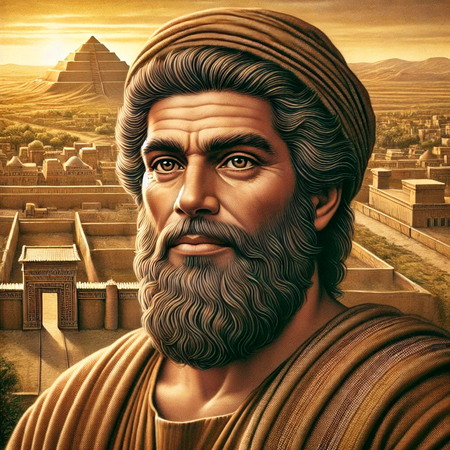
Your Life And What Comes After (19): 4 Ways To Plug Into God’s Grand Plan

God’s plan worked through Israel and through key people in the Old Testament, like Abraham, Moses, and King David. But what did these people do that put them right in the middle of God’s plan? And how can we do the same in our own lives?

Here are four ways we can plug into God’s grand plan.

Seek God first.
Learn what He wants through prayer and study. Pay attention to how He speaks—through Scripture, wise people, and everyday moments. Then follow where He leads.

Add value to the world around you.
Grow your knowledge, skills, and talents, and use them for the right purposes and to do good in God’s creation.

Do hard things without fear.
Don’t always choose what’s easy or comfortable. Be willing to challenge bad habits and wrong thinking, starting with yourself.

Fight darkness with light.
Don’t just ignore what’s wrong. Stand against it by helping people in your family, faith, and community find hope, care, encouragement, and challenge.

Abraham

Abraham is known as the father of the Jewish people. God chose Abraham and promised to give him many descendants, land for his people, and that through his family all nations of the world would be blessed.

Read this passage from Genesis 12:1-5 (he was called Abram before God named him Abraham) and see if you can find the ways Abraham plugged into God’s plan and if they line up with the four ways we just looked at:

Here’s some of what I see in these verses:

Seek God first
God spoke directly to Abram and told him to go to a new land. Abram was listening for God and he responded in faith. Genesis 12:1

Add value to the world
Notice in verse 5, “all their substance that they had gathered…”. Abram was a successful livestock owner who moved with his flocks and herds and used his “substance” to feed, clothe, and add value to the world around him, and to have the means to go where God led him. Genesis 12:5

Do hard things without fear
Abram left his country, relatives, and father’s household—everything familiar—to follow God into the unknown. Genesis 12:1, 4

Fight darkness with light
By obeying God, Abram became part of God’s plan to bring blessing, hope, and goodness to the world along with his wife, nephew, and community of, “souls that they had gotten in Haran”, knowing that we are to shine light first among those closest to us. Genesis 12:3-5

More of Abraham’s (Abram’s) life and story are found in the book of Genesis, chapters 12–25.
Your Life And What Comes After (18): How God Carries Out His Plan

How does God carry out His big plan?
He does it through people.

Which people?

First, His chosen people—Israel—as we see in the Old Testament.

Then, the promised Seed from Genesis 3:15—Jesus Christ—revealed in the New Testament Gospels.

And now, in our time, it’s you and me—the Church—as we read in the rest of the New Testament.


Israel

From the Old Testament up until the birth of Jesus, Israel played a special role in God’s plan. But God’s plan was never just about one nation—it was always about rescuing the whole world (Genesis 12:3; Isaiah 49:6).

Israel was like a delivery vehicle God drove through history to bring the Messiah, Jesus, into the world as Savior.

Along the way, Abraham got on board by trusting God’s promise, even when it didn’t make sense.

Moses rode along by leading Israel out of slavery, showing God’s power and faithfulness.

King David became a passenger too, pointing ahead to the true King who would come from his family line. All of them played their part as God moved His plan forward.

But what we really want to get to is how those guys and gals in the Old Testament discovered their own purpose and best lives by plugging into God’s bigger plan, so that we can learn how to do the same in our own lives.

Stay tuned.

Abraham – And The Greater Vision

Often, looking at the stars, contemplating how many I can’t see in the middle of town with street lights all around, I think about God’s promise to Abraham that his seed would be as numerous as the stars. If you’ve ever been out in the desert at night, away from population, if you’ve ever been up in the mountains in a place like Montana, the enormity, the immensity, the sheer number of stars is wondrous. You can’t really imagine it unless you’ve seen it. So many stars stretching through the Milky Way alone that it looks like a sheet of soft light spread across the sky. Spilled milk. The Way of Milk.

Yet the Apostle Paul notes that the promises of God to Abraham were to his seed – not as of many seeds, but as of ONE seed, who is the Lord Jesus, the Christ.

Galatians 3:16 KJV
Now to Abraham and his seed were the promises made. He saith not, and to seeds, as of many; but as of one, And to thy seed, which is Christ.

So how are we included in God’s promise to Abraham? As many as believe on Christ, The Seed, are welcomed under the umbrella of Abraham’s seed by faith and we represent that vision of stars stretching through the Milky Way and beyond.

Galatians 2:7 KJV
Know ye therefore that they which are of faith, the same are the children of Abraham.

In this Biblical account of the exchange between God and Abraham, God gets Abraham to look up, and in effect, to get a greater vision for his life and purpose. Many success-oriented coaches teach that if we want to be truly successful in life, we need to get our vision up.

One of the great phrases I heard years ago from such coaches (probably Jim Rohn) was to set a goal so big it scares you. The reason? You have to grow up into the goal to achieve it.

So there I am this week, reading through these excerpts in the Bible, pondering the beauty of being part of the family of Christ, welcomed in as Abraham’s seed through Christ, and I was inspired to read Psalm 2.

Psalm 2:7-8 KJV
(7) I will declare the decree: the Lord hath said unto me, Thou art my Son; this day have I begotten thee.
(8) Ask of me, and I shall give thee the heathen for thine inheritance, and the uttermost parts of the earth for thy possession.

It came to me, that as the seed of Christ through faith, God is asking us to get our vision up. The Body of Christ, the body of believers, can ask the Father to give us the heathen (the yet unsaved) as part of the inheritance of Jesus Christ, in whose inheritance we share.

Romans 8:16-17a KJV
(16) The Spirit itself beareth witness with our spirit, that we are the children of God:
(17a) And if children, then heirs; heirs of God, and joint-heirs with Christ;

God the Father is declaring that we can ask to possess the uttermost parts of the earth for Him by declaring the witness of Christ. Not a material possession, but a spiritual realm. That what Christ began and then commissioned disciples to continue, equipped with the Gift of Holy Spirit and all its manifestations, as well as the written Word, was prophesied in Psalm 2 not just for the Messiah, but for his seed. And if we can grab the vision and see the goal, what we will become in the process of trying to achieve it? Why, we will grow up into Christ, we will mature as members of his body.

You reading this must think me dull-witted! How could I have not seen this so clearly before? God is so lovely to break things down for me in the most simple terms. What is required here to get my vision up is to see the vision God already gave.

Ask of me, He says. Ask.

Watchdog Alert: Kazakhstan Signs On To Abraham Accords

The Abraham Accords are a series of agreements that normalized diplomatic relations between Israel and several Arab nations, starting in 2020 refer to formal peace and normalization agreements between Israel and the following countries:

  1. United Arab Emirates (UAE) – signed August 13, 2020
  2. Bahrain – joined September 15, 2020
  3. Sudan – announced October 23, 2020
  4. Morocco – announced December 10, 2020

The accords were brokered by the United States under the Trump administration, led by Jared Kushner and Secretary of State Mike Pompeo, and now Kazakhstan has been added to the list of participating countries as of this week.

They marked the first major Arab-Israeli peace agreements in over 25 years, following Egypt’s (1979) and Jordan’s (1994) treaties with Israel.

The name “Abraham Accords” was chosen because Abraham (known as Ibrahim in Arabic) is a biblical patriarchal figure shared by Judaism, Christianity, and Islam. So, the name highlights religious and cultural unity as the foundation for political cooperation and coexistence.

What Is Palestine? Who Are Palestinians?

Who Are The Palestinians?

There’s a very interesting and informative article published recently on the Jewish Press website by Dr. Harold Rhode titled “Most Palestinian Families Come from Immigrants from the Past Two Centuries“.

Here are a few excerpts from his piece.

Prior to 1948, the date when the Jewish state was re-established, practically the only people who referred to themselves as Palestinians were the Jews who lived there. The others there, mainly Muslim Arabs, referred to themselves as Muslims.” 

“…The modern Palestinian identity was largely invented in 1964, when the Palestinian Liberation Organization (PLO) was created.”

“…By the 19th century, much of what is now the West Bank and Gaza was sparsely populated and underdeveloped. Travelers such as Mark Twain and former U.S. President Ulysses S. Grant described the region as barren and largely uninhabited. These accounts, written without political bias, provide insight into the state of the land before the demographic shifts that followed.”

And in his conclusion to the article, Dr. Rhode states: “The historical connections between the people of Gaza, the West Bank and British Mandate Palestine are complex—shaped by centuries of migration, trade and political shifts. They are not one people, but a hodge-podge of peoples with no prior connection to pre-1948 Palestine, who settled there during the past two centuries.”

The biblical history of the region is clear – the land and the blessing were given to Abraham and his seed through Isaac by God’s covenant.

Genesis 17:18-21 (KJV) – 18 And Abraham said unto God, O that Ishmael might live before thee!

19 And God said, Sarah thy wife shall bear thee a son indeed; and thou shalt call his name Isaac: and I will establish my covenant with him for an everlasting covenant, and with his seed after him.

20 And as for Ishmael, I have heard thee: Behold, I have blessed him, and will make him fruitful, and will multiply him exceedingly; twelve princes shall he beget, and I will make him a great nation.

21 But my covenant will I establish with Isaac, which Sarah shall bear unto thee at this set time in the next year.

What Is Palestine?

The following was recently posted on the Thomas Sowell Foundation page by Mr. Sam Fregiato.

“A crash course on history of PALESTINIAN STATE:

1. Before Israel, there was a British mandate, not a Palestinian state

2. Before the British Mandate, there was the Ottoman Empire, not a Palestinian state.

3. Before the Ottoman Empire, there was the Islamic state of the Mamluks of Egypt, not a Palestinian state.

4. Before the Islamic state of the Mamluks of Egypt, there was the Ayubid Arab-Kurdish Empire, not a Palestinian state.

5. Before the Ayubid Empire, there was the Frankish and Christian Kingdom of Jerusalem, not a Palestinian state.

6. Before the Kingdom of Jerusalem, there was the Umayyad and Fatimid empires, not a Palestinian state.

7. Before the Umayyad and Fatimid empires, there was the Byzantine empire, not a Palestinian state.

8. Before the Byzantine Empire, there were the Sassanids, not a Palestinian state.

9. Before the Sassanid Empire, there was the Byzantine Empire, not a Palestinian state.

10. Before the Byzantine Empire, there was the Roman Empire, not a Palestinian state.

11. Before the Roman Empire, there was the Hasmonean state, not a Palestinian state.

12. Before the Hasmonean state, there was the Seleucid, not a Palestinian state.

13. Before the Seleucid empire, there was the empire of Alexander the Great, not a Palestinian state.

14. Before the empire of Alexander the Great, there was the Persian empire, not a Palestinian state.

15. Before the Persian Empire, there was the Babylonian Empire, not a Palestinian state.

16. Before the Babylonian Empire, there were the Kingdoms of Israel and Judah, not a Palestinian state.

17. Before the Kingdoms of Israel and Judah, there was the Kingdom of Israel, not a Palestinian state.

18. Before the kingdom of Israel, there was the theocracy of the twelve tribes of Israel, not a Palestinian state.

19. Before the theocracy of the twelve tribes of Israel, there was an agglomeration of independent Canaanite city-kingdoms, not a Palestinian state.

20. Actually, in this piece of land there has been everything, EXCEPT A PALESTINIAN STATE.”