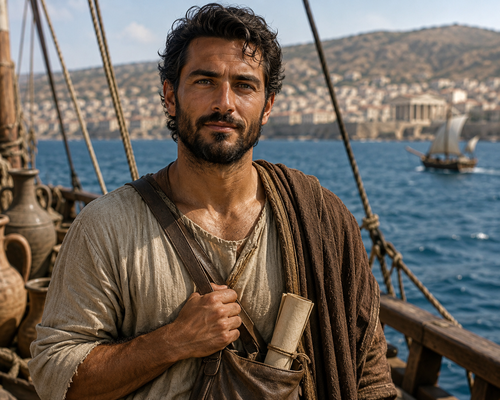
Nicanor is the main character in our short historical fiction episodes showing how the Book of Revelation may have first traveled from Patmos in the Aegean Sea in the first century to the churches in Asia Minor—and eventually to the whole world and people in every age since.
During this “Armchair Apocalypse” series, we’ll follow Nicanor on his travels to better understand the Book of Revelation by exploring the people and the times in which it was first revealed.
Nicanor heard the horses before he saw them. Hooves struck the hard Roman road north of Ephesus, and he instinctively moved aside. Four Roman soldiers appeared around the bend, mounted and armed, their cloaks shifting in the afternoon wind. Nicanor lowered his eyes and pulled his own cloak tighter around the leather-wrapped scroll hidden beneath it. John’s Revelation. If the wrong Roman decided to search him, his trip to Smyrna could end considerably sooner than planned. As the riders passed, however, another image flashed through his mind: four horses—white, red, black and pale.
Nicanor had lived long enough to know that armies rarely arrived alone. He remembered soldiers entering a village when he was younger—the shouting, terrified families, grain taken from storerooms, animals slaughtered, fields abandoned. Conquest came first. Then violence. Then hunger. Then death. Suddenly John’s strange vision didn’t seem strange at all. The white rider went forth conquering. The red rider took peace from the earth. The black rider carried scales while food became ruinously expensive. And the pale horse followed them all, carrying the simplest and ugliest name imaginable: Death.
People hearing Revelation in the churches of Asia Minor didn’t need a prophecy seminar to understand that sequence. Rome celebrated military conquest, while the feared Parthians beyond Rome’s eastern frontier were famous mounted archers—the sort of warriors John’s bow-carrying horseman could immediately bring to mind. War could devastate crops and disrupt grain supplies. John’s black horse described wheat costing about an entire day’s wage for a day’s food. Imagine working all day just to buy enough bread to survive until tomorrow. That wasn’t spooky symbolism to John’s audience. It was nightmare economics.
The soldiers disappeared down the road, leaving only dust behind them. Nicanor finally exhaled. He understood something modern readers sometimes miss: John wasn’t inventing monsters to scare people two thousand years later. He was taking realities his first readers already feared—conquest, bloodshed, famine and death—and turning them into four unforgettable riders. The imagery also reached deeper into Israel’s Scriptures, where sword, famine, pestilence and beasts were familiar images of judgment.
Nicanor touched the scroll beneath his cloak and continued toward Smyrna. Rome looked unstoppable. Its soldiers rode the roads. Its emperors ruled nations. Its armies conquered kingdoms. But in John’s vision, even the horsemen didn’t ride whenever they pleased. The Lamb opened the seals. That was the real message.
Nicanor smiled.
Rome wasn’t running history after all.
Read the Book
Your Life And What Comes After
Discover God’s plan from Genesis to eternity — and where your life fits into it.
Get It on Amazon
Child of God, husband, father, grandfather, rabblerouser, songwriter, pot stirrer, waiting for the King.