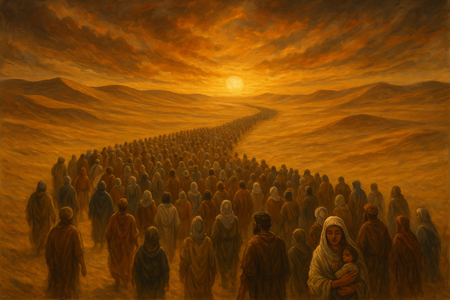
Here are some famous quotes about the second book in the Bible, Exodus.
“Exodus is the story of God’s power to deliver, not just from Egypt, but from every form of bondage.” — Charles Spurgeon
“The Exodus is the central act of redemption in the Old Testament; it is to Israel what the Cross is to the Church.” — Philip Graham Ryken
“The story of the Exodus is not only Israel’s story—it is the human story of liberation from oppression into the freedom to serve God.” — Walter Brueggemann
“In Exodus, God reveals Himself not as an idea, but as a living Redeemer who steps into history to rescue His people.” — A.W. Tozer
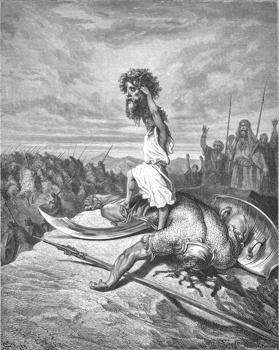
David killed Goliath. End of immediate story, right? We know David went on to become king of Israel (years later), but until recently mulling over this story, I overlooked the immediate end of the story of David and Goliath. It did not end with David and Goliath.
In fact, the beheading of Goliath was just the beginning of that story. Not only did David “get after it” by killing Goliath, the entire army of Israel had to then “get after it” by rallying to the battle and fighting the Philistines until the victory was won and the spoils of war were retrieved.
What if the army had failed to rally? Obviously the giant would have been dead but the battle would not have been won.
I don’t need to give the explanation of this lesson as a type for us. It’s enough to state the facts and allow ourselves to ponder the implications.
One final thought: King Saul offered David his armor and sword, which David refused because he had not “proved it”. The covering of men, even the king, was not going to win this fight. It was the covering of God’s goodness and grace upon David that he relied on, the strong arm of the Lord his God, rather than that of men.
I just read a great blog article by Dan Kent from a couple of years ago titled ‘Why Did David Pick Up 5 Stones?’. Good stuff, highly recommended reading, which you can find here.
Kent’s piece is a good meditation on faith and faithfulness as well as a thoughtful discussion on how God does and does not act and respond to His people in this age and broken world.
The last two sentences in the article really hit home for me:
“Don’t stand around waiting for God to act, or for God to win your battles for you: don’t stand around watching for what God might do: rather, show God what you can do. Gain wisdom, gather knowledge, develop skills, give the Lord something to use as he rumbles through the earth unfolding his glorious will.” Dan Kent – thatdankent.com
If you’re wondering what your own individual purpose in life might be and what it is that you should be doing day by day, it’s hard to find a better, more succinct admonition than, “…give the Lord something to use as he rumbles through the earth unfolding his glorious will.“
As I pointed out in a previous post in this ‘Your Life And What Comes After’ series, God created man not only to reflect His image and add value to His creation, but we are to work together with Him to do so.
We are helping the Creator bring about His grand plan for His creation. That is our purpose. Look for your own individual purpose there and you will be delighted and amazed at what you find.
Bible Rebel keeps a watchdog’s eye on discoveries and news from the world of biblical archaeology and brings it to our readers.
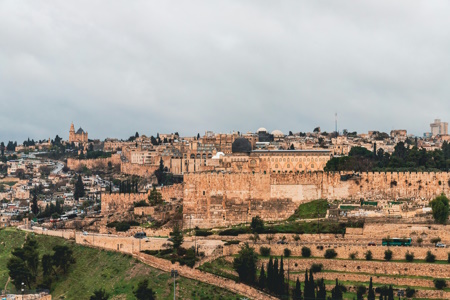
Monumental Dam Wall in the City of David (Jerusalem)
Archaeologists in Jerusalem’s City of David uncovered a massive dam wall dating to around 805–795 BCE — the era of the kings of Judah, possibly King Joash or King Amaziah. The structure measures about 12 meters high, 8 meters wide, and over 20 meters long, making it the largest such dam ever found in ancient Israel.
This discovery supports Biblical references to Jerusalem’s advanced water systems during the First Temple period, including those mentioned in 2 Kings and 2 Chronicles relating to royal construction and fortification near the Gihon Spring and the Pool of Siloam.
A large flint-blade manufacturing workshop dating to the Early Bronze Age (~3500 BCE) was discovered near Kiryat Gat in southern Israel. The site includes hundreds of underground pits, large flint cores, and finished blades — evidence of full-scale organized production.
Although the workshop predates Israelite settlement, it reflects the advanced culture of the early Canaanite inhabitants of the land. The Bible frequently references the Canaanites as the people living in the land before the Israelites (Genesis 10:15–19; Exodus 13:5), making this discovery relevant background to the Biblical setting.
In 2025, archaeologists resumed excavations at Sebastia — the ancient capital of the Northern Kingdom of Israel. They uncovered remains including a paved street leading to the main city gate, decorative columns, and a monumental base structure, marking the first major dig there in a century
Sebastia (Samaria) became the capital of the Northern Kingdom under King Omri (1 Kings 16:23–24) and is mentioned throughout the Old Testament in accounts involving later kings and prophets such as Elijah and Elisha.
Here are some famous quotes from influential faith leaders about Paul’s Epistle to the Ephesians.
John Stott (Christian theologian)
“The Letter to the Ephesians is a marvelously concise, yet comprehensive summary of the Christian good news and its implications. Nobody can read it without being moved to wonder and worship.” — John Stott, “The Message of Ephesians”
Watchman Nee (Chinese church leader)
“Ephesians tells us what the Church is in Christ. God’s greatest work is not the creation of the universe, but the creation of the Church.” — Watchman Nee, “Sit, Walk, Stand”
Charles Haddon Spurgeon (English preacher)
“There is no book more full of doctrine and experience than this brief epistle. He who would understand the mystery of the Church, let him read Ephesians.” — C.H. Spurgeon, Sermon on Ephesians
Warren Wiersbe (Bible teacher and commentator)
“Ephesians is the believer’s bank book. In it, Paul explains the wealth we have in Christ and how to use it for God’s glory.” — Warren Wiersbe, “Be Rich: Ephesians”
To monitor current news and events related to faith and culture.
To provide an alternative viewpoint to the world’s pervasive climate of darkness, nihilism, and hopelessness for those seeking truth, light, and purpose.
To examine and question the assumptions of religious tradition and provide a resource for information and inspiration for people of faith who have become dissatisfied with an increasingly lifeless and empty ‘churchianity’.
To present the Biblical truths which reveal God’s nature and purposes and proclaim the lifechanging, world-altering, radical message of Yeshua the Messiah – Jesus Christ, our risen Lord and Savior.
At Bible Rebel, this is our one and only creed: Our living God is a loving God and the Bible is His revealed word and will. Our hope and eternal salvation relies entirely on the work of God’s only begotten son, Jesus Christ, who is the way, the truth, and the life.
So, expect some controversial viewpoints and uncomfortable ideas in some of the coming content from Bible Rebel.
Coming in October/November
More in our “Your Life and What Comes After” series.
More in-depth content on deeper biblical studies and theological issues.
We’ll also be continuing our regular features, guest articles, and series:
Biblical Literacy: What the Bible does and doesn’t say
They Said It: Poignant quotes on a variety of topics
Guest articles
And more…
Watchdogs
As always, we’ll be keeping a watchdogs eye on all of the latest political, religious, biblical archaeology, and cultural news and events from around the world and bringing to you in bite-size chunks to keep you informed.
Finally, are you interested in contributing content to Bible Rebel?
Bible Rebel is always looking for interesting, compatible content for our biblerebel.com website/blog. We are accepting writing and video submissions for review and possible publication on our platform.
If you have a teaching series, opinion piece, research piece or other content that fits with the Bible Rebel mission we’d like to see it!
If your content fits our mission and creed, included below, then email it to us at in**@********el.com. Written pieces should be no more than 500 words and video content no longer than 7 minutes – either can be submitted as part of a longer series for consideration.
The Bible does not actually say that three kings brought gifts to baby Jesus.
In Matthew 2:1–12, the Bible tells us that “wise men from the east” (Greek: magoi, meaning “magi” or scholars/astrologers) came to visit Jesus after His birth. It mentions that they brought three gifts — gold, frankincense, and myrrh — but it never specifies how many magi there were, nor that they were kings.
Here’s the key verse (Matthew 2:11, KJV):
“And when they were come into the house, they saw the young child with Mary his mother, and fell down, and worshipped him: and when they had opened their treasures, they presented unto him gifts; gold, and frankincense, and myrrh.”
The Bible mentions magi (wise men), not kings.
It mentions three gifts, but not the number of visitors.
The idea of “three kings” likely came later from tradition and song (like “We Three Kings”), probably because there were three types of gifts.
Also, according to the Bible, the wise men (Magi) did not arrive at the same time as the shepherds. The shepherds came the night Jesus was born, but the Magi came later, possibly months — or even up to two years — afterward.
The Shepherds
Found in Luke 2:8–20.
The shepherds were in the fields nearby when the angel announced Jesus’ birth.
They immediately went to Bethlehem and found “the babe lying in a manger.” This clearly happened the night of Jesus’ birth.
The Wise Men (Magi)
Found in Matthew 2:1–12.
They came “from the east” after seeing a special star that signified a new king.
When they arrived, they entered a house (not a stable) and saw “the young child with Mary his mother” (Matthew 2:11).
King Herod asked when the star appeared and later ordered the killing of boys two years old and under (Matthew 2:16), suggesting Jesus could have been as much as two years old by the time the Magi visited.
Summary
Group
When They Arrived
Where They Found Jesus
Biblical Source
Shepherds
The night of His birth
In a manger
Luke 2:8–20
Wise Men
Weeks or months later
In a house
Matthew 2:1–12
So, while Christmas pageants often combine the two groups for simplicity, the Bible clearly describes two separate visits — first by shepherds, then later by the Magi.
Editors note: the guest article appearing here does not necessarily reflect the views of Bible Rebel editors or other guest authors and contributors. Bible Rebel seeks to present a wide range of ideas and viewpoints in order to fulfill our mission to provide resources for “Curious Fearless Faith”.This is the Part 2 in a new series on prayer called ‘Greater Works Than These’ by Steve Sann.
John 14:12: Most assuredly, I say to you, he who believes in Me, the works that I do he will do also; and greater works than these he will do, because I go to My Father. Can’t you just hear the squawking when you begin broadcasting you can do greater works? “What—you think you can do greater works than Jesus Christ?!” Yet, that is exactly what the Word of God declares.
So, every Christian in modern times must ask himself this question: “What are these greater works that God would have me to perform?” The evidence is found in Mark 16. Here, Jesus Christ foretold specifically of tongues: it was to be a sign of the future believers. It would be a sign simply because it would be a uniquely new work—one not yet available until after Christ’s ascension:
Mark 16:12: And these signs will follow those who believe: In My name…they will speak with new tongues. So, what then qualifies tongues as truly a greater work? Because when we speak, we bring to pass multiple accomplishments simultaneously. By means of tongues, God was able to incorporate into one work nearly all of the greatest works a man can do for God—and perform them perfectly, and simultaneously! For example:
praying perfectly,
making intercession for others,
receiving the mysteries of God,
praising and worshipping Him,
bonding with Him,
acquiring confirmation that you are a son of God…
…and this summarizes only some of the benefits. These are the greatest works believers perform before God. A single work of this magnitude was previously unachievable.
If Jesus Christ called it a “greater work”, wouldn’t that infer that he wished speaking in tongues were available in his day? And why wouldn’t he? Yet, it could not become available until he himself made the ultimate sacrifice.
Take a moment to recall some of what we would think are the super-cinematic “20th Century Fox” greatest works of Jesus Christ: raising the dead, giving sight to the blind, commanding devils out. Water into wine. Walking on water. Yet, above all these, Jesus Christ prized speaking in tongues as a “greater work.” Either we have not yet risen up to realize the raw power of tongues, or just perhaps our value scale of “greatness” is skewed.
But this we know to be certain—looking ahead to the coming of speaking in tongues, Jesus Christ foresaw its impact to be of such enormity that it was to be a “game changer” for the Church. Does it not seem astonishing to you how that which Jesus Christ so highly esteemed, his ministers today have made least significant?
But now, God has preserved this for our time, your tool to rely on throughout life’s travels. Analogous to the revolutionary cellular and internet technologies of recent decades, tongues is a convenience and a time-saver, which as you familiarize yourself with it, becomes easier and more dependable. It is truly a spiritual technological advancement. And like all newer and greater technologies, its purpose is to carry out a greater work.
Bible Rebel keeps a watchdog’s eye on discoveries in biblical archaeology and brings the information to our readers. Here are some key discoveries and why they support the biblical record.
Dam Wall from the Time of King Joash at the Pool of Siloam (~805-795 BCE)
A large dam wall in the City of David, near the Pool of Siloam, has been excavated and dated via carbon-14 to about 805-795 BCE. The walls are substantial: ~21 meters long, ~12 meters high, ~8 meters thick. Bible Archaeology Report
Why it supports biblical history:
The Bible describes several construction/repair projects by Judahite kings; a major water-infrastructure project fits in with what one might expect of a centralized Judah in that era.
The dam would have helped manage water supply in times of dryness and flooding, which matches other environmental/climate evidence from the region showing arid conditions with occasional flash floods. Bible Archaeology Report
It gives physical confirmation of large scale civic/royal activity in Jerusalem in the early 8th century BCE.
Clay Seal (“Bulla”) Inscribed with “Yeda‘yah son of Asayahu” (7th-6th century BCE)
A clay seal impression, or bulla, reading “Belonging to Yed[a‛]yah, son of Asayahu”, from the late 7th / early 6th century BCE. Found via the Temple Mount Sifting Project in soil removed from the Temple Mount area. Bible Archaeology Report
Why it supports biblical history:
The names “Asayahu” (and variations) appear in the Hebrew Bible, particularly in connection with King Josiah: 2 Kings 22:12; 2 Chronicles 34:20. Bible Archaeology Report
The bulla confirms that these names (and presumably persons with these names or offices) were in use in Judah at the appropriate period.
The preservation of writing/sealing activity supports the idea that Judah had administrative bureaucracies with literacy in the late monarchic period.
Olive and Grape Traces Beneath the Church of the Holy Sepulchre / Mount Calvary (1st Century AD Garden Context)
Under the floor of the Church of the Holy Sepulchre, archaeologists found about 2,000-year-old olive pits (stones), grape pips, pollen evidence, and remains of stone walls or features consistent with cultivation. These lie beneath a basilica, in an area associated with Golgotha / Mount Calvary, part of Jerusalem’s ancient quarter. The Times+1
Why it supports biblical history:
The Gospel of John (and other Gospels) mention that Jesus was crucified at a place called Golgotha, “place of a skull,” outside / near a garden and tomb. The presence of a garden (olive and grape cultivation) at that location in the 1st century AD gives archaeological plausibility to that Gospel description. The Times
It shows that agricultural use was present in that area just before or around the time of Jesus, rather than all being occupied by other structures.
Identification of Widespread Literacy / Use of Seals in Jerusalem ca. 2,700 Years Ago
An ancient seal discovered in the City of David area (Jerusalem), dating to the First Temple period (approx 700-600 BCE), evidences artistic craftsmanship and inscription. It is taken as evidence that reading, writing, and use of official seals were more widespread than some earlier models of Judahite society assumed. GB News
Why it supports biblical history:
The Hebrew Bible presumes certain levels of bureaucratic administration — e.g. prophets, kings, scribes, royal decrees, temple officials, etc. Widespread literacy or at least administrative writing (seals) is a necessary component for those functions.
It helps move faceless administrative structures from being purely literary imagination to part of the archaeological record.
Editors note: the guest article appearing here does not necessarily reflect the views of Bible Rebel editors or other guest authors and contributors. Bible Rebel seeks to present a wide range of ideas and viewpoints in order to fulfill our mission to provide resources for “Curious Fearless Faith”.This is the first part in a new series on prayer called ‘Greater Works Than These’ by Steve Sann.
The Prayer of the Prophets
“Greater works than these he will do…”
Now, here is a challenging subject to ponder: Today we have tongues as a tool to pray for unforeseeable matters in advance.
But, how did Jesus Christ and the prophets before him make intercession for future events that were beyond their sense knowledge to know anything about? The answer is apparent: they had to rely on revelation, as speaking in tongues became available only after Christ’s ascension. Until that time, when God requested prayer for matters beyond a believer’s senses perception, He had to reveal it with word of knowledge and word of wisdom.
Once details were made known to the believer, prayers could be offered via the understanding. So, before Pentecost, prayer for the unknown was limited by the recipients’ ability to first believe to receive the revelation.
Not so today. Praying by the spirit makes prayer as easy as prayer can be, and yet still be called “prayer!” Now we can pray with the same accuracy and precision that Christ and the prophets were able to achieve by revelation, yet accomplish it “passively” in tongues. This is because the “Christ in you” is actively originating the prayer, and is aware of all needs. As accurate as Christ’s revelation is, so is your prayer in tongues. Likewise, unless your revelation receptivity rivals that of the prophets, speaking in tongues might be the choice for you! Let the spirit obtain the guidance—we need only to speak in tongues with faith for perfect intercession to be successfully made!
Why couldn’t Jesus Christ nor the greatest of Old Testament prophets ever speak in tongues? Because it was simply not available. Only after Jesus Christ was seated at God’s right hand—and we with him—did speaking in tongues become available to the church. Foreseeing this, Jesus Christ declared specifically that we today would do even greater works than he himself was able to perform—a claim that would be censured as blasphemous today, if Christ had not said it himself!