I don’t believe the Bible teaches a strict dispensational framework as some, a minority, in the modern Church era teach.
Just a reminder: John Nelson Darby was not an author of Scripture, and Hal Lindsey’s The Late Great Planet Earth (1970) and Tim LaHaye’s Left Behind series are not books of Scripture.
I think the Bible clearly teaches that the return of Jesus Christ is a singular event—not a Second Coming where the Church is scooped up and taken away for three and a half or seven years, followed by a third coming.
That doesn’t preclude our gathering together unto Him to meet Him in the air at His return, or the Millennial Kingdom that immediately follows. It also doesn’t mean that the people of God aren’t going to suffer great tribulation—they have, they are, and they will until the restoration of all things.
Just a reminder – John Nelson Darby was not an author of scripture, and Hal Lindsey’s The Late Great Planet Earth (1970) and Tim LaHaye’s Left Behind series are not books of scripture.
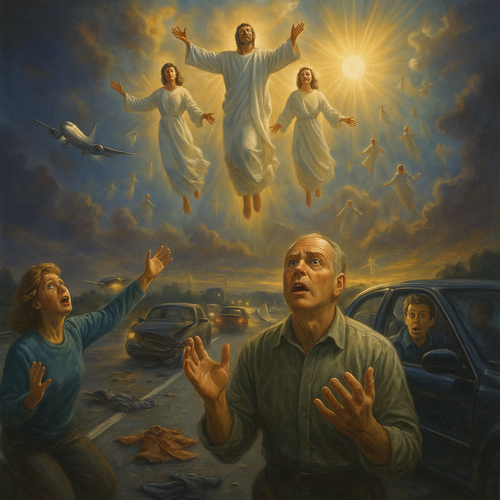
The doctrine of the Rapture—the belief that Christians will be suddenly “caught up” to meet Christ in the air before a time of tribulation on earth—has a complex history. Its origins are more recent than many assume. Here’s the breakdown:
Biblical Roots (1st Century)
The idea comes mainly from 1 Thessalonians 4:16–17, where Paul says believers will be “caught up” (harpazō in Greek, later translated in Latin as rapiemur, “we shall be snatched up”).
Early Christians saw this as part of the Second Coming of Christ, not as a separate secret event. The expectation was one climactic return of Christ, not two stages.
Early Church & Medieval Period
Church Fathers like Irenaeus, Augustine, and Chrysostom interpreted these passages within the framework of a general resurrection and final judgment, not a pre-tribulation rapture.
The dominant view for centuries (Catholic, Orthodox, and later Protestant Reformers) was amillennial (symbolic millennium) or postmillennial (Christ returns after a golden age), with no idea of a sudden, secret removal of believers.
Rise of Premillennialism (17th–18th Century)
In the wake of wars, plagues, and upheavals, some Protestant groups revisited literal interpretations of Revelation and Daniel.
Joseph Mede (1627) was influential in reviving premillennialism in England, but still didn’t propose a two-phase coming.
Some fringe sects speculated about believers escaping tribulation, but it wasn’t mainstream.
John Nelson Darby & Dispensationalism (1830s)
The modern Rapture doctrine, especially the pre-tribulation Rapture, is most closely tied to John Nelson Darby (1800–1882), leader of the Plymouth Brethren movement in Britain.
Darby developed dispensationalism, which divided biblical history into ages (dispensations). He taught that the church would be secretly taken before the Great Tribulation, leaving Israel and the world to face judgment.
His views spread widely in Britain and North America.
Popularization in America (Late 19th–20th Century)
The Scofield Reference Bible (1909) systematized Darby’s dispensational teaching, embedding the Rapture into evangelical theology in the U.S.
Bible conferences, prophecy seminars, and later mass media (books, radio, film) spread the idea.
The Cold War era (1940s–80s) fueled Rapture expectations amid fears of nuclear war and global unrest.
Modern Influence
Best-selling books like Hal Lindsey’s The Late Great Planet Earth (1970) and Tim LaHaye’s Left Behind series (1995–2007) brought the Rapture into popular culture.
Today, it remains central in many evangelical and Pentecostal traditions, though Catholic, Orthodox, Anglican, and Reformed traditions largely reject it as unbiblical or a modern innovation.
In summary: The concept of believers being “caught up” comes from Paul’s letters, but the specific doctrine of a pre-tribulation Rapture as a distinct, secret coming of Christ originates with John Nelson Darby in the 1830s. It spread through dispensationalism, the Scofield Bible, and American evangelical culture.