Why Must We Pray, Anyway: Part 2

Editors note: the guest article appearing here does not necessarily reflect the views of Bible Rebel editors or other guest authors and contributors. Bible Rebel seeks to present a wide range of ideas and viewpoints in order to fulfill our mission to provide resources for “Curious Fearless Faith”. This is Part 2 in a new series on prayer called ‘Why Must We Pray, Anyway’ by Steve Sann.

Why Must We Pray, Anyway: Part 1


E.M. Bounds further correlated: “If prayer puts God to work on earth, then, by the same token, prayerlessness rules God out of the world’s affairs, and prevents him from working.” Truth be told, God is regulated by the same laws of justice that He incorporated in all His creation. He cannot just interrupt the continuum, violate personal property rights, suppress dissent, and generally force His will on the lives of others. In contrast, Satan and the governments of men overstep these boundaries with reckless abandon. Nonetheless, God is constrained by the rule of law: to God, what is His property is His, and that which is Satan’s is Satan’s.

John Wesley, the founder of the Methodist Church, observed in his day: “It seems God is limited by our prayer life – that He can do nothing for humanity unless someone asks Him.” He went on to say: “God does nothing but in answer to prayer.”

But how could that be?

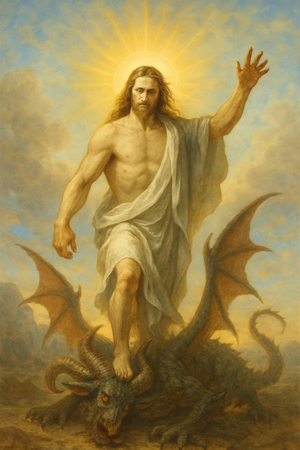
The ugly facts are these: Adam legally transferred to Satan the authority and rulership of this world by heeding Satan’s words and rejecting God’s command in the garden. With that transaction, God’s liberty to direct the affairs of this world became restricted. At that time, the day-to-day administration of the material realm passed from man to Satan, limiting the scope of God’s involvement. Satan was instated as “the god of this world” (2 Corinthians 4:4), with mankind subjected unto him.

Satan is now the god of this world! Clearly, ”The earth is the Lord’s, and the fullness thereof” (Psalms 24:1), but God leased out the property management to man—who summarily legally transferred that lease to Satan. Christ terminated that lease for we who believe, and the eviction notice has been sent. The sheriff will soon be arriving (1 Corinthians 15:24). Yet, now, with God’s sovereignty temporarily impaired and man ensnared in Satan’s world, man became alienated from God.

Because many do not understand this, they are forever making excuses for why God does not save the suffering children, stop the hate and war, cure the world’s diseases, and generally make all of us wealthy! These matters are now left up to the faith and labor of the individual person.

Rethinking The Rapture: N.T. Wright’s ‘Farewell to the Rapture’

Did you know that belief in the Rapture is actually a minority view among Christians worldwide?

While belief in the Rapture is widespread among evangelical Christians, especially in the United States, it is not universally accepted across all Christian traditions.

Many Catholic, Orthodox, and mainline Protestant believers and churches do not hold to a Rapture theology, instead focusing on Christ’s second coming as a singular, visible event rather than a secret removal of believers.

Prominent New Testament scholar N.T. Wright sums it up well in his 2001 essay, Farewell to the Rapture:

The American obsession with the second coming of Jesus — especially with distorted interpretations of it — continues unabated. Seen from my side of the Atlantic, the phenomenal success of the Left Behind books appears puzzling, even bizarre. Few in the U.K. hold the belief on which the popular series of novels is based: that there will be a literal “rapture” in which believers will be snatched up to heaven, leaving empty cars crashing on freeways and kids coming home from school only to find that their parents have been taken to be with Jesus while they have been “left behind.” This pseudo-theological version of Home Alone has reportedly frightened many children into some kind of (distorted) faith.”

I agree. There is much about the modern picture of the Rapture that doesn’t make sense and doesn’t fit with a sound and comprehensive scriptural view.

The main ‘proof text’ for the version of the Rapture depicted in the fictional Left Behind novels is 1 Thessalonians 4:16-17 – “For the Lord himself will come down from heaven, with a loud command, with the voice of the archangel and with the trumpet call of God, and the dead in Christ will rise first. After that, we who are still alive and are left will be caught up together with them in the clouds to meet the Lord in the air. And so we will be with the Lord forever.”

One of the first questions that should be asked when reading any section of scripture is, “How would the the folks to whom it was originally addressed have understood it in their historical, cultural, and religious context?”

Again, N.T. Wright points out in his essay:

Paul’s mixed metaphors of trumpets blowing and the living being snatched into heaven to meet the Lord are not to be understood as literal truth, as the Left Behind series suggests, but as a vivid and biblically allusive description of the great transformation of the present world of which he speaks elsewhere.

So how should we understand 1 Thessalonians 4:16-17? What are some other possible interpretations of this passage?

Well be looking in detail at those questions as we continue with this ‘Rethinking The Rapture’ series, so stay tuned. In the meantime I highly recommend that you read Wrights short essay.

Rethinking The Rapture: Introduction

Rethinking The Rapture: Questions

Rethinking The Rapture: More Questions

Rethinking The Rapture: More Questions

According to the standard Evangelical/Dispensational Rapture doctrine, the Rapture occurs before the apocalyptic events of the Book of Revelation begin to unfold.

So why is the Rapture not explicitly mentioned in Revelation, not even once?

Why would the most shocking, impactful, and monumental event (supposedly) in the Bible and in human history; an event that miraculously and suddenly removes millions of people from the earth triggering the beginning of a worldwide apocalypse, not be mentioned at all in the book of the Bible called the Apocalypse?

Yes, I’m aware of the interpretations of Revelation 4:1-2, where John is called up to heaven, supposedly being a symbolic reference to the Rapture. I’m not buying it though. That kind of handling of the Word is a perfect example of reading a preconceived notion into scripture rather than letting scripture speak for itself.

To speculate that Revelation 4:1, where John heard a voice that said, “Come up hither, and I will shew thee things which must be hereafter…” is referring to the Rapture seems to me a weak, almost desperate, argument. And the same for the ‘missing church’ argument that claims the absence of the Greek word for ‘church’, ekklesia, after Revelation chapter 3 implies a Rapture occurs somewhere between chapter 3 and 4.

The Rapture is not mentioned at all in the Book of Revelation. Why?

More to come in this ongoing series, “Rethinking The Rapture”.

Rethinking The Rapture: Questions

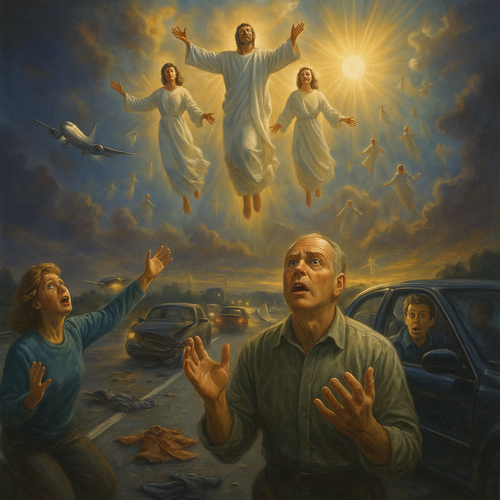
In the Left Behind series, the Rapture is depicted as the sudden disappearance of all true Christian believers, leaving behind their clothes, possessions, and even prosthetic devices. This event is based on biblical passages such as 1 Thessalonians 4:16-17, where believers are “caught up together…to meet the Lord in the air”.

The immediate aftermath is chaos—planes crash as pilots vanish, cars swerve off roads, and families are torn apart. Governments and media scramble to explain the mass disappearances, with theories ranging from natural disasters to extraterrestrial intervention.

The two main ‘proof texts’ for this interpretation of what is called ‘the Rapture’ are 1 Thessalonians 4:16-17 and Matthew 24:40-42.

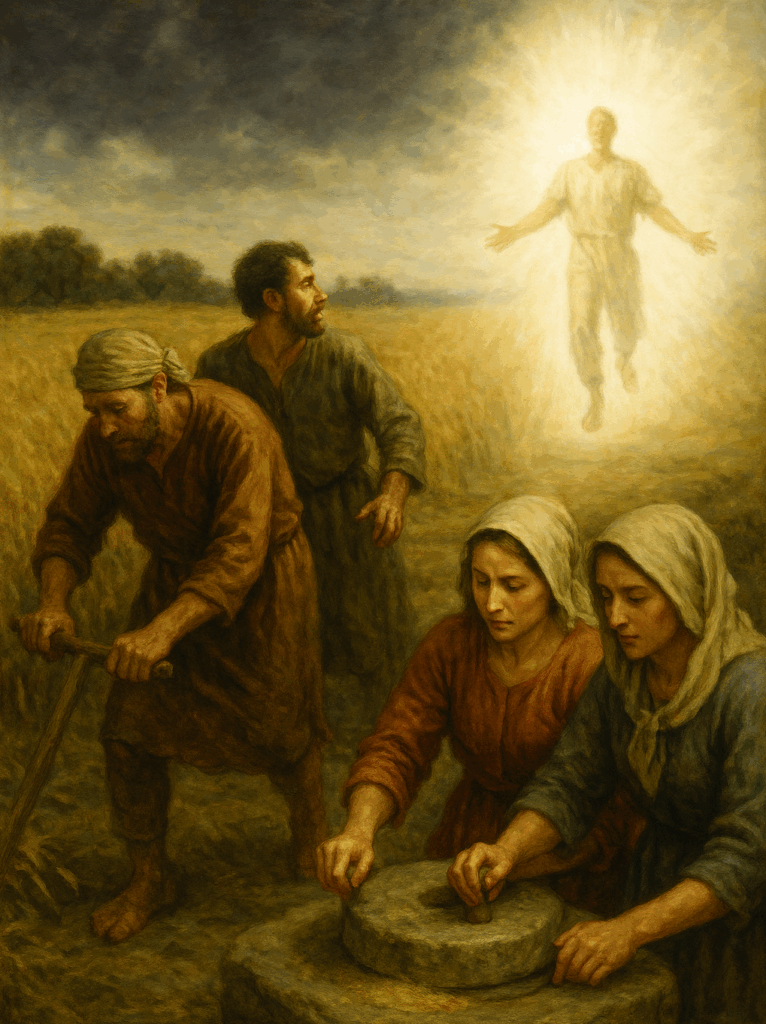
Matthew 24:40-42 “Then shall two be in the field; the one shall be taken, and the other left.
Two women shall be grinding at the mill; the one shall be taken, and the other left.
Watch therefore: for ye know not what hour your Lord doth come.”

1 Thessalonians 4:16-17 “For the Lord himself shall descend from heaven with a shout, with the voice of the archangel, and with the trump of God: and the dead in Christ shall rise first:
 Then we which are alive and remain shall be caught up together with them in the clouds, to meet the Lord in the air: and so shall we ever be with the Lord.”

Questions

Now, let’s ask some questions about the presumed meaning of these verses:

Would the people who heard the words of Jesus recorded in Matthew 24 have understood that he was referring to a future Rapture of the Church? The context would definitely suggest that they would not have understood his words to mean a future Rapture. Read the chapter and consider the general topic Jesus was discussing and who he was teaching at that time.

Similarly, would the 1st Century Thessalonians and other Christians, Greeks, and Jews of that place and time have understood Paul’s words in his first epistle to the Thessalonians to be describing a ‘secret Rapture’ as described in a 20th Century fiction novel? What in their experience, religious teaching, or worldview would have given them a basis to picture such an event?

Or did Paul know that those who read his teachings in Thessalonians would understand something entirely different than a suctioning up of believers to be secretly carried away somewhere for seven years while the world goes to hell in a handbasket?

We’ll be taking up each of those questions in order in coming installments of this series on ‘Rethinking The Rapture’.

Rethinking The Rapture: Introduction

There are three major views on the so-called ‘Rapture’ and its biblical legitimacy; pre-tribulation, post-tribulation, and non-rapture.

Bible Rebel will be spending some time rethinking the traditional, evangelical Rapture doctrine and weighing it against the other views.

The first installment in this series is the following summary and introduction to the Rapture doctrine and it’s variations and alternatives.


1. Pre-Tribulation Rapture (Dispensational View)

Summary:
This view holds that the Rapture will occur before a seven-year period of tribulation (Daniel 9:27; Revelation 6–19), removing true believers from the earth to be with Christ. It is most commonly associated with Dispensational Premillennialism.

Key Verses Used:

  • 1 Thessalonians 4:16–17 — “…the dead in Christ will rise first. After that, we who are still alive… will be caught up together with them…”
  • John 14:2–3 — “I will come back and take you to be with me…”
  • Revelation 3:10 — “I will keep you from the hour of trial…”

Arguments For:

  • Emphasizes a literal interpretation of prophecy.
  • Sees a clear distinction between Israel and the Church.
  • Argues that believers are promised deliverance from God’s wrath.

Notable Proponents:

  • John Walvoord
  • Tim LaHaye (co-author of Left Behind)
  • Dallas Theological Seminary

Sources:

  • John F. Walvoord, The Rapture Question
  • Tim LaHaye and Jerry Jenkins, Left Behind series (fictional but influential)

2. Post-Tribulation Rapture

Summary:
This view asserts that the Rapture and Second Coming of Christ are a single event that occurs after the tribulation. Believers will endure the tribulation and be raptured when Christ returns to establish His kingdom.

Key Verses Used:

  • Matthew 24:29–31 — “Immediately after the distress… he will send his angels… and they will gather his elect…”
  • 2 Thessalonians 2:1–4 — The day of the Lord will not come until the “man of lawlessness” is revealed.
  • Revelation 20:4–6 — Martyrs from the tribulation are raised to reign with Christ.

Arguments For:

  • Emphasizes the unity of Christ’s return and the Rapture.
  • Sees no Scriptural evidence of a secret or separate coming.
  • Suggests that the Church has always faced tribulation and will continue to do so.

Notable Proponents:

  • George E. Ladd
  • Craig S. Keener
  • Historic Premillennialists

Sources:

  • George Eldon Ladd, The Blessed Hope
  • Craig Keener, Revelation (NIVAC Commentary)

3. Amillennial/Non-Rapture View

Summary:
This view does not see the Rapture as a separate event at all. Instead, it interprets related texts symbolically or metaphorically. Christ’s Second Coming will be a single, visible event at the end of history, followed by the final judgment.

Key Verses Used:

  • 1 Thessalonians 4:16–17 — Interpreted as a metaphor for a royal welcome of Christ by His people.
  • 2 Peter 3:10 — Emphasizes a sudden final judgment, not two stages of return.
  • John 6:39–40 — Resurrection occurs “on the last day,” not before.

Arguments For:

  • Sees “rapture” texts as apocalyptic language, not literal.
  • Rejects a secret or pre-tribulational event.
  • Claims that church history lacks early support for the pre-tribulational Rapture.

Notable Proponents:

  • Augustine (early influence)
  • R.C. Sproul (Partial Preterism/Amillennialism)
  • Kim Riddlebarger

Sources:

  • R.C. Sproul, The Last Days According to Jesus
  • Kim Riddlebarger, A Case for Amillennialism

Satanism And Witchcraft In America

Satan has been defeated. The resurrected, ascended, and returning Son of God is victorious.

But while we await the final execution of the serpent, he runs loose for a time, all pissed off, still doing his best to steal, kill, and destroy those created in the image of the Most High God.

Satan knows he’s toast, but he will continue to deceive and seduce people into bending the knee to him. Some of those people are foolishly ignorant and think it’s a game, but some know exactly what they’re doing and, like their master, they hate God.

A quick AI request for news and stats on Satanism and witchcraft in America returned the following results:

  • Witchcraft and Paganism Growth: The number of Americans identifying as witches has risen dramatically. Estimates suggest 1 to 1.5 million people practice Wicca or paganism, surpassing the 1.4 million members of the Presbyterian Church in the U.S. From Newsweek
  • Global Witchcraft Beliefs: A massive study found that 40% of people worldwide believe in witchcraft, translating to about 1 billion people across 95 countries. From Science Alert
  • Decline in Christianity: Younger generations are increasingly turning to alternative spiritual practices, including astrology, tarot, and Wicca, as they move away from traditional Christianity. From Newsweek
  • Rise of Witchcraft Among Millennials: Millennials are embracing witchcraft and occult practices as a form of spiritual freedom. Social media has played a significant role in popularizing these beliefs. From Newsweek
  • Academic Studies on Witchcraft: Research from American University highlights that witchcraft beliefs cut across socio-demographic groups, with education and economic security influencing belief levels. From Science Alert
  • Cultural Shifts: The “witch aesthetic” has gained popularity, with celebrities and activists embracing elements of witchcraft in their personal and public lives. From Newsweek

Death Row Letters: The Hiddenness of God 2

Greetings,

In my previous letter I asked the question a lot folks have: If God is real why doesn’t He just do a bunch of magic tricks for everyone all the time so that they will see Him, believe in Him, and love Him?

Well, lets take a bit of a deep dive into the answer.

Maybe God seems ‘hidden’ to our five senses so that folks can choose faith freely, rather than being forced by undeniable proof.

God isn’t some old dude up in the clouds or some alien in outer space – God is spirit, imperceptible to our limited senses.

“God is spirit, and those who worship Him must worship in spirit and truth.” John 4:24

God wants a genuine, personal relationship with us, and He wants us to know him as He is. That requires some effort on our part, as in any human relationship. God doesn’t seek robots or slaves who have no choice but to obey and believe in Him.

God’s hiddenness requires us to seek deeper understanding, to doubt, to wrestle with Him, and to develop faith and patience. It requires us to work on our own character.

But make no mistake, God reveals Himself everywhere and at every moment through the complexity, precise workings, and order of His creation.

Until next time,
Your fellow death row occupant.

A New Reformation?

Churchianity and the theological status quo should be scrutinized by all people of faith regularly. That is exactly how we got the Reformation.

Is there a New Reformation brewing? It seems so. There is a difference between truth and tradition.

Man-made Christian creeds and doctrines are no longer being blindly accepted as biblical truth just because the Protestant clergy or the Catholic Papacy say so.

The nature of God, heaven, hell, sin, the apocalypse, predestination or free-will, the Rapture, the origins of the universe – all of these ideas and more need solid reexamination to see if the commonly accepted doctrines of men used to explain them measure up to the message of scripture.

The Bible Rebel blog is a resource for those seeking original and curated content, including news and commentary, covering faith, biblical studies and interpretation, and the intersection of politics, culture, and the Bible.

Our Mission

  1. To monitor current news and events related to faith and culture.
  2. To provide an alternative viewpoint to the world’s pervasive climate of darkness, nihilism, and hopelessness for those seeking truth, light, and purpose.
  3. To examine and question the assumptions of religious tradition and provide a resource for information and inspiration for people of faith who have become dissatisfied with an increasingly lifeless and empty ‘churchianity’.
  4. To present the Biblical truths which reveal God’s nature and purposes and proclaim the lifechanging, world-altering, radical message of Yeshua the Messiah – Jesus Christ, our risen Lord and Savior.

At Bible Rebel, this is our one and only creed:
Our living God is a loving God and the Bible is His revealed word and will.
Our hope and eternal salvation relies entirely on the work of God’s only begotten son, Jesus Christ, who is the way, the truth, and the life.

So, expect some controversial viewpoints and uncomfortable ideas in some of the coming content from Bible Rebel.

You can find all of the current Bible 101 episodes and One-Minute Mini Messages here on our YouTube Channel, and you can subscribe to our YouTube channel here.

Give us a follow on Facebook and X (formerly Twitter) and subscribe to our monthly newsletter here.

Watchdog Alert: Middle East Updates

Picture via Lara Jameson pexels.com

Bible Rebel continues to keep a watchdog’s eye on events in the Middle East. That is not to say that we are watching for any fulfillment of biblical prophecy there, we keep our eyes and ears open to news that affects people of faith from every region around the world.

The Holy Land is of particular interest for three reasons:

  • It is a geographical crossroads, referred to by some the “Center of the Earth”.
  • It is also the historical birthplace of the two largest religions of the world; Christianity and Islam, as well as the ‘Father’ of both those religions – Judaism.
  • It is of major military and strategic importance because of oil production and logistics.

Are the biblical prophecies focusing on geographical locations in the Middle East, especially in and around current-day Israel, relevant to the Church in our times today?

Or will those prophecies only come to pass and be revealed in some future time after the destiny of the Church has been realized? This is a subject Bible Rebel will be exploring in some depth going forward. Stay tuned.

For now, here’s the latest from the Middle East.

Israel Strikes Near Syrian Presidential Palace

Israel conducted an airstrike near Syria’s presidential palace in Damascus, targeting the new Islamist-led government under interim President Ahmed al-Sharaa. The strike aimed to signal Israel’s commitment to defending the Druze minority amid escalating sectarian violence in Syria.
From Reuters

US attacks Yemen port again; Houthis launch missiles at Israel

The Houthi-affiliated Al Masirah TV media outlet has reported that seven US strikes hit the Ras Isa oil port in al-Salif district in Hodeidah in the last few hours, where a US strike at the same port last month killed at least 80 people and wounded 150 in one of the deadliest attacks on the country by US forces.

Earlier Friday, the Houthis claimed responsibility for launching two missiles towards northern Israel, targeting the Ramat David military airbase and the Tel Aviv area, as the group continues its military pressure in solidarity with Palestinians under Israeli fire.
From Al Jazeera

U.S.-Iran Talks Postponed

A fourth round of talks between the United States and Iran, scheduled to take place in Rome, has been postponed. An Iranian official stated that the new date depends on the U.S. approach, citing contradictory behavior and provocative statements from Washington.
From Reuters

Netanyahu calls defeating Israel’s enemies the ‘supreme objective,’ not freeing hostages

Israeli Prime Minister Benjamin Netanyahu said Thursday that defeating Israel’s enemies is more important than securing the release of the remaining hostages in Gaza.

While the prime minister acknowledged that freeing the 59 remaining hostages is a “very important goal,” he described Israel’s fight against its enemies as the “supreme objective” of the war.

“We have many objectives, many goals in this war. We want to bring back all of our hostages,” Netanyahu said. “That is a very important goal. In war, there is a supreme objective. And that supreme objective is victory over our enemies. And that is what we will achieve.”
From CNN

Paul Prayed ‘Without Ceasing’ – Part 3

Editors note: the guest article appearing here does not necessarily reflect the views of Bible Rebel editors or other guest authors and contributors. Bible Rebel seeks to present a wide range of ideas and viewpoints in order to fulfill our mission to provide resources for “Curious Fearless Faith”. This is Part 3 in a new series on prayer called ‘Paul Prayed Without Ceasing’ by Steve Sann.

Read Part 1 Here
Read Part 2 Here


The Benefits: Let’s highlight a few of the many benefits richly awarded to you each and every time you utter His words by the spirit. Please turn to these scriptures and study them on your own: a wealth of confidence and appreciation of speaking in tongues will begin to mature in you.

a. We pray bypassing our earthly understanding. Praying by the spirit in another language, we are able to pray for needs beyond our understanding and perception (I Corinthians 14:14-17);
While praying beyond your understanding, the spirit addresses your personal needs—for example, in your family, finances, spirit, soul, and body.

b. We intercede for others according to God’s will. The spirit searches the hearts and lives of others, making requests for needs of which we, in our limited perception, are unaware. (Rom. 8:26,27);
This makes us global prayer warriors. Interceding for others, the spirit identifies and prays for the needs of your loved ones and worldwide for all the saints.

c. God speaks to our spirit unfolding His mysteries, guidance and truths, spiritually renewing, strengthening and edifying you (II Corinthians 5: I Corinthians 14:2,4; Jude 20; Ephesians 3:14-19; John 14:25; 16:13);
When we speak to God in the spirit, He speaks back. He not only reveals spiritual truths, but opens your eyes to wisdom and insight in all aspects of your life, and of others, as well. In addition, He builds up your spirit, preparing and strengthening you in the operation of the other manifestations.

d. We praise and bless God by giving thanks well, speaking the wonderful works of God (I Corinthians 14:16,17; Acts 2:11);
When we “bless with the spirit” we are energizing the Christ within us to bring forth perfect praise to God. If translated, we would hear a litany of the great things God is doing, His nature, and His love for his people. So, by the spirit we “give thanks well”, we are “speaking the wonderful works of God.”

e. We offer the “true worship” the Father seeks. We “worship God in the spirit” (Phil. 3:3). Jesus Christ foretold: “…the true worshippers will worship the Father in spirit and truth; for the Father is seeking such to worship Him. God is Spirit, and those who worship Him must worship in spirit and truth.” (John 4:21-24);
Man has always sought various methods of worshipping God, most of which God is spirit and cannot be truly worshipped in the flesh. Rather, by worshipping in the spirit, scripture assures us we are pleasing Him, as we, with confidence, properly “worship Him in spirit and in truth.”

f. It engenders intimacy with the Father, sharing our heart’s secrets with Him (Rom. 8:15; Gal 4:6; Rom. 8:27; I Corinthians 14:2);
On the surface, it is difficult to become acquainted with the heart of a man. But the inner desires and secrets of our hearts the spirit shares with the Father. We speak with each other tenderly like a child with His Father.

g. The spirit continually reaffirms to us that we are the sons of God. (Rom. 8:14-17; Ephesians 1:13,14);
Speaking in tongues is the absolute proof in the senses realm to you that you have received eternal life, are born-again, and have received the spirit. It confirms to you that the promises of the Word are true.

As with all of God’s promises, these many benefits come to those who expect and believe. By holding these benefits in our hearts, we can acknowledge them as we pray in the spirit. We do not need to understand the specifics of prayer by the spirit to claim and believe to bring it to pass. Build up your faith in these benefits.