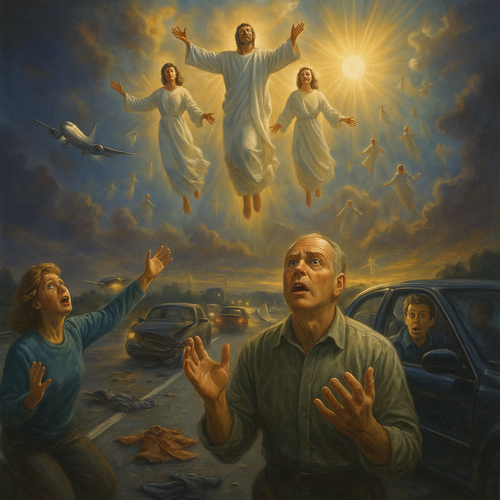
Rethinking The Rapture: Millions Of Christians Were Not Delivered From Wrath

One of the arguments for a Rapture of believers is that God will not allow Christians to go through the ‘wrath to come’, as described in the book of Revelation, but will rescue them out of the world before those purportedly horrific, literal events occur.

But wait a minute, what about all of the other believers who have suffered torture, persecution, burnings, beheadings, skinning and worse throughout the history of the world since the resurrection and ascension of our Lord?

Here’s a brief and general review that barely scratches the surface:

Roman Persecutions (1st–4th centuries) – Early Christians faced brutal persecution under Roman emperors like Nero and Diocletian. Nero blamed Christians for the Great Fire of Rome in AD 64, leading to mass executions, including crucifixions and being burned alive. Diocletian’s persecution (AD 303–311) was one of the most systematic, involving the destruction of churches, scriptures, and widespread martyrdom.

Ottoman Empire Genocides (1910s–1920s) – During World War I, the Ottoman Empire carried out genocides against Christian minorities, including Armenians, Greeks, and Assyrians. These events led to the deaths of millions through massacres, forced deportations, and starvation.

Modern-Day Persecution (21st century) – In various parts of the world, Christians continue to face persecution, particularly in regions with strict religious laws. Countries in Africa and Asia have seen imprisonment, violence, and even executions of Christians.

So why are the comparatively very, very few Christians who happen to be of the generation alive at the time of the so-called Rapture the lucky ones?

Well, they say, “Nothing like the coming tribulation has ever happened before and it will be unparalleled in its awfulness for people living on the earth at that time, so God has to rescue His people out of it.”

Come on now, that is absurd, and would be especially so to those Christians who have experienced, and still do, suffering and death in various places at various times. Death and suffering are death and suffering whether it’s in a so-called tribulation period, a 10th Century Caliphate, or a 21st Century gulag.

So what is the meaning of verses like 1 Thessalonians 1:10?
And to wait for his Son from heaven, whom he raised from the dead, even Jesus, which delivered us from the wrath to come.

We’ll take a closer look in our next “Rethinking The Rapture” post.

Rethinking The Rapture: Introduction

Rethinking The Rapture: Questions

Rethinking The Rapture: More Questions

Rethinking The Rapture: N.T. Wright’s ‘Farewell to the Rapture’

Rethinking The Rapture: What 1 Thessalonians 4:16-17 Doesn’t Say

    Rethinking The Rapture: Questions

    In the Left Behind series, the Rapture is depicted as the sudden disappearance of all true Christian believers, leaving behind their clothes, possessions, and even prosthetic devices. This event is based on biblical passages such as 1 Thessalonians 4:16-17, where believers are “caught up together…to meet the Lord in the air”.

    The immediate aftermath is chaos—planes crash as pilots vanish, cars swerve off roads, and families are torn apart. Governments and media scramble to explain the mass disappearances, with theories ranging from natural disasters to extraterrestrial intervention.

    The two main ‘proof texts’ for this interpretation of what is called ‘the Rapture’ are 1 Thessalonians 4:16-17 and Matthew 24:40-42.

    Matthew 24:40-42 “Then shall two be in the field; the one shall be taken, and the other left.
    Two women shall be grinding at the mill; the one shall be taken, and the other left.
    Watch therefore: for ye know not what hour your Lord doth come.”

    1 Thessalonians 4:16-17 “For the Lord himself shall descend from heaven with a shout, with the voice of the archangel, and with the trump of God: and the dead in Christ shall rise first:
     Then we which are alive and remain shall be caught up together with them in the clouds, to meet the Lord in the air: and so shall we ever be with the Lord.”

    Questions

    Now, let’s ask some questions about the presumed meaning of these verses:

    Would the people who heard the words of Jesus recorded in Matthew 24 have understood that he was referring to a future Rapture of the Church? The context would definitely suggest that they would not have understood his words to mean a future Rapture. Read the chapter and consider the general topic Jesus was discussing and who he was teaching at that time.

    Similarly, would the 1st Century Thessalonians and other Christians, Greeks, and Jews of that place and time have understood Paul’s words in his first epistle to the Thessalonians to be describing a ‘secret Rapture’ as described in a 20th Century fiction novel? What in their experience, religious teaching, or worldview would have given them a basis to picture such an event?

    Or did Paul know that those who read his teachings in Thessalonians would understand something entirely different than a suctioning up of believers to be secretly carried away somewhere for seven years while the world goes to hell in a handbasket?

    We’ll be taking up each of those questions in order in coming installments of this series on ‘Rethinking The Rapture’.

    Rethinking The Rapture: Introduction

    There are three major views on the so-called ‘Rapture’ and its biblical legitimacy; pre-tribulation, post-tribulation, and non-rapture.

    Bible Rebel will be spending some time rethinking the traditional, evangelical Rapture doctrine and weighing it against the other views.

    The first installment in this series is the following summary and introduction to the Rapture doctrine and it’s variations and alternatives.


    1. Pre-Tribulation Rapture (Dispensational View)

    Summary:
    This view holds that the Rapture will occur before a seven-year period of tribulation (Daniel 9:27; Revelation 6–19), removing true believers from the earth to be with Christ. It is most commonly associated with Dispensational Premillennialism.

    Key Verses Used:

    • 1 Thessalonians 4:16–17 — “…the dead in Christ will rise first. After that, we who are still alive… will be caught up together with them…”
    • John 14:2–3 — “I will come back and take you to be with me…”
    • Revelation 3:10 — “I will keep you from the hour of trial…”

    Arguments For:

    • Emphasizes a literal interpretation of prophecy.
    • Sees a clear distinction between Israel and the Church.
    • Argues that believers are promised deliverance from God’s wrath.

    Notable Proponents:

    • John Walvoord
    • Tim LaHaye (co-author of Left Behind)
    • Dallas Theological Seminary

    Sources:

    • John F. Walvoord, The Rapture Question
    • Tim LaHaye and Jerry Jenkins, Left Behind series (fictional but influential)

    2. Post-Tribulation Rapture

    Summary:
    This view asserts that the Rapture and Second Coming of Christ are a single event that occurs after the tribulation. Believers will endure the tribulation and be raptured when Christ returns to establish His kingdom.

    Key Verses Used:

    • Matthew 24:29–31 — “Immediately after the distress… he will send his angels… and they will gather his elect…”
    • 2 Thessalonians 2:1–4 — The day of the Lord will not come until the “man of lawlessness” is revealed.
    • Revelation 20:4–6 — Martyrs from the tribulation are raised to reign with Christ.

    Arguments For:

    • Emphasizes the unity of Christ’s return and the Rapture.
    • Sees no Scriptural evidence of a secret or separate coming.
    • Suggests that the Church has always faced tribulation and will continue to do so.

    Notable Proponents:

    • George E. Ladd
    • Craig S. Keener
    • Historic Premillennialists

    Sources:

    • George Eldon Ladd, The Blessed Hope
    • Craig Keener, Revelation (NIVAC Commentary)

    3. Amillennial/Non-Rapture View

    Summary:
    This view does not see the Rapture as a separate event at all. Instead, it interprets related texts symbolically or metaphorically. Christ’s Second Coming will be a single, visible event at the end of history, followed by the final judgment.

    Key Verses Used:

    • 1 Thessalonians 4:16–17 — Interpreted as a metaphor for a royal welcome of Christ by His people.
    • 2 Peter 3:10 — Emphasizes a sudden final judgment, not two stages of return.
    • John 6:39–40 — Resurrection occurs “on the last day,” not before.

    Arguments For:

    • Sees “rapture” texts as apocalyptic language, not literal.
    • Rejects a secret or pre-tribulational event.
    • Claims that church history lacks early support for the pre-tribulational Rapture.

    Notable Proponents:

    • Augustine (early influence)
    • R.C. Sproul (Partial Preterism/Amillennialism)
    • Kim Riddlebarger

    Sources:

    • R.C. Sproul, The Last Days According to Jesus
    • Kim Riddlebarger, A Case for Amillennialism