Some interesting and insightful quotes about the third book of the Bible, Leviticus.
Rabbi Jonathan Sacks
“Leviticus teaches us that holiness is not an abstract concept but a way of life, shaping how we live, how we love, and how we treat one another.” — Rabbi Lord Jonathan Sacks, former Chief Rabbi of the UK
John Calvin
“In Leviticus God shows that true worship must begin with atonement. Without reconciliation to God, nothing we do can be pleasing in His sight.” — John Calvin, Reformer and theologian
N.T. Wright
“Leviticus forms the vital foundation for understanding Jesus’ work. Its sacrifices and purity codes point forward to the healing, forgiveness, and restoration He brings.” — N.T. Wright, New Testament scholar and bishop
Matthew Henry
“Though many parts of Leviticus appear obscure to us, the whole book points to Christ, the true sacrifice and our great High Priest.” — Matthew Henry, Bible commentator
In a previous piece in this ‘Rethinking The Rapture’ series I referenced New Testament scholar N.T. Wright’s 2001 essay, Farewell to the Rapture in the context of the Left Behind books and the pop theology of a secret Rapture.
Here, I’d like to return to Wright’s essay and offer a couple of more quotes from it in order to illustrate some of the thinking behind the views held by those who reject the evangelical, Left Behind, invisible Rapture interpretation of eschatology.
“It is Paul who should be credited with creating this scenario. Jesus himself, as I have argued in various books, never predicted such an event. The gospel passages about “the Son of Man coming on the clouds” (Mark 13:26, 14:62, for example) are about Jesus’ vindication, his “coming” to heaven from earth. The parables about a returning king or master (for example, Luke 19:11-27) were originally about God returning to Jerusalem, not about Jesus returning to earth. This, Jesus seemed to believe, was an event within space-time history, not one that would end it forever.”
You’ll need to open your Bible and put on your thinking cap for some serious, critical biblical exegesis as you consider what Wright is saying here.
And here:
“The Ascension of Jesus and the Second Coming are nevertheless vital Christian doctrines, and I don’t deny that I believe some future event will result in the personal presence of Jesus within God’s new creation. This is taught throughout the New Testament outside the Gospels. But this event won’t in any way resemble the Left Behind account. Understanding what will happen requires a far more sophisticated cosmology than the one in which “heaven” is somewhere up there in our universe, rather than in a different dimension, a different space-time, altogether.
The New Testament, building on ancient biblical prophecy, envisages that the creator God will remake heaven and earth entirely, affirming the goodness of the old Creation but overcoming its mortality and corruptibility (e.g., Romans 8:18-27; Revelation 21:1; Isaiah 65:17, 66:22). When that happens, Jesus will appear within the resulting new world (e.g., Colossians 3:4; 1 John 3:2).”
We’ll dive deeper into these ideas in coming ‘Rethinking The Rapture’ posts – for now, I hope you will take a hard look at what Wright is conveying here.
Did you know that belief in the Rapture is actually a minority view among Christians worldwide?
While belief in the Rapture is widespread among evangelical Christians, especially in the United States, it is not universally accepted across all Christian traditions.
Many Catholic, Orthodox, and mainline Protestant believers and churches do not hold to a Rapture theology, instead focusing on Christ’s second coming as a singular, visible event rather than a secret removal of believers.
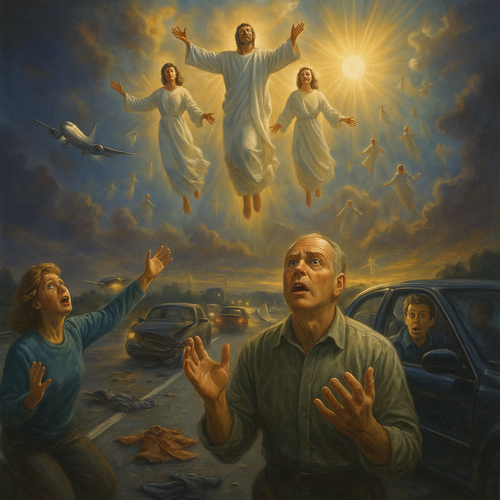
“The American obsession with the second coming of Jesus — especially with distorted interpretations of it — continues unabated. Seen from my side of the Atlantic, the phenomenal success of the Left Behind books appears puzzling, even bizarre. Few in the U.K. hold the belief on which the popular series of novels is based: that there will be a literal “rapture” in which believers will be snatched up to heaven, leaving empty cars crashing on freeways and kids coming home from school only to find that their parents have been taken to be with Jesus while they have been “left behind.” This pseudo-theological version of Home Alone has reportedly frightened many children into some kind of (distorted) faith.”
I agree. There is much about the modern picture of the Rapture that doesn’t make sense and doesn’t fit with a sound and comprehensive scriptural view.
The main ‘proof text’ for the version of the Rapture depicted in the fictional Left Behind novels is 1 Thessalonians 4:16-17 – “For the Lord himself will come down from heaven, with a loud command, with the voice of the archangel and with the trumpet call of God, and the dead in Christ will rise first. After that, we who are still alive and are left will be caught up together with them in the clouds to meet the Lord in the air. And so we will be with the Lord forever.”
One of the first questions that should be asked when reading any section of scripture is, “How would the the folks to whom it was originally addressed have understood it in their historical, cultural, and religious context?”
Again, N.T. Wright points out in his essay:
“Paul’s mixed metaphors of trumpets blowing and the living being snatched into heaven to meet the Lord are not to be understood as literal truth, as the Left Behind series suggests, but as a vivid and biblically allusive description of the great transformation of the present world of which he speaks elsewhere.“
So how should we understand 1 Thessalonians 4:16-17? What are some other possible interpretations of this passage?
Well be looking in detail at those questions as we continue with this ‘Rethinking The Rapture’ series, so stay tuned. In the meantime I highly recommend that you read Wrights short essay.