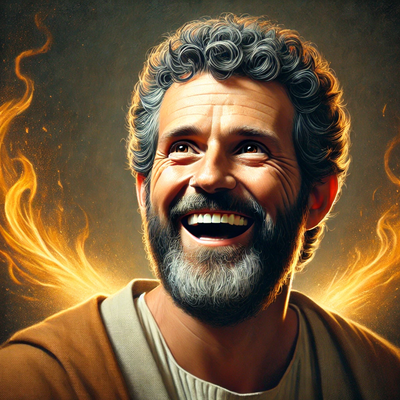
Here are some famous quotes from influential religious leaders about Paul’s Epistle to the Romans.
Martin Luther
“The Epistle to the Romans is the true masterpiece of the New Testament and the very purest Gospel. It is worthy not only that every Christian should know it word for word, by heart, but occupy himself with it every day, as the daily bread of the soul.”
— Martin Luther, Preface to the Epistle to the Romans (1522)
John Calvin
“When anyone understands this Epistle, he has a passage opened to him to the understanding of the whole Scripture.”
— John Calvin, Commentary on Romans (1540)
Frederic Godet
“Every great spiritual revival in the Church will be connected as effect and cause with a deeper understanding of this book.”
— Frederic Godet, Commentary on St. Paul’s Epistle to the Romans (1869)
John Stott
“Romans is the fullest, plainest, and grandest statement of the Gospel in the New Testament. Its message is still as relevant and revolutionary as when it was first written.”
— John R. W. Stott, The Message of Romans: God’s Good News for the World (1994)
Editors note: the guest article appearing here does not necessarily reflect the views of Bible Rebel editors or other guest authors and contributors. Bible Rebel seeks to present a wide range of ideas and viewpoints in order to fulfill our mission to provide resources for “Curious Fearless Faith”.This is the fourth and final part in a new series on prayer called ‘Cease Not To Pray’ by Steve Sann.
Conceivably, there are countless matters around the world for which God would have us to pray, about most of which we are abysmally ignorant. Admittedly, at any time—even in our own lives—critical issues go neglected because we are woefully unaware. How could we possibly know all the events of tomorrow that yearn for prayer today? Unmistakably, this is our greatest prayer weakness. But now God has enabled us to articulate these critical prayers that we, heretofore, were powerless to utter. Bypassing the limitations of our senses, we can now lift to God the burdens that He Himself would have us pray for.
Watch as Romans 8:26-28 unfolds these very truths: Romans 8:26: Likewise, the Spirit also helps in our weaknesses [literally, “weakness” – being singular in the text]. For we do not know what we should pray for as we ought, but the Spirit Himself [or, “itself” in KJV] makes intercession for us with groanings which cannot be uttered.
Our weakness places us at a distinct disadvantage: we do not know what to pray for “as we ought”— or, literally “as we must.” Why must we know what to pray for? Because, if you don’t know what to pray for, you can’t pray for it—right? So, praying solely with our understanding leaves scores of specific needs unaddressed.
For example, how would you possibly know that a financial crisis is looming only months ahead that could downsize your industry and devalue your profession, sending thousands of unemployed into the streets? Wouldn’t you want God working on your situation far in advance? Even perhaps opening the door into a more secure income stream long before?
Or, how could you possibly know to pray today to protect your loved ones from a freeway winter storm pile-up that threatens to kill or injure dozens of motorists? They need to not be on the freeway at that moment—but who’s going to make that intercession? Or, would you like the right people at just the right time to notice your talents, elevating you to new opportunities? Who better than God knows exactly when those “right times” really are?
These are prayers best prayed in the spirit. Romans 8: 27: Now He who searches the hearts knows what the mind of the Spirit is, because He makes intercession for the saints according to the will of God. Verse 27 hammers home that the spirit enables us to intercede not only for ourselves, but for God’s people the world over. By the spirit you will be praying for the specific needs of specific people. You may not know them, but rest assured the Father does, and He is the one giving you the words. Moreover, the spirit intercedes for the saints literally “according to God”—with God’s actual words, as the spirit’s function is to speak verbatim that which has been received, (John 16:13).
Do you see why the centerpiece of the Church, the responsibility which is bedrock to all others, is that of the intercessor? These are the warriors upon which all church achievement is reliant. Without the intercessors calling in God’s involvement, the wheels of church advancement rumble to a standstill. Armed with SIT, a basic, critical component to the armor of God, these prayer warriors clear the way for God’s ministers to enter into the fray, (Ephesians 6:13-20).
Do you seek to find your calling in the church? God is looking for men and women right now who can pick up the calling to become intercessors for His people. There is not a single, more vital, more urgent job within the church. Romans 8:28 follows on the heels of verse 27 continuing in this context of prayer and intercession by the spirit: Romans 8:28: And we know that all things work together for good to those who love God, to those who are the called according to His purpose.
To obtain a promise from God that all things will work together for good would certainly be exhilarating for anybody. Yet, have we understood this promise in its actual context? The “good” received in verse 28 is a result of the “intercession” in the spirit given in verse 27! Of course—that makes perfect sense, doesn’t it? Good things just don’t happen to good people. For it is only by our intercession for all things in life do all things work together for our good. Speaking in tongues is what makes that kind of global intercession available at your fingertips.
Furthermore, verse 28 points out that those whose love for God are those who are called—and subsequently answering the call by walking—according to His purpose. Again, in regards to intercessory prayer, the context immediately preceding clearly states God’s purpose for us.
For those of us who live this prayer lifestyle, this verse promises that, in the end result, we will prosper. In my life, each road to success is fraught with the hazards of the unexpected. Nonetheless, in the very end, I always believe God’s good is mine to obtain. That is precisely the promise. You see if you are confident that the war is yours to win, would you let battles lost along the way discourage you? No—lost battles are often just “the cost of doing business.” And, my friend, you must be willing to pay the cost of doing business. It’s the persistent folk in life who reap the rewards—armed with prayer in the spirit, coupled with the wisdom of life and sheer determination.
Let’s pick up where we left off last time where we were discussing one of the main arguments atheists have against the existence of God, which is the problem of evil.
We’ll probably spend a lot of time talking about this in our correspondence here, so let’s start off with defining the two kinds of evil.
Moral Evil
First, there is moral evil, or human evil. Simply put, moral evil is defined as the willful acts of human beings – like murder, rape, thievery, destruction etc.
Lots of that going on in the world, right? Always has been.
Human nature is, by default, depraved and desperately wicked. It’s the natural state as a result of the primeval and continuing disobedience to and hatred for God.
Jeremiah 17:9 – The heart is deceitful above all things, and desperately wicked: who can know it?
You can’t blame God for moral evil, we’re not robots or puppets. God does provide grace and protection for those who claim it in faith, but murder, genocide, and all manner of horribleness is not on God, it’s on the freewill ickiness of people.
Natural Evil
Second, you’ve got your natural evil, which is stuff like earthquakes, floods, tsunamis, pestilence and disease etc. You can’t really blame a human being for an earthquake that kills thousands of people.
But can you blame God for causing those awful things to happen, or at least for allowing them to happen? Well, ‘blame’ is a pretty harsh word, but yes I think we can say God does allow natural evil to happen.
The question is ‘for what purposes’ and ‘under what circumstances’ does He allow earthquakes and tsunamis and cancer to have their way with human beings?
I’ll leave you with this to chew on for now and we’ll dig deeper in my next letter.
Romans 8:22-23 – For we know that the whole creation groaneth and travaileth in pain together until now. And not only they, but ourselves also, which have the firstfruits of the Spirit, even we ourselves groan within ourselves, waiting for the adoption, to wit, the redemption of our body.
In my last letter to y’all I only made it as far as addressing the anti-natalists and didn’t get around to those of the nihilist persuasion. So, I’ll dedicate this letter to those of you who believe that life is meaningless and who reject all religious and moral principles – which is the definition of a nihilist.
You may be right in thinking that your life is meaningless, but that doesn’t mean that all life is meaningless. Right?
And if your life is meaningless and without purpose, well, read on.
Now to the bigger, much bigger, problem: To actually believe that the universe is empty of meaning and purpose is to deny the plain evidence directly in front of you every day.
Is there a purpose to the rain that falls? Of course there is. How about the sun that shines or the wind that blows? Of course, and I don’t need to explain or list the reasons and purposes for those things, everyone already knows and understands them.
Is there a reason behind the way our physical bodies are made to function or the way the planets and moons in our solar system move in predictable cycles? Undeniably and absolutely.
So how can you believe that there is no reason or purpose in our existence?
I’m reminded of this verse from the Book of Romans: “For the invisible things of him from the creation of the world are clearly seen, being understood by the things that are made, even his eternal power and Godhead; so that they are without excuse.”
Everything has purpose, even you. If you don’t know, believe in, or understand your purpose, then you haven’t looked hard enough or asked the right questions.
Seek, and you’ll find. Knock, and the door will open.