Texas Flood Response And How To Help

Catholic Church Response

  • The Archdiocese of San Antonio called on Catholics to pray “for all those affected,” especially for victims, the missing, and their families. Archbishop Gustavo García‑Siller and Auxiliary Bishop Boulette visited Kerrville, while Notre Dame Church in Kerrville opened its gym as an emergency shelter, with Catholic Charities providing food, clothing, hygiene kits, and water.
  • Special Masses were held on July 6, and priests from the Diocese of Beaumont and Austin encouraged prayers, invoked Our Lady of Prompt Succor, and launched additional fundraising efforts across the region aleteia.org.

Southern Baptist & Texas Baptist Relief

  • Southern Baptists of Texas Disaster Relief (SBTC DR) mobilized immediately:
    • A Quick Response Unit arrived July 4–5 in Kerrville and San Saba, offering meals, chaplaincy services, damage assessment, cleaning crews, shower and laundry facilities.
    • They partnered with First Baptist Kerrville, coordinating with pastor Joey Tombrella, and plan extended ‘mud-out’ and recovery efforts as waters recede.
  • Texas Baptists’ “Texans On Mission” deployed chaplains and assessors as early as July 7, preparing feeding, shower/laundry, recovery crews, and infrastructure teams. Local pastors are actively registering volunteers to support flood relief.

Evangelical Christian Leaders & Organizations

  • Franklin Graham of Samaritan’s Purse and BGEA led prayers with DHS Secretary Kristi Noem inside a Kerrville church. His teams are hosting volunteers beginning July 8 for mud-out and cleanup; a second relief site is being set up in San Angelo.
  • Samaritan’s Purse has deployed North American Ministries and BGEA Rapid Response Teams, coordinating with local churches like Kerrville Bible Church, with on-site cleanup and spiritual support still underway.
  • An article in Crosswalk compiled statements from six Christian leaders urging prayer, trusting in God’s hope, emphasizing both immediate comfort and long-term salvation amid tragedy crosswalk.com.

Other Denominations & Churches

  • Episcopal Church leaders called for prayers and donations to support flood-stricken communities. Episcopal News Service quoted leaders asking congregations to “please pray” and contribute toward relief episcopalnewsservice.org.
  • Many local Protestant churches joined long-term recovery efforts, working alongside Baptist and evangelical groups to support victims beyond initial rescue .

Summary

There has been a broad, ecumenical response across Christian communities:

  • Prayer & spiritual care: daily Masses, prayers in churches, visits by bishops, and pastoral support for grieving families.
  • Physical aid & logistics: emergency shelters, feeding, hygiene services, cleanup and “mud-out” crews, volunteer coordination, chaplains, and equipment.
  • Samaritan’s Purse and Southern Baptist/Texas Baptist ministries are leading the operational efforts, working through local church partnerships.
  • Ongoing recovery: after immediate rescue, longer-term rebuilding and spiritual care will continue as floodwaters recede.
Kerr County Flood Relief Fund

Why Does God Allow Children To Drown?

The latest from CNN as of Sunday afternoon: At least 80 people have died in connection with the flash floods that struck central Texas early Friday, according to officials. The toll includes at least 21 children in Kerr County, where 11 girls and one counselor are still missing from Camp Mystic, authorities said.

An often-asked question: “How could anyone believe in an all-powerful, loving God who would allow so much evil and suffering in the world?

That’s a very difficult question, and there are countless books, articles, sermons, doctoral theses, movies, songs, and philosophical/theological debates on that subject (often referred to as theodicy or the problem of suffering), dating back centuries, that attempt to answer it.

The typical and extremely simplistic reasoning offered by some Christians as to why God would allow children at a Christian camp to drown goes something like this: “Well, God needed more angels in heaven.”

I believe that explanation is light-years away from the truth—and could even be considered inappropriately cavalier.

For me, beginning to understand the “why” of it all starts with this simple proposition: in order for there to be a level playing field where human beings are able to exercise actual free will, the conditions that create the possibility for failure, tragedy, and death must exist. Free agency is meaningless if there are no possible negative consequences resulting from human choices.

Matthew 5:45“For He maketh His sun to rise on the evil and on the good, and sendeth rain on the just and on the unjust.”

God is entirely just, and He has committed Himself to abiding by the conditions that allow free agency—and the processes of nature in a now fallen creation—to operate.

God doesn’t break His own rules, and He absolutely has a grand purpose in mind, which He will bring to pass by His own power and in His own time.

For now, we live in a broken and fallen world, and sometimes it’s nearly impossible for us to see light through all the darkness, given our very limited understanding—but a day certain is coming when we will know, even as we are known.

Rethinking The Rapture: Matthew 24:40-42

Let’s return to an earlier post in this Rethinking the Rapture series, where I raised a question concerning the words of Jesus in Matthew 24: “One will be taken and one left.”

Matthew 24:40–42 (KJV):

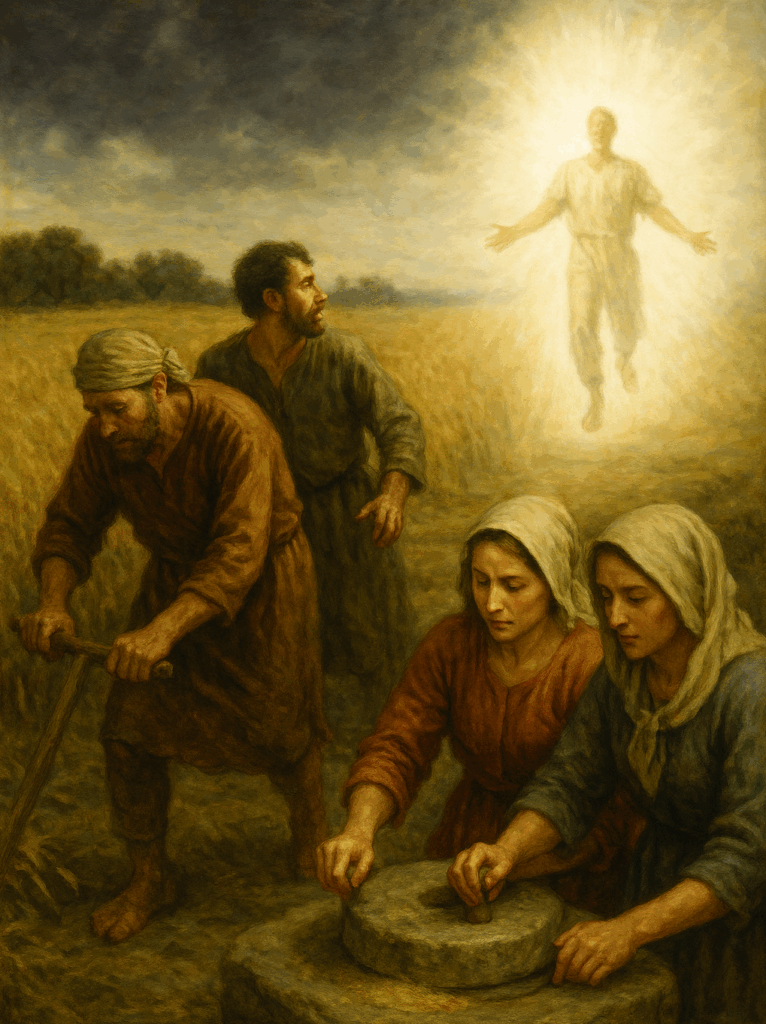
“Then shall two be in the field; the one shall be taken, and the other left.
Two women shall be grinding at the mill; the one shall be taken, and the other left.
Watch therefore: for ye know not what hour your Lord doth come.”

Would the disciples, to whom Jesus was speaking those words at that time and in that place, have understood Him to be referring to a future Rapture of the Church—where some people would disappear into the sky in a secret event, while their walking or working companions would be left behind on earth?

The context strongly suggests that they would not have understood His words to mean a future Rapture.

The immediately preceding verses, 37–39, compare the coming of the Son of Man to the days of Noah, when people were eating, drinking, and marrying—until the flood came and took them all away.

Plainly, the ones who were “taken” were those swept away in the flood in judgment. The ones left behind were Noah and his family, who were spared and remained on the earth to begin anew after the flood judgment.

Understanding this context should make it crystal clear who Jesus was referring to in Matthew 24:40–42 when He said, “One will be taken and one left.” The one taken is taken in judgment, not in a Rapture. And the one left remains to experience the blessings of the Kingdom—not the punishment of woe and tribulation.

Rethinking The Rapture: Introduction

Rethinking The Rapture: Questions

Rethinking The Rapture: More Questions

Rethinking The Rapture: N.T. Wright’s ‘Farewell to the Rapture’

Rethinking The Rapture: What 1 Thessalonians 4:16-17 Doesn’t Say

Rethinking The Rapture: Millions Of Christians Were Not Delivered From Wrath

Rethinking The Rapture: What Does ‘Delivered From Wrath’ Mean?

Rethinking The Rapture: What Does ‘Delivered From Wrath’ Mean? Part 2

Historical Facts And Background Of American Independence Day

Independence Day in the United States, commonly known as the Fourth of July, commemorates the adoption of the Declaration of Independence on July 4, 1776. On that day, the thirteen American colonies formally declared their independence from Great Britain, marking the birth of the United States of America.

Colonial Tensions with Britain

  • In the 1700s, the American colonies were governed by Great Britain, which imposed increasing taxes and trade restrictions.
  • Key grievances included:
    • The Stamp Act (1765) and Townshend Acts (1767) taxing colonists without representation in Parliament.
    • The Boston Massacre (1770) and Boston Tea Party (1773) intensified colonial resistance.
    • Britain’s harsh response to colonial protests further fueled revolutionary sentiment.

Move Toward Independence

  • In 1774, the First Continental Congress met to protest British policies.
  • Fighting began in April 1775 with the Battles of Lexington and Concord—the start of the Revolutionary War.
  • In 1776, momentum grew for a complete break from Britain.

Declaration of Independence

  • Drafted primarily by Thomas Jefferson, the Declaration was debated and revised by the Continental Congress.
  • It was officially adopted on July 4, 1776, in Philadelphia, Pennsylvania.
  • The document declared the colonies free and independent states and outlined Enlightenment ideals of liberty, equality, and the right to self-government.

Why July 4th?

  • July 4 is the date the final version of the Declaration was formally approved by Congress.
  • However, the actual signing occurred over the next few weeks and months.
  • John Adams, who advocated for independence, expected July 2 (when Congress voted for independence) to be the celebrated date, but July 4 became the tradition.

Early Celebrations

  • The first Independence Day celebrations included:
    • Public readings of the Declaration.
    • Parades, bonfires, and cannon fire.
    • Celebrations symbolized unity and defiance against tyranny.
  • By the early 1800s, July 4 had become the most important secular holiday in the U.S.

Becoming a National Holiday

  • Independence Day was declared a federal holiday in 1870.
  • It became a paid holiday for federal employees in 1938.

Rethinking The Rapture: In The Twinkling Of An Eye

Along with 1 Thessalonians 4:17, 1 Corinthians 15:52 is often uses as a ‘proof text’ for the Rapture.

1 Corinthians 15:52 – “In a moment, in the twinkling of an eye, at the last trump: for the trumpet shall sound, and the dead shall be raised incorruptible, and we shall be changed.” (KJV)

Let’s consider what this verse doesn’t say (a consideration I will continue to use often).
1 Corinthians 15:52 doesn’t say, “Believers will be instantaneously caught up into heaven in a secret Rapture which will be invisible and inexplicable to those left behind.”

The verse simply says and simply means that at Christ’s Second Coming all the dead will rise and all believers will be changed into immortal, glorified bodies in a nearly imperceptible moment of time.

There’s nothing in there about being secretly taken away for seven years and then coming back with Jesus for a Third Coming. There’s nothing in 1 Corinthians 15:52 that even remotely indicates that millions of Christians will suddenly simply disappear from the earth leaving the folks that are left behind to wonder what the hell just happened.

While the transformation of our mortal bodies to immortality will be miraculous and instantaneous, it will not be a secret event – on the contrary, it will be a glorious manifestation of Almighty God’s power and purpose for all of creation to behold.

Rethinking The Rapture: Introduction

Rethinking The Rapture: Questions

Rethinking The Rapture: More Questions

Rethinking The Rapture: N.T. Wright’s ‘Farewell to the Rapture’

Rethinking The Rapture: What 1 Thessalonians 4:16-17 Doesn’t Say

Rethinking The Rapture: Millions Of Christians Were Not Delivered From Wrath

Rethinking The Rapture: What Does ‘Delivered From Wrath’ Mean?

Rethinking The Rapture: What Does ‘Delivered From Wrath’ Mean? Part 2

Faith And The Founders

The overwhelming majority of the signers of the Declaration of Independence in 1776 were Christians. About half (roughly 32 to 34 signers) were affiliated with the Anglican Church, including George Washington.

A few key signers—most notably Thomas Jefferson, Benjamin Franklin, and John Adams—are often associated with Deism or Enlightenment rationalism. However, they still operated within a broadly Christian cultural framework. For instance:

  • Jefferson believed in God and moral teachings of Jesus but rejected the Trinity and miracles.
  • Franklin described himself as a Deist but often spoke positively about religion’s role in public virtue.
  • Adams was a devout Christian, though critical of Calvinist doctrines.

Providence in the Revolutionary War

“The hand of Providence has been so conspicuous in all this, that he must be worse than an infidel that lacks faith.”
— George Washington in a letter to Thomas Nelson, August 20, 1778

General Washington frequently spoke of “Providence” in his writings, referring to seemingly miraculous events which benefitted the American cause and led to the extremely improbable result of thirteen little colonies defeating the world’s most powerful empire.

A few examples:

The Fog at Brooklyn Heights (1776)

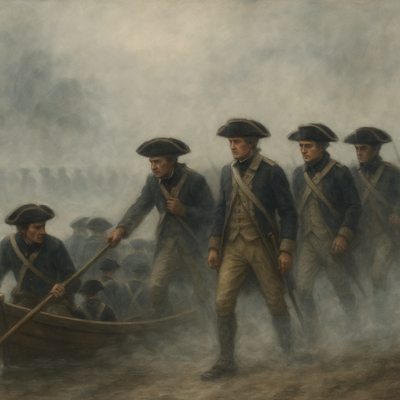
After the Battle of Long Island, Washington’s army was trapped by British forces. A thick fog descended unexpectedly, allowing his troops to retreat safely across the East River without British interference.

  • Many viewed this fog as a miraculous act of divine intervention.
  • Even British officers later admitted they were baffled by the escape.

The Storm That Saved Washington at Dorchester Heights (1776)

Washington fortified Dorchester Heights to threaten British-held Boston. A storm delayed British attacks long enough for the Americans to finish fortifications.

  • The British decided against assaulting the position.
  • Many patriots saw this as an act of God protecting the Continental Army.

The Victory at Saratoga (1777)

The American victory at Saratoga convinced France to join the war on the American side.

  • Clergy and political leaders interpreted this as a sign that God was guiding the cause of liberty.
  • Congress declared national days of thanksgiving in response.

Happy Independence Day, America!