A willing slave to the thing you hate?
Month: June 2025
Creed of the Fellowship of the Nons
Anyone who knows even a little bit about the Bible and the history of Christianity knows that it was the religious leaders of the time, along with their secular allies, that were responsible for the killing of the prophets, the reformers, and even the Son of God himself, Yeshua our Messiah.
The religious leaders. The wolves in sheep’s clothing. The whited sepulchers. The vipers. The religious leaders.
There is no new thing under the sun. Fallen human nature and the rot of man-made religion hasn’t changed since they murdered the prophets, burned the ‘heretics’, and tortured and crucified our Lord.
That is part of the reason why I do not subscribe to a modern denominational creed of set of doctrines. I don’t think that modern day Evangelicals, or Baptists, or Lutherans, or Catholics are going to burn anyone in the town square – it’s just that I don’t trust organized religion.
I’m non-denominational. I’m a ‘Non’. And there are a lot of others just like me, in fact more and more folks are fleeing traditional ‘churchianity’ every day. Why? More on that in future posts.
Here’s my one and only creed, which I’m happy share with my brothers and sisters in The Fellowship of the Nons:
Creed of the Fellowship of the Nons
Our living God is a loving God and the Bible is His revealed word and will.
Our hope and eternal salvation relies entirely on the work of God’s only begotten son, Jesus Christ, who is the way, the truth, and the life.
A huge part of the purpose and reason for the Bible Rebel blog is stated in our mission:
“To examine and question the assumptions of religious tradition and provide a resource for information and inspiration for people of faith who have become dissatisfied with an increasingly lifeless and empty ‘churchianity’.”
Watchdog Alert: Eye On The Vatican

Pope Leo XIV Blesses Giro d’Italia Cyclists in Historic Vatican Ride
On June 1, 2025, Pope Leo XIV blessed 159 cyclists participating in the Giro d’Italia as the race’s final stage commenced with a historic three-kilometer ride through the Vatican Gardens. This marked the first time the route entered Vatican walls. The peloton, including race leader Simon Yates, paused to meet the pope and presented him with a replica of the leader’s pink jersey. The route passed key Vatican landmarks, including St. Peter’s Basilica and the Santa Marta residence of the late Pope Francis. This event was part of the race’s neutralized zone before the competitive segment started. The 143-kilometer final stage concluded with a circuit through downtown Rome, ending near the Circus Maximus. This event marked Pope Leo XIV’s third engagement with the sports community since his recent election. – From AP
Pope Leo XIV Visits Castel Gandolfo, Raises Questions About Its Future Use
On May 29, 2025, Pope Leo XIV visited Castel Gandolfo, the traditional papal summer residence south of Rome. This raised questions about whether he will restore its use as a retreat or maintain it as a museum and environmental center, as his predecessor Pope Francis did. The estate, originally built in 1624 by Pope Urban VIII and spanning 136 acres—larger than Vatican City—served for centuries as a summer escape for popes. Pope Francis ended the tradition, opting to stay in Rome and opening the palace’s gardens to the public in 2014, later converting parts of the property into a museum to support local tourism. During his visit, Leo toured the Borgo Laudato Si, an environmental education initiative inspired by Francis’ 2015 encyclical “Praised Be.” This public project incorporates sustainable practices and operates a working farm that supplies the Vatican with fresh produce and dairy, embodying a vision for a “circular economy.” Leo, who previously served as a missionary in Peru, has not yet announced where he will reside in Rome or whether he will use Castel Gandolfo as a personal retreat. From AP
New Allegations Emerge in Emanuela Orlandi Disappearance Case
In May 2025, new allegations emerged in the decades-old mystery of Emanuela Orlandi, a 15-year-old Vatican schoolgirl who vanished in Rome in 1983. A blogger recently claimed on Facebook that Emanuela was pregnant and died following a botched abortion. The blogger, identified as MB, reportedly relied on an informant known only as LC, who claimed to have witnessed Emanuela’s visit to a gynecologist and was later asked to destroy related documents. Italian police have seized MB’s communication devices, and he is under investigation for aiding and abetting a crime after refusing to name his source. Emanuela’s brother Pietro Orlandi, a longstanding campaigner for truth in her case, has dismissed the claims as false and defamatory. Her disappearance has long been associated with conspiracy theories involving the Vatican, Cold War politics, and internal scandals. The Vatican, once criticized for obfuscation, opened its own investigation after Pope Francis cryptically told Pietro that “Emanuela was in heaven.” Rome magistrates reopened their inquiry in 2023, alongside a parliamentary investigation. These developments may pose early challenges for Pope Francis’s successor. – From The Times
Pope Leo XIV’s Inauguration Mass Draws Global Attention
On May 18, 2025, Pope Leo XIV celebrated the inauguration Mass of his pontificate, formally known as the Mass for the Beginning of the Petrine Ministry of the Bishop of Rome. The event was attended by approximately 200,000 people, including dozens of world leaders and 150 formal delegations. While Leo became the Roman pontiff at the moment of his acceptance in the Sistine Chapel upon being elected in the 2025 papal conclave, the inauguration celebration marked the formal beginning of his ministry as the bishop of Rome. The Mass included the bestowal of the pallium and Ring of the Fisherman, and was followed by meetings with various delegations and world leaders. In his homily, Pope Leo XIV emphasized unity and communion in the Church and the world, condemned exploitation of Earth’s resources and marginalization of the poor, and referenced his papal motto, “in the one Christ, we are one.” He concluded with the exhortation, “Look to Christ! Come closer to him!” – From Wikipedia
Why Must We Pray, Anyway: Part 1

Editors note: the guest article appearing here does not necessarily reflect the views of Bible Rebel editors or other guest authors and contributors. Bible Rebel seeks to present a wide range of ideas and viewpoints in order to fulfill our mission to provide resources for “Curious Fearless Faith”. This is Part 1 in a new series on prayer called ‘Why Must We Pray, Anyway’ by Steve Sann.
The Commandments of the Lord
God takes speaking in tongues seriously. How seriously? In the Pauline Epistles alone, we find there are more verses referencing speaking in tongues than contain the words “heaven” or “hell” combined!
I Corinthians 14 is the richest chapter in the Bible regarding tongues. In it is found an abundance of instructions, promises, and commandments clarifying God’s will for us on this vital subject. But, most notably, it concludes with this stern exhortation for us all:
I Corinthians 14:37-39:
If anyone thinks himself to be a prophet or spiritual, let him acknowledge that the things which I write to you are the commandments of the Lord.
But if anyone is ignorant, let him be ignorant. Therefore, brethren, desire earnestly to prophesy, and do not forbid to speak with tongues.
We are to accept the Lord’s instructions to us regarding tongues not merely as recommendations. These are commandments, not helpful suggestions. He expects every son and daughter to take their place as spirit-filled men and women. Frankly, should church elite, or loved ones agree, is of secondary significance to God. Then it should be to us, as well.
E.M. Bounds, the Civil War era author acclaimed in modern times as the “prophet of prayer,” accurately penned: “Only God can move mountains, but faith and prayer move God.” Yes, we move God…through prayer. If this alone was taught from the pulpits today, the very foundation of churches would be shaken. Yet, it is true: God is limited by the prayers of His people.
If we are to begin to grasp how the all-powerful God depends on us to exercise His power, we must first intelligently answer this question—a question feared by the faithful: “Why must we pray, anyway?” “After all,” the question begs, “if God loves us, knowing our every need even before we ask it, why must we pray at all? Can God not answer our prayers even without asking?!” Shocking to some, the answer is no. If not you, then someone else will have to pray on your behalf before God can meet that need.
Stay tuned for ‘Why Must We Pray, Anyway: Part 2’
Watchdog Alert: Biblical Archaeology
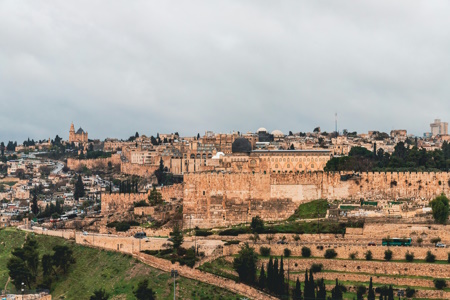
Ancient Cave Burial Reinterpreted as Herodian Royal Tomb
A cave southwest of Jerusalem, long venerated as the burial site of Salome, the midwife of Jesus, is now believed by archaeologists Vladik Lifshits and Nir-Shimshon Paran to be the tomb of a Herodian royal, possibly King Herod the Great’s sister, also named Salome. The site’s monumental architecture and ornate features align with elite Herodian-era tombs. Rediscovered in the 1980s, the cave contained hundreds of oil lamps, likely sold to Byzantine Christian pilgrims. While an ossuary inscribed with the name Salome was found, the name’s commonality necessitates further evidence to confirm the tomb’s occupant. – From Live Science
Evidence of Garden at Crucifixion Site Unearthed
Italian archaeologists from Sapienza University have uncovered 2,000-year-old grape and olive traces beneath the Church of the Holy Sepulchre in Jerusalem, traditionally identified as the site of Jesus’s crucifixion. This discovery supports the Gospel of John’s account of a garden at the crucifixion site. Soil and pollen analyses revealed ancient grape pips and olive stones, indicating cultivation before Emperor Hadrian’s reign, aligning with the time of Christ. The excavation, part of a restoration project begun in 2022, has been conducted with sensitivity due to the site’s religious significance, involving collaboration among major Christian denominations and the Israel Antiquities Authority. – From the New York Post
3,800-Year-Old Canaanite Scarab Found by Toddler
At Tel Azekah in Israel’s Shephelah region, a 3-year-old named Ziv Nitzan discovered a 3,800-year-old Canaanite scarab amulet during a family outing. The artifact, shaped like a dung beetle and dating to the Middle Bronze Age, was verified by expert Daphna Ben-Tor as a seal used for religious or status purposes. Scarabs held sacred symbolism in ancient Egypt, representing life and creation. Tel Azekah is historically notable for its biblical association with the story of David and Goliath. The find underscores the site’s historical richness and provides a tangible link to the ancient past. – From the New York Post
Subatomic Imaging Reveals Hidden Structures in Ancient Jerusalem
A team of Israeli archaeologists and physicists has employed muon detectors—devices that utilize cosmic-ray muons—to non-invasively explore subterranean structures in ancient Jerusalem. Focusing on “Jeremiah’s cistern” near the City of David, the detectors have begun mapping hidden voids and structural anomalies beneath the surface. This innovative approach allows researchers to investigate areas that are otherwise inaccessible due to practical and political constraints, offering new insights into Jerusalem’s 5,000-year history without the need for destructive excavation methods. – From Christianity Today