Your Life And What Comes After (31): Ending The End Of The World?

So what is the Book of Revelation all about?

It’s about the victory of God over evil by way of His grand plan through Jesus Christ.

It’s about God winning even when it looks like Satan and the wicked kingdoms of this world have all the power.

It’s about God’s people staying faithful and trusting in Him – no matter how long it takes until He sets things right.

Revelation is meant to encourage and bless God’s people – not scare them or cause them to freak out over 666 and the Antichrist.

The End is Really a Beginning

After Jesus was raised from the dead, he spent many days with his followers, being with them and teaching them about things to come. They asked him about the end of the world as they knew it.

And the same is true for us today, over 2,000 years later — no one knows when the end times will come. So, if you hear someone say they know the date that Jesus will return, you can be sure that they really don’t know. Only God knows.

But don’t think of it as the end of the world, because it will actually be the beginning of forever — with God and each other in a glorious new creation.

I’m not sure who first said this, but it’s worth saying again here: “In the end, everything will be all right. And if it’s not all right, it’s not the end.”

Next, we’ll start digging into what that glorious new forever looks like.
Your Life And What Comes After (30): What’s Going On In Revelation?

There are lots of fiction novels and movies about the end of the world, and some of those stories use the images and words from the Bible’s Book of Revelation.

Let’s not get all worked up and frightened by novels and movies, though. Let’s look at what Revelation actually says and doesn’t say, rather than what others say about it.

It helps to get an idea of the “who” and “what” of Revelation. It is a short book written around 2,000 years ago by a man named John, describing a vision from God, and then sent out in a scroll to be read to groups of believers.

Our goal here is not to do a deep study of it, but it’s important to understand that Revelation is a vision with deeper meanings beneath what many of the words seem to be saying at first.

At times in the Bible God gave visions and dreams to people, using mysterious pictures and symbols that aren’t meant to be taken literally.

Years Not Ears

Here’s an example from the Old Testament Book of Genesis where Pharaoh tells Joseph about a dream he had and Joseph tells him what it meant:

See? The ears of corn weren’t meant to be understood as actual ears of corn, they were dream symbols that actually meant years.

Most of Revelation is just like that – you have to understand the symbols and how the people back in that time and place would have understood those symbols. By the way, the time was about 2,000 years ago and the place was Asia Minor, which is the modern-day country of Turkey, under the rule of the ancient Roman Empire.

Symbols in Revelation

Here’s what Jesus looked like in John’s vision in the first chapter of Revelation:

Does Jesus actually look like this? Does he have a sword coming out of his mouth and feet made of brass? No, these are symbols and images to tell us something deeper. And if we want to understand what those symbols mean we first have to understand how the people who first heard and read those words understood them.

That makes for an interesting, but much longer study. For now, let’s take a peek at the overall subject and point of the Book of Revelation. That’s coming next.

Your Life And What Comes After (29): Starting The End Of The World

Adriana, a football fan, wrote a letter to her friend who also really liked following and watching football games. In the letter, Adriana described a high school football game she went to recently like this:

“It was raining cats and dogs as if the sky had sprung a leak, but the game marched on as if the gridiron were Noah’s front yard. The quarterback was trying to thread the needle through a secondary playing tighter than a drum. Some of the fans were hollering that the offense needed to stop shooting themselves in the foot with their false starts and do a better job of establishing the run.

By the second half, the field had turned into a mud pit worthy of a hog-calling contest, and the players were slipping and sliding like greased lightning. The defense was bringing the house with all-out blitzes on three straight downs. Finally, midway through the fourth quarter, our junior kicker split the uprights. The score held, and that missed point-after attempt in the first quarter didn’t come back to haunt our squad.”

If you aren’t familiar with American football, then Adriana’s report on the game would be kind of confusing to you.

Now just try to imagine how strange and confusing that letter would sound to a young girl in a little fishing village in a faraway country who knew nothing about America, football, or the figures of speech in the English language, like “shooting themselves in the foot.” That young girl would have to see everything through the eyes of the friend Adriana wrote the letter to in order to understand its meaning.

The Book of Revelation

Have you ever heard about the Antichrist, or the mark of the beast, 666? How about stars falling from heaven, earthquakes and wars, and the four horsemen of the Apocalypse at the end of the world?

Those are all images from the Book of Revelation, the last book in the Bible, which is full of strange language, numbers, and symbols that some say foretells what will happen at the end of the world.

Here we are in modern times reading Revelation kind of like the young girl in the faraway fishing village reading Adriana’s letter, not really understanding that “raining cats and dogs” doesn’t mean that thousands of cats and dogs are actually falling out of the sky.

So, what do all of those weird visions and scary beasts and such we hear about in stories about the end of the world actually mean? Is Revelation a play-by-play, exact preview of what’s going to happen to us at the end of the world?

Nah.

Next, we’ll take a closer look at it all.

Rethinking The Rapture: What Does ‘Delivered From Wrath’ Mean? Part 2

In this post I want to wrap up our brief discussion on what the phrase “delivered from the wrath to come” in 1 Thessalonians 1:10 means.

1 Thessalonians 1:10 – “And to wait for his Son from heaven, whom he raised from the dead, even Jesus, which delivered us from the wrath to come.” (KJV)

Notice what this verse doesn’t say. It doesn’t say, “Jesus will come from heaven and pull us into the sky with him, then take us away so that we won’t have to suffer a seven-year tribulation period.”

Paul certainly had the vocabulary to say that if that is what God had wanted him to write to the Thessalonians.

Notice also that the tense of the verb “delivered” (rhuomenon) in the Greek is the present participle form which implies ongoing or continuous action: “the one who is delivering” or “who delivers.” It suggests a current, ongoing protection from wrath, not a specific future time period of seven years or some other period of time.

Believers can be, are being, and will be delivered from wrath without being taken up into heaven. In other words, God is more than able to protect and shield His people in all circumstances and places, even great tribulation on earth, through the mercy and grace provided in Jesus Christ.

My personal rule in reading the Bible is to first consider how the original readers for whom the words were written would understand the text in its broader historical, biblical, and cultural context, as well as it’s more immediate textual context.

So, do you suppose the First Century Thessalonians would have understood this verse to mean, “Hey, y’all, don’t worry about the seven years of wrath coming in the Great Tribulation period, you won’t have to go through that because Jesus will scoop us up and out of here before that happens.”?

I think that one can only come to that interpretation by reading a great deal of pre-conceived pop theology into the scripture, rather than just reading what’s plainly written.

More on “Rethinking The Rapture” coming soon.


Rethinking The Rapture: Introduction

Rethinking The Rapture: Questions

Rethinking The Rapture: More Questions

Rethinking The Rapture: N.T. Wright’s ‘Farewell to the Rapture’

Rethinking The Rapture: What 1 Thessalonians 4:16-17 Doesn’t Say

Rethinking The Rapture: Millions Of Christians Were Not Delivered From Wrath

Rethinking The Rapture: What Does ‘Delivered From Wrath’ Mean?

Rethinking The Rapture: More Questions

According to the standard Evangelical/Dispensational Rapture doctrine, the Rapture occurs before the apocalyptic events of the Book of Revelation begin to unfold.

So why is the Rapture not explicitly mentioned in Revelation, not even once?

Why would the most shocking, impactful, and monumental event (supposedly) in the Bible and in human history; an event that miraculously and suddenly removes millions of people from the earth triggering the beginning of a worldwide apocalypse, not be mentioned at all in the book of the Bible called the Apocalypse?

Yes, I’m aware of the interpretations of Revelation 4:1-2, where John is called up to heaven, supposedly being a symbolic reference to the Rapture. I’m not buying it though. That kind of handling of the Word is a perfect example of reading a preconceived notion into scripture rather than letting scripture speak for itself.

To speculate that Revelation 4:1, where John heard a voice that said, “Come up hither, and I will shew thee things which must be hereafter…” is referring to the Rapture seems to me a weak, almost desperate, argument. And the same for the ‘missing church’ argument that claims the absence of the Greek word for ‘church’, ekklesia, after Revelation chapter 3 implies a Rapture occurs somewhere between chapter 3 and 4.

The Rapture is not mentioned at all in the Book of Revelation. Why?

More to come in this ongoing series, “Rethinking The Rapture”.

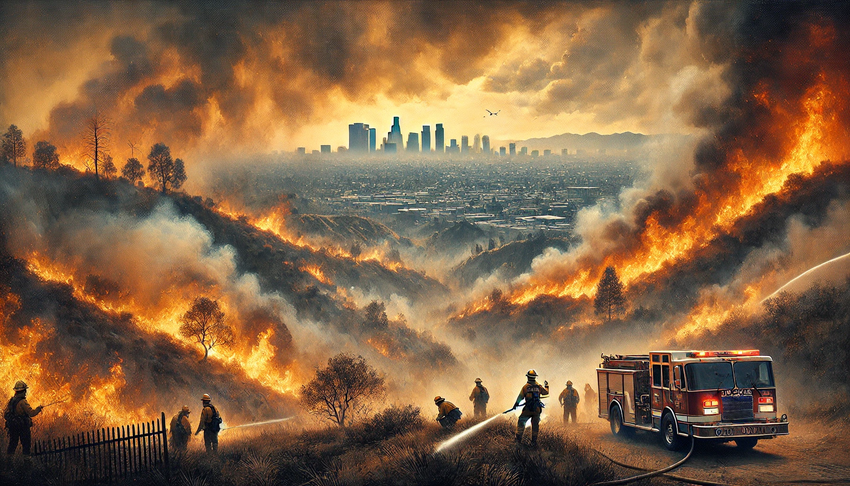
Are The L.A. Fires ‘The Wrath of God’

No doubt there are going to be those who claim that the current devastating wildfires in Los Angeles are God’s wrath being poured out on a sinful and wicked city and state.

And sadly, this kind of ‘hellfire and brimstone’ nonsense will be preached by so-called ‘Christians’ as it has been countless times when death and tragedy strikes a particular community or geographical area. No wonder people are abandoning traditional and Evangelical Christian churches in droves.

Let’s look at the answer Jesus gave to his questioners in Luke 13:1-5 when they asked him about Pilate slaughtering a group of Galileans:

“There were present at that season some that told him of the Galilaeans, whose blood Pilate had mingled with their sacrifices.

And Jesus answering said unto them, Suppose ye that these Galilaeans were sinners above all the Galilaeans, because they suffered such things I tell you, Nay: but, except ye repent, ye shall all likewise perish.

Or those eighteen, upon whom the tower in Siloam fell, and slew them, think ye that they were sinners above all men that dwelt in Jerusalem? I tell you, Nay: but, except ye repent, ye shall all likewise perish.

Our Lord could not be more clear. Disaster, suffering, and death, natural or man-caused, are not meted out according to the level of sinfulness present in an area. Bad things don’t happen to bad people exclusively, and tragedy is NOT a sign of God’s judgement in this present age.

However, there is a time coming when God’s judgement and restoration will fall on the entire creation. The Apocalypse is real, but it is reserved for a future time, and those who have already accepted and covered themselves in the sacrifice of the Lamb are spared from that great and terrible day.