Lucas was walking home from school when he spotted a man on the corner holding a cardboard sign that read “THE END IS NEAR.” People hurried past without looking, but Lucas stopped. The man’s shoulders sagged, his eyes heavy with worry, as if he’d been standing there a long time.
Lucas studied the sign, then looked up at him with a small smile. “I think you’ve got it backwards,” he said. “Actually, the beginning is near.” The man blinked, startled. Lucas added, “My mom says every ending starts something new. Maybe things aren’t ending—maybe they’re about to get better.” He waved and continued down the sidewalk, leaving the man staring at his sign, wondering if the boy might be right.
This world and this life are not all there is. The way things are now is not the way they will always be, because God is taking the world to someplace new and very exciting.
What comes after the end of the world? What will it look like as God completes His grand plan to bring His family into a new creation and into everlasting life with Him?
We’ll explore the three most important events, according to God’s promises, that are coming our way as the grand plan unfolds and comes to its completion.
The Return of Jesus Christ
The Kingdom of Heaven
Heaven on Earth Forever
Remember, “In the end, everything will be all right. And if it’s not all right, it’s not the end.”
Let’s look at the “everything will be all right” part together, up next.
It’s about the victory of God over evil by way of His grand plan through Jesus Christ.
Revelation 11:15 And the seventh angel sounded; and there were great voices in heaven, saying, The kingdoms of this world are become the kingdoms of our Lord, and of his Christ; and he shall reign for ever and ever.
It’s about God winning even when it looks like Satan and the wicked kingdoms of this world have all the power.
Revelation 17:14 These shall make war with the Lamb, and the Lamb shall overcome them: for he is Lord of lords, and King of kings: and they that are with him are called, and chosen, and faithful.
It’s about God’s people staying faithful and trusting in Him – no matter how long it takes until He sets things right.
Revelation 21:3–4 And I heard a great voice out of heaven saying, Behold, the tabernacle of God is with men, and he will dwell with them, and they shall be his people, and God himself shall be with them, and be their God. And God shall wipe away all tears from their eyes; and there shall be no more death, neither sorrow, nor crying, neither shall there be any more pain: for the former things are passed away.
Revelation is meant to encourage and bless God’s people – not scare them or cause them to freak out over 666 and the Antichrist.
Revelation 1:3 Blessed is he that readeth, and they that hear the words of this prophecy, and keep those things which are written therein: for the time is at hand.
The End is Really a Beginning
After Jesus was raised from the dead, he spent many days with his followers, being with them and teaching them about things to come. They asked him about the end of the world as they knew it.
Acts 1:6-7 When they therefore were come together, they asked of him, saying, Lord, wilt thou at this time restore again the kingdom to Israel? And he said unto them, It is not for you to know the times or the seasons, which the Father hath put in his own power.
And the same is true for us today, over 2,000 years later — no one knows when the end times will come. So, if you hear someone say they know the date that Jesus will return, you can be sure that they really don’t know. Only God knows.
Matthew 24:30 & 36 And then shall appear the sign of the Son of man in heaven: and then shall all the tribes of the earth mourn, and they shall see the Son of man coming in the clouds of heaven with power and great glory… …But of that day and hour knoweth no man, no, not the angels of heaven, but my Father only.
But don’t think of it as the end of the world, because it will actually be the beginning of forever — with God and each other in a glorious new creation.
Revelation 21:2-5 And I John saw the holy city, new Jerusalem, coming down from God out of heaven, prepared as a bride adorned for her husband. And I heard a great voice out of heaven saying, Behold, the tabernacle of God is with men, and he will dwell with them, and they shall be his people, and God himself shall be with them, and be their God. And God shall wipe away all tears from their eyes; and there shall be no more death, neither sorrow, nor crying, neither shall there be any more pain: for the former things are passed away. And he that sat upon the throne said, Behold, I make all things new. And he said unto me, Write: for these words are true and faithful.
I’m not sure who first said this, but it’s worth saying again here: “In the end, everything will be all right. And if it’s not all right, it’s not the end.”
Next, we’ll start digging into what that glorious new forever looks like.
There are lots of fiction novels and movies about the end of the world, and some of those stories use the images and words from the Bible’s Book of Revelation.
Let’s not get all worked up and frightened by novels and movies, though. Let’s look at what Revelation actually says and doesn’t say, rather than what others say about it.
It helps to get an idea of the “who” and “what” of Revelation. It is a short book written around 2,000 years ago by a man named John, describing a vision from God, and then sent out in a scroll to be read to groups of believers.
Our goal here is not to do a deep study of it, but it’s important to understand that Revelation is a vision with deeper meanings beneath what many of the words seem to be saying at first.
At times in the Bible God gave visions and dreams to people, using mysterious pictures and symbols that aren’t meant to be taken literally.
Years Not Ears
Here’s an example from the Old Testament Book of Genesis where Pharaoh tells Joseph about a dream he had and Joseph tells him what it meant:
Genesis 41:22-26 And I saw in my dream, and, behold, seven ears came up in one stalk, full and good: And, behold, seven ears, withered, thin, and blasted with the east wind, sprung up after them: And the thin ears devoured the seven good ears: and I told this unto the magicians; but there was none that could declare it to me. And Joseph said unto Pharaoh…God hath shewed Pharaoh what he is about to do. …the seven good ears are seven years…
See? The ears of corn weren’t meant to be understood as actual ears of corn, they were dream symbols that actually meant years.
Most of Revelation is just like that – you have to understand the symbols and how the people back in that time and place would have understood those symbols. By the way, the time was about 2,000 years ago and the place was Asia Minor, which is the modern-day country of Turkey, under the rule of the ancient Roman Empire.
Symbols in Revelation
Here’s what Jesus looked like in John’s vision in the first chapter of Revelation:
Revelation 1:13-16 And in the midst of the seven candlesticks one like unto the Son of man, clothed with a garment down to the foot, and girt about the paps with a golden girdle. His head and his hairs were white like wool, as white as snow; and his eyes were as a flame of fire; And his feet like unto fine brass, as if they burned in a furnace; and his voice as the sound of many waters. And he had in his right hand seven stars: and out of his mouth went a sharp two-edged sword: and his countenance was as the sun shineth in his strength.
Does Jesus actually look like this? Does he have a sword coming out of his mouth and feet made of brass? No, these are symbols and images to tell us something deeper. And if we want to understand what those symbols mean we first have to understand how the people who first heard and read those words understood them.
That makes for an interesting, but much longer study. For now, let’s take a peek at the overall subject and point of the Book of Revelation. That’s coming next.
Adriana, a football fan, wrote a letter to her friend who also really liked following and watching football games. In the letter, Adriana described a high school football game she went to recently like this:
“It was raining cats and dogs as if the sky had sprung a leak, but the game marched on as if the gridiron were Noah’s front yard. The quarterback was trying to thread the needle through a secondary playing tighter than a drum. Some of the fans were hollering that the offense needed to stop shooting themselves in the foot with their false starts and do a better job of establishing the run.
By the second half, the field had turned into a mud pit worthy of a hog-calling contest, and the players were slipping and sliding like greased lightning. The defense was bringing the house with all-out blitzes on three straight downs. Finally, midway through the fourth quarter, our junior kicker split the uprights. The score held, and that missed point-after attempt in the first quarter didn’t come back to haunt our squad.”
If you aren’t familiar with American football, then Adriana’s report on the game would be kind of confusing to you.
Now just try to imagine how strange and confusing that letter would sound to a young girl in a little fishing village in a faraway country who knew nothing about America, football, or the figures of speech in the English language, like “shooting themselves in the foot.” That young girl would have to see everything through the eyes of the friend Adriana wrote the letter to in order to understand its meaning.
The Book of Revelation
Have you ever heard about the Antichrist, or the mark of the beast, 666? How about stars falling from heaven, earthquakes and wars, and the four horsemen of the Apocalypse at the end of the world?
Those are all images from the Book of Revelation, the last book in the Bible, which is full of strange language, numbers, and symbols that some say foretells what will happen at the end of the world.
Here we are in modern times reading Revelation kind of like the young girl in the faraway fishing village reading Adriana’s letter, not really understanding that “raining cats and dogs” doesn’t mean that thousands of cats and dogs are actually falling out of the sky.
So, what do all of those weird visions and scary beasts and such we hear about in stories about the end of the world actually mean? Is Revelation a play-by-play, exact preview of what’s going to happen to us at the end of the world?
Have you ever heard anyone say, “If you’re bad, you’re going down there!” as they point to the ground?
The idea that you’ll go “up there” if you’re good and “down there” if you’re bad is not an idea found in the Bible, and is not part of God’s grand plan.
Cartoon devils with pitchforks tossing bad people into flames and movie images of an underground fire pit of hell are pictures and ideas that have been made up by some to scare others for various reasons. Can you think of why some people in the old days, and even now, would do that?
What and Where Is Hell
The Bible does teach that there is some kind of punishment for people, and for evil spiritual forces, who do evil things on purpose and who don’t want or accept God’s love and forgiveness. So, hell is a kind of punishment and judgment for them.
But just like heaven isn’t a location somewhere in the universe but instead the realm where God exists, hell also isn’t a physical location somewhere, but instead a description of God’s judgment on evil.
But punishment and judgment for who, where, and when — and what kind of punishment is it?
Those are questions that people who have studied the Bible, now and in the past, have had very different answers for.
Some believe that everyone who is bad or doesn’t accept God’s forgiveness goes to hell when they die to burn forever, and those who are good and accept God’s forgiveness go to heaven to play harps and sing praises forever. I don’t believe that either of those ideas is what the Bible teaches.
Fear Not
The Bible teaches that God’s plan includes a day and time when God will raise all people from the dead, and then comes the judgment. If we have put our faith in Jesus Christ, then we know that when that day comes, He has taken any punishment or judgment we may deserve on Himself. We are forgiven and cleared for takeoff into eternal life with our Savior and with our Heavenly Father.
Over and over in God’s Word, He encourages His people to “fear not” or “don’t be afraid.” About 140 times, in fact. At least six times in the Bible, it was the first thing angels said when they appeared to people.
When it comes to the topic of hell, we should all focus on the “fear not” message rather than the “be afraid of hell, you sinner” message.
What’s Next?
As I said a little bit ago, God’s plan includes a day and time when God will raise all people from the dead. Next, we’ll be talking about what happens during that day and time, and what it means for you and me.
Adriana pressed her forehead gently against the cool windowpane, watching the trees sway and dance as if whispering secrets to one another. She could see the branches bend, the leaves shimmer, and the grass ripple in soft waves, yet the wind itself remained invisible—always present, always felt, but never seen. As she watched the world move without a visible mover, she wondered how something so real could hide so completely, as if the wind were a shy friend who preferred to speak through the trees rather than show its face.
In the Bible, ‘heaven‘ often simply means the spiritual realm where God lives, not an actual place up in the clouds with angels, pearly gates, and such.
But where is that place where God lives actually located? I like the way N. T. Wright, a Bible teacher, puts it:
‘Heaven’ and ‘earth’, as I have often said, are not, in biblical theology, separated a great gulf, as they are in much popular imagination. ‘Heaven’, God’s sphere of reality, is right here close beside us, intersecting with our ordinary reality. It is not so much like a door opening high up in the sky, far away. It is more like a door opening right in front of us where before we could only this room, this field, this street. Suddenly, there is an opening leading into a different world…
N.T. Wright – Revelation For Everyone
Going to Heaven?
Did you know that the Bible never uses the phrases “go to heaven” or “going to heaven” to describe what happens to people when they die? That’s because heaven isn’t a place where people are going someday; it’s a place where God is right now.
Heaven isn’t a place that we go as a reward for being good, like Disneyland. It’s not a location on a map, like Chicago or New York, that we can find directions to or roads that take us there.
So, where is that place where God lives? Well, it’s all around us. It’s next to us, above us, and below us. God lives in the unseen places that surround and fill everything.
Like the wind all around us that we can’t see, yet moving the things that we can see.
We’ve talked about heaven quite a bit; next, we’ll take a little tour of how we should think about hell. Ooooohhhhhh!
Where exactly is heaven? Is it up in the clouds? In outer space? On another planet, or in a galaxy far away?
Before we can understand where heaven is, we should first know what heaven is. When heaven is mentioned in the Bible, it can either mean any place above the ground or it can mean the realm in which God lives.
Anywhere Above the Ground
Genesis 1:20 And God said, Let the waters bring forth abundantly the moving creature that hath life, and fowl that may fly above the earth in the open firmament of heaven.
The birds we often see flying above us are in heaven, so to speak.
The stars, clouds, and planets are also above the ground, and there are many verses in the Bible that talk about those things being in the heavens.
Where God Lives
Matthew 6:9 After this manner therefore pray ye: Our Father which art in heaven, Hallowed be thy name.
This verse says that our Father, God, is in heaven. Does that mean He’s flying around with the birds that are in heaven? No, of course not.
Here the Bible is talking about a different kind of heaven. This heaven is the realm where God lives—invisible to our eyes, yet very real and near.
Acts 17:27-28 That they should seek the Lord, if haply they might feel after him, and find him, though he be not far from every one of us: For in him we live, and move, and have our being; as certain also of your own poets have said, For we are also his offspring.
The main idea about heaven that we should understand is that it is not a place up in the clouds where we go someday after we die to get wings and play harps if we’re good in this life.
Heaven is a place we can go to now—and every day—in prayer, to be in the presence of our Father, God.
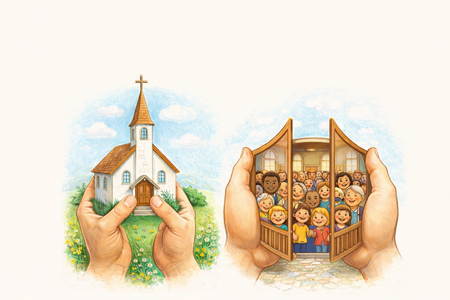
Have you ever heard the nursery rhyme that goes like this—‘Here’s the church, here’s the steeple, open the doors and see all the people’?
Is the Church Age about church buildings, or is it about people? In the Bible’s New Testament books after the Gospels of Matthew, Mark, Luke, and John, the ‘Church’ always refers to the people who believe that Jesus Christ is the Savior and Son of God.
Just as the Old Testament was instruction for the people who lived back in those times on how to walk in God’s purposes, and the Gospels of Matthew, Mark, Luke, and John show us how Jesus lived according to God’s plan, the New Testament books after the Gospels now instruct us today on how to do the same.
Seek God First
Colossians 3:1–2 If ye then be risen with Christ, seek those things which are above, where Christ sitteth on the right hand of God. Set your affection on things above, not on things on the earth.
Spend some time every morning praying and just enjoying the presence of God, speaking to Him and letting Him speak to you.
Add Value to the World Around You
Galatians 6:9-10 And let us not be weary in well doing: for in due season we shall reap, if we faint not. As we have therefore opportunity, let us do good unto all men, especially unto them who are of the household of faith.
Do meaningful work. Gain knowledge and learn valuable skills. Help and serve others around you in real ways that meet real needs.
Do Hard Things Without Fear
2 Timothy 1:7 For God hath not given us the spirit of fear; but of power, and of love, and of a sound mind.
Don’t ever be afraid of hard work or of doing hard things. God loves you and has already given you great strength and courage.
Fight Darkness with Light
Romans 13:12 The night is far spent, the day is at hand: let us therefore cast off the works of darkness, and let us put on the armour of light.
Stand up, speak up, and show up. Dispel the darkness around you by shining forth God’s love and light.
The You Miracle
Always remember that you are a miracle, and that God’s plan includes you in His family and household. See yourself as God sees you: His beautiful child.
Plug into God’s purposes and plan, and your life will be an exciting adventure as a co-worker with the Creator of the universe!
Next, we’ll start our journey into understanding heaven, hell, and the end of the world.
A wise king once chose a quiet stretch of countryside and there he built a house so vast it was the size of a town, with countless rooms, wide halls, and courtyards. When it was finished, he sent his loyal servants to live inside it. Their work was to prepare every room—sweeping floors, setting tables, lighting lamps, and making each place ready for life. Yet the king gave one puzzling command: the doors were to remain locked. The servants obeyed, working faithfully day after day, hearing the sounds of people passing by outside but never opening the doors to them.
At the right time, the king sent his son, the prince, to the great house. Unlike the servants, the prince carried the keys. He walked through the halls, threw open the doors, and called out to the people from every road and field, inviting them to come in. Families, strangers, and wanderers entered together, filling the rooms with laughter and conversation.
The prince welcomed them to live with him, not as guests but as family, alongside the servants who had prepared the house. And at last the king’s house became what it was always meant to be—a living home where many shared one life under the care of the king’s son.
That Sign at Football Games
In the Old Testament, God worked through Israel to carry out His plan. Then came Jesus, who completed that plan through His life, His death on the cross, and His resurrection from the grave.
Because of what Jesus did, we are now in the Church Age, where all people—not just the people of Israel—are invited into the household of God.
Have you ever seen the signs people hold up at football games for the TV cameras that say, “John 3:16”? That verse tells us what God’s plan was all along and why Jesus is the most important part of that grand plan.
John 3:16 For God so loved the world, that he gave his only begotten Son, that whosoever believeth in him should not perish, but have everlasting life.
Whosoever. Not just some, but everyone is invited to take part in the goal of God’s plan through Jesus Christ—everlasting life.
Next, we’ll look at how we plug into God’s plan in this new Church Age. Hint: it’s not different from the ways we’ve already talked about.
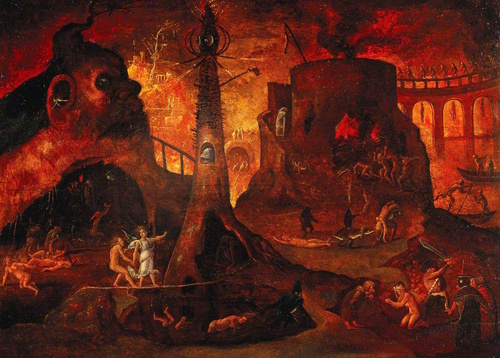
Bosch, Hieronymus; An Angel Leading a Soul into Hell; Wellcome Library; http://www.artuk.org/artworks/an-angel-leading-a-soul-into-hell-125754
In upcoming posts we’ll be exploring the three major Christian doctrines concerning the theology of hell.
Annihilationism (often called “conditional immortality”)
Infernalism (eternal conscious torment)
Universalism (everyone winds up in “heaven” eventually)
We start with annihilationism and some quotes from three prominent theologians/scholars who hold the conditional immortality view.
John Stott (Anglican theologian, pastor)
“Emotionally, I find the concept of hell intolerable and do not understand how people can live with it without either cauterizing their feelings or cracking under the strain. … My question must be—and is—not what does my heart tell me, but what does God’s word say? And it seems to me that the annihilation of the wicked is more consistent with the biblical emphasis on the finality of judgment and the gift of immortality to the redeemed alone.”
John Stott & David Edwards, Evangelical Essentials (InterVarsity Press, 1988)
Edward Fudge (biblical scholar, author of The Fire That Consumes)
“The wicked will finally perish. They will be no more. This conclusion rests on the consistent testimony of Scripture that immortality is a gift God gives only to the redeemed, and that the lost suffer punishment ending in death, not everlasting life in misery.”
Edward Fudge, The Fire That Consumes (3rd ed., Cascade Books, 2011)
Clark H. Pinnock (theologian, professor)
“Hell is not torture forever but the final destruction of the wicked. God does not sustain the wicked in endless conscious agony; rather, they are finally and completely destroyed, which better reflects both biblical language and the justice of God.”
Clark H. Pinnock, “The Destruction of the Finally Impenitent,” in Criswell Theological Review (1990)