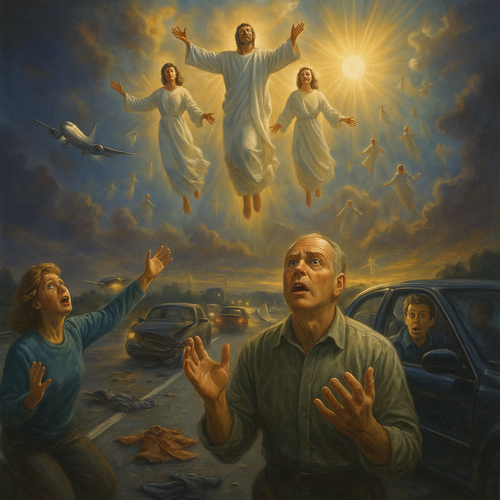
Rethinking The Rapture: What Does ‘Delivered From Wrath’ Mean? Part 2

In this post I want to wrap up our brief discussion on what the phrase “delivered from the wrath to come” in 1 Thessalonians 1:10 means.

1 Thessalonians 1:10 – “And to wait for his Son from heaven, whom he raised from the dead, even Jesus, which delivered us from the wrath to come.” (KJV)

Notice what this verse doesn’t say. It doesn’t say, “Jesus will come from heaven and pull us into the sky with him, then take us away so that we won’t have to suffer a seven-year tribulation period.”

Paul certainly had the vocabulary to say that if that is what God had wanted him to write to the Thessalonians.

Notice also that the tense of the verb “delivered” (rhuomenon) in the Greek is the present participle form which implies ongoing or continuous action: “the one who is delivering” or “who delivers.” It suggests a current, ongoing protection from wrath, not a specific future time period of seven years or some other period of time.

Believers can be, are being, and will be delivered from wrath without being taken up into heaven. In other words, God is more than able to protect and shield His people in all circumstances and places, even great tribulation on earth, through the mercy and grace provided in Jesus Christ.

My personal rule in reading the Bible is to first consider how the original readers for whom the words were written would understand the text in its broader historical, biblical, and cultural context, as well as it’s more immediate textual context.

So, do you suppose the First Century Thessalonians would have understood this verse to mean, “Hey, y’all, don’t worry about the seven years of wrath coming in the Great Tribulation period, you won’t have to go through that because Jesus will scoop us up and out of here before that happens.”?

I think that one can only come to that interpretation by reading a great deal of pre-conceived pop theology into the scripture, rather than just reading what’s plainly written.

More on “Rethinking The Rapture” coming soon.


Rethinking The Rapture: Introduction

Rethinking The Rapture: Questions

Rethinking The Rapture: More Questions

Rethinking The Rapture: N.T. Wright’s ‘Farewell to the Rapture’

Rethinking The Rapture: What 1 Thessalonians 4:16-17 Doesn’t Say

Rethinking The Rapture: Millions Of Christians Were Not Delivered From Wrath

Rethinking The Rapture: What Does ‘Delivered From Wrath’ Mean?
Why Must We Pray, Anyway: Part 4

Editors note: the guest article appearing here does not necessarily reflect the views of Bible Rebel editors or other guest authors and contributors. Bible Rebel seeks to present a wide range of ideas and viewpoints in order to fulfill our mission to provide resources for “Curious Fearless Faith”. This is Part 4, the final part, in a new series on prayer called ‘Why Must We Pray, Anyway’ by Steve Sann.

Why Must We Pray, Anyway: Part 1
Why Must We Pray, Anyway: Part 2
Why Must We Pray, Anyway: Part 3


Holding Back the Destruction

With this in mind, it is easy to understand the spiritual pressure mounting from this world to minimize the importance of prayer. All the while, however, it is only the “believing believers,” those who remain active in prayer, who continue to restrain the powers of darkness from raiding and destroying.

II Thessalonians2:6-8a:

And now you know what is restraining, that he [the “son of perdition”; i.e., the anti-Christ] may be revealed in his own time.
For the mystery of lawlessness is already at work; only He who now restrains will do so until He is taken out of the way.
And then the lawless one will be revealed…

We know Satan is the god, the authority, of this world. It is his to destroy. So, we must ask: Why hasn’t Satan completed his objective of annihilating the earth and all the people in it? After all, he’s “large and in charge!”

As long as the believers—those who actually call upon God in prayer—are intermixed within Satan’s kingdom, the grand finale of Satan’s power cannot be revealed. But the day will come at Christ’s return when the believers will be taken out of the way (1 Thessalonians 4:16-17), and the authorities of Satan will usurp preeminence. This event of our departure is detailed in I Thessalonians 4 and referred to in II Thessalonians 2:1 as the Gathering Together, in more recent times as the Rapture.

Until that day, however, it is the believers who restrain Satan’s rage. Yet, not just any believer; it is the “believing believer” that stands between the people of this world and Satan’s wholesale wrath.

Who are these “believing believers”? These are not just the people who have attended a few church fellowships, perhaps have read a lot of the bible, or even who are merely born-again. Satan has been haply running over these folks for centuries. No—rather, the believers spoken of here are those who have sharpened their skills at bringing the powers of heaven to bear on earth—by walking in their sonship rights, claiming their authority, walking in the spirit, and petitioning God. We are speaking here of the true intercessors, those who bring the fight into the streets.

These are they who cannot be destroyed because they reside within the cone of God’s presence. And until they are taken out of the way at Christ’s return, it is they who restrain Satan’s ultimate will upon this world and its inhabitants.

Since man’s expulsion from the garden, throughout history, there has always been at least one “believing believer” standing, interceding on behalf of protecting God’s people. In fact, in the Old Testament, this was taught: it was understood as a vital responsibility of every man and woman of God to readily intercede for God’s people.

Rethinking The Rapture: What Does ‘Delivered From Wrath’ Mean?

Many Rapturists believe that 1 Thessalonians 1:10 must be interpreted to mean that God will not allow believers to go through a 7 or 3 1/2 year tribulation period and that the Rapture will rescue the saved who are alive at the time.

Here’s the thing – there are other ways of reading “delivered from the wrath to come” that, in my opinion, make way more sense and fit more accurately with the overall themes of the Bible in the context of judgement and salvation.

So, asked Mr. Art Intelligence to provide a summary of what it means, here’s what I got:

“The phrase “delivered from the wrath to come” refers to a key theme in Christian theology, particularly in relation to salvation, judgment, and the end times. It’s most directly found in 1 Thessalonians 1:10:

“…and to wait for his Son from heaven, whom he raised from the dead—Jesus, who delivers us from the wrath to come.” (ESV)

Here’s what it generally means:


1. “Wrath to Come” = God’s Future Judgment

  • In biblical context, “wrath” refers to God’s righteous anger and judgment against sin and evil.
  • “The wrath to come” is typically seen as a future event — often associated with the Day of the Lord, end-time judgment, or the Great Tribulation.

2. Deliverance Through Jesus Christ

  • Christians believe that Jesus’ death and resurrection satisfy the demands of divine justice, so those who trust in Him are not subject to God’s wrath.
  • To be “delivered from the wrath to come” means being spared from God’s judgment, whether that’s:
    • eternal separation from God (hell),
    • or specific apocalyptic judgment in the end times (depending on one’s eschatological view).

3. Different Theological Interpretations

There are several interpretations of how and when this “deliverance” happens:

  • Pre-Tribulation View (Dispensational):
    • Believers will be raptured before a time of tribulation and judgment on earth (Revelation-style wrath).
    • This is a common belief among many evangelicals and in popular media like Left Behind.
  • Historical View:
    • The “wrath” may refer to eternal condemnation, not necessarily a future earthly tribulation.
    • In this view, deliverance is more about salvation from hell than escape from earthly suffering.
  • Ongoing Deliverance:
    • Some theologians see this as a present spiritual reality: Jesus continually intercedes for believers, shielding them from God’s wrath (Romans 5:9; John 3:36).

Summary:

To be “delivered from the wrath to come” means that through faith in Jesus Christ, Christians are spared from God’s future judgment, whether that’s understood as eternal damnation or a specific time of tribulation. It underscores the Christian hope of salvation, security, and peace with God, even in the face of future judgment.”

End AI answer. I’ll be exploring these ideas in more detail in the next post on “Rethinking The Rapture”.

Rethinking The Rapture: Introduction

Rethinking The Rapture: Questions

Rethinking The Rapture: More Questions

Rethinking The Rapture: N.T. Wright’s ‘Farewell to the Rapture’

Rethinking The Rapture: What 1 Thessalonians 4:16-17 Doesn’t Say

Rethinking The Rapture: Millions Of Christians Were Not Delivered From Wrath

Why Must We Pray, Anyway: Part 3

Editors note: the guest article appearing here does not necessarily reflect the views of Bible Rebel editors or other guest authors and contributors. Bible Rebel seeks to present a wide range of ideas and viewpoints in order to fulfill our mission to provide resources for “Curious Fearless Faith”. This is Part 3 in a new series on prayer called ‘Why Must We Pray, Anyway’ by Steve Sann.

Why Must We Pray, Anyway: Part 1
Why Must We Pray, Anyway: Part 2


The newborn baby is but an heir of man’s disaster. At the moment of birth, without the freedom to choose or even to comprehend his circumstance, each child is launched headlong into a world of hurt. As good a person as he or she may try to be or should ever possibly become, at best they will remain citizens of the kingdom of darkness. Literally, each of us is conceived and born in sin, far apart from the spiritual entrée needed to walk and talk with God.

But now, as a result of Christ, mankind regains the authority to bring God back on the scene wherever we are present! We still reside within the borders of Satan’s kingdom, true, but we are no longer citizens. Sure, within his own kingdom, Satan has every legal right to rule his own subjects. However, we now, being the citizens of heaven (Philippians 3:20), as God’s people, we are released from Satan’s authority (Colossians 1:13), even while still dwelling within his kingdom. “No one is a firmer believer in the power of prayer than the devil; not that he practices it, but he suffers from it!”

Right here, while still in the Devil’s empire, we have new legal rights! But it is up to each of us to claim them. At any time, we have every right to call upon God, who then may enter into Satan’s kingdom to protect and prosper us! We are His now. God is limited only by our willingness to petition Him on our behalf.

When you call upon God in the name of Jesus Christ, you are literally delegating to Him the authority to enter into this world behind these enemy lines to fight for you. God loves it! At that very moment, God has legal authority to utilize whatever resources are at His disposal to respond to that specific need. The insight of Martin Luther in the 16th century still rings true today: “Prayer is not overcoming God’s reluctance, but laying hold of His willingness.”

God’s people are all the time making excuses for the “sovereign” God as to why He did not act, save, or bless when really it is they who did not pray. By their many excuses for God, they are, in effect, blaming God for their own lack of prayer. Those who do pray see His results, tempered only by the weakness to believe. This, then, is why we must pray. And much. The responsibility for God’s good in this troubled world falls back upon us.

Rethinking The Rapture: Millions Of Christians Were Not Delivered From Wrath

One of the arguments for a Rapture of believers is that God will not allow Christians to go through the ‘wrath to come’, as described in the book of Revelation, but will rescue them out of the world before those purportedly horrific, literal events occur.

But wait a minute, what about all of the other believers who have suffered torture, persecution, burnings, beheadings, skinning and worse throughout the history of the world since the resurrection and ascension of our Lord?

Here’s a brief and general review that barely scratches the surface:

Roman Persecutions (1st–4th centuries) – Early Christians faced brutal persecution under Roman emperors like Nero and Diocletian. Nero blamed Christians for the Great Fire of Rome in AD 64, leading to mass executions, including crucifixions and being burned alive. Diocletian’s persecution (AD 303–311) was one of the most systematic, involving the destruction of churches, scriptures, and widespread martyrdom.

Ottoman Empire Genocides (1910s–1920s) – During World War I, the Ottoman Empire carried out genocides against Christian minorities, including Armenians, Greeks, and Assyrians. These events led to the deaths of millions through massacres, forced deportations, and starvation.

Modern-Day Persecution (21st century) – In various parts of the world, Christians continue to face persecution, particularly in regions with strict religious laws. Countries in Africa and Asia have seen imprisonment, violence, and even executions of Christians.

So why are the comparatively very, very few Christians who happen to be of the generation alive at the time of the so-called Rapture the lucky ones?

Well, they say, “Nothing like the coming tribulation has ever happened before and it will be unparalleled in its awfulness for people living on the earth at that time, so God has to rescue His people out of it.”

Come on now, that is absurd, and would be especially so to those Christians who have experienced, and still do, suffering and death in various places at various times. Death and suffering are death and suffering whether it’s in a so-called tribulation period, a 10th Century Caliphate, or a 21st Century gulag.

So what is the meaning of verses like 1 Thessalonians 1:10?
And to wait for his Son from heaven, whom he raised from the dead, even Jesus, which delivered us from the wrath to come.

We’ll take a closer look in our next “Rethinking The Rapture” post.

Rethinking The Rapture: Introduction

Rethinking The Rapture: Questions

Rethinking The Rapture: More Questions

Rethinking The Rapture: N.T. Wright’s ‘Farewell to the Rapture’

Rethinking The Rapture: What 1 Thessalonians 4:16-17 Doesn’t Say

    Why Must We Pray, Anyway: Part 2

    Editors note: the guest article appearing here does not necessarily reflect the views of Bible Rebel editors or other guest authors and contributors. Bible Rebel seeks to present a wide range of ideas and viewpoints in order to fulfill our mission to provide resources for “Curious Fearless Faith”. This is Part 2 in a new series on prayer called ‘Why Must We Pray, Anyway’ by Steve Sann.

    Why Must We Pray, Anyway: Part 1


    E.M. Bounds further correlated: “If prayer puts God to work on earth, then, by the same token, prayerlessness rules God out of the world’s affairs, and prevents him from working.” Truth be told, God is regulated by the same laws of justice that He incorporated in all His creation. He cannot just interrupt the continuum, violate personal property rights, suppress dissent, and generally force His will on the lives of others. In contrast, Satan and the governments of men overstep these boundaries with reckless abandon. Nonetheless, God is constrained by the rule of law: to God, what is His property is His, and that which is Satan’s is Satan’s.

    John Wesley, the founder of the Methodist Church, observed in his day: “It seems God is limited by our prayer life – that He can do nothing for humanity unless someone asks Him.” He went on to say: “God does nothing but in answer to prayer.”

    But how could that be?

    The ugly facts are these: Adam legally transferred to Satan the authority and rulership of this world by heeding Satan’s words and rejecting God’s command in the garden. With that transaction, God’s liberty to direct the affairs of this world became restricted. At that time, the day-to-day administration of the material realm passed from man to Satan, limiting the scope of God’s involvement. Satan was instated as “the god of this world” (2 Corinthians 4:4), with mankind subjected unto him.

    Satan is now the god of this world! Clearly, ”The earth is the Lord’s, and the fullness thereof” (Psalms 24:1), but God leased out the property management to man—who summarily legally transferred that lease to Satan. Christ terminated that lease for we who believe, and the eviction notice has been sent. The sheriff will soon be arriving (1 Corinthians 15:24). Yet, now, with God’s sovereignty temporarily impaired and man ensnared in Satan’s world, man became alienated from God.

    Because many do not understand this, they are forever making excuses for why God does not save the suffering children, stop the hate and war, cure the world’s diseases, and generally make all of us wealthy! These matters are now left up to the faith and labor of the individual person.

    Rethinking The Rapture: N.T. Wright’s ‘Farewell to the Rapture’

    Did you know that belief in the Rapture is actually a minority view among Christians worldwide?

    While belief in the Rapture is widespread among evangelical Christians, especially in the United States, it is not universally accepted across all Christian traditions.

    Many Catholic, Orthodox, and mainline Protestant believers and churches do not hold to a Rapture theology, instead focusing on Christ’s second coming as a singular, visible event rather than a secret removal of believers.

    Prominent New Testament scholar N.T. Wright sums it up well in his 2001 essay, Farewell to the Rapture:

    The American obsession with the second coming of Jesus — especially with distorted interpretations of it — continues unabated. Seen from my side of the Atlantic, the phenomenal success of the Left Behind books appears puzzling, even bizarre. Few in the U.K. hold the belief on which the popular series of novels is based: that there will be a literal “rapture” in which believers will be snatched up to heaven, leaving empty cars crashing on freeways and kids coming home from school only to find that their parents have been taken to be with Jesus while they have been “left behind.” This pseudo-theological version of Home Alone has reportedly frightened many children into some kind of (distorted) faith.”

    I agree. There is much about the modern picture of the Rapture that doesn’t make sense and doesn’t fit with a sound and comprehensive scriptural view.

    The main ‘proof text’ for the version of the Rapture depicted in the fictional Left Behind novels is 1 Thessalonians 4:16-17 – “For the Lord himself will come down from heaven, with a loud command, with the voice of the archangel and with the trumpet call of God, and the dead in Christ will rise first. After that, we who are still alive and are left will be caught up together with them in the clouds to meet the Lord in the air. And so we will be with the Lord forever.”

    One of the first questions that should be asked when reading any section of scripture is, “How would the the folks to whom it was originally addressed have understood it in their historical, cultural, and religious context?”

    Again, N.T. Wright points out in his essay:

    Paul’s mixed metaphors of trumpets blowing and the living being snatched into heaven to meet the Lord are not to be understood as literal truth, as the Left Behind series suggests, but as a vivid and biblically allusive description of the great transformation of the present world of which he speaks elsewhere.

    So how should we understand 1 Thessalonians 4:16-17? What are some other possible interpretations of this passage?

    Well be looking in detail at those questions as we continue with this ‘Rethinking The Rapture’ series, so stay tuned. In the meantime I highly recommend that you read Wrights short essay.

    Rethinking The Rapture: Introduction

    Rethinking The Rapture: Questions

    Rethinking The Rapture: More Questions

    Rethinking The Rapture: More Questions

    According to the standard Evangelical/Dispensational Rapture doctrine, the Rapture occurs before the apocalyptic events of the Book of Revelation begin to unfold.

    So why is the Rapture not explicitly mentioned in Revelation, not even once?

    Why would the most shocking, impactful, and monumental event (supposedly) in the Bible and in human history; an event that miraculously and suddenly removes millions of people from the earth triggering the beginning of a worldwide apocalypse, not be mentioned at all in the book of the Bible called the Apocalypse?

    Yes, I’m aware of the interpretations of Revelation 4:1-2, where John is called up to heaven, supposedly being a symbolic reference to the Rapture. I’m not buying it though. That kind of handling of the Word is a perfect example of reading a preconceived notion into scripture rather than letting scripture speak for itself.

    To speculate that Revelation 4:1, where John heard a voice that said, “Come up hither, and I will shew thee things which must be hereafter…” is referring to the Rapture seems to me a weak, almost desperate, argument. And the same for the ‘missing church’ argument that claims the absence of the Greek word for ‘church’, ekklesia, after Revelation chapter 3 implies a Rapture occurs somewhere between chapter 3 and 4.

    The Rapture is not mentioned at all in the Book of Revelation. Why?

    More to come in this ongoing series, “Rethinking The Rapture”.

    Rethinking The Rapture: Questions

    In the Left Behind series, the Rapture is depicted as the sudden disappearance of all true Christian believers, leaving behind their clothes, possessions, and even prosthetic devices. This event is based on biblical passages such as 1 Thessalonians 4:16-17, where believers are “caught up together…to meet the Lord in the air”.

    The immediate aftermath is chaos—planes crash as pilots vanish, cars swerve off roads, and families are torn apart. Governments and media scramble to explain the mass disappearances, with theories ranging from natural disasters to extraterrestrial intervention.

    The two main ‘proof texts’ for this interpretation of what is called ‘the Rapture’ are 1 Thessalonians 4:16-17 and Matthew 24:40-42.

    Matthew 24:40-42 “Then shall two be in the field; the one shall be taken, and the other left.
    Two women shall be grinding at the mill; the one shall be taken, and the other left.
    Watch therefore: for ye know not what hour your Lord doth come.”

    1 Thessalonians 4:16-17 “For the Lord himself shall descend from heaven with a shout, with the voice of the archangel, and with the trump of God: and the dead in Christ shall rise first:
     Then we which are alive and remain shall be caught up together with them in the clouds, to meet the Lord in the air: and so shall we ever be with the Lord.”

    Questions

    Now, let’s ask some questions about the presumed meaning of these verses:

    Would the people who heard the words of Jesus recorded in Matthew 24 have understood that he was referring to a future Rapture of the Church? The context would definitely suggest that they would not have understood his words to mean a future Rapture. Read the chapter and consider the general topic Jesus was discussing and who he was teaching at that time.

    Similarly, would the 1st Century Thessalonians and other Christians, Greeks, and Jews of that place and time have understood Paul’s words in his first epistle to the Thessalonians to be describing a ‘secret Rapture’ as described in a 20th Century fiction novel? What in their experience, religious teaching, or worldview would have given them a basis to picture such an event?

    Or did Paul know that those who read his teachings in Thessalonians would understand something entirely different than a suctioning up of believers to be secretly carried away somewhere for seven years while the world goes to hell in a handbasket?

    We’ll be taking up each of those questions in order in coming installments of this series on ‘Rethinking The Rapture’.

    Rethinking The Rapture: Introduction

    There are three major views on the so-called ‘Rapture’ and its biblical legitimacy; pre-tribulation, post-tribulation, and non-rapture.

    Bible Rebel will be spending some time rethinking the traditional, evangelical Rapture doctrine and weighing it against the other views.

    The first installment in this series is the following summary and introduction to the Rapture doctrine and it’s variations and alternatives.


    1. Pre-Tribulation Rapture (Dispensational View)

    Summary:
    This view holds that the Rapture will occur before a seven-year period of tribulation (Daniel 9:27; Revelation 6–19), removing true believers from the earth to be with Christ. It is most commonly associated with Dispensational Premillennialism.

    Key Verses Used:

    • 1 Thessalonians 4:16–17 — “…the dead in Christ will rise first. After that, we who are still alive… will be caught up together with them…”
    • John 14:2–3 — “I will come back and take you to be with me…”
    • Revelation 3:10 — “I will keep you from the hour of trial…”

    Arguments For:

    • Emphasizes a literal interpretation of prophecy.
    • Sees a clear distinction between Israel and the Church.
    • Argues that believers are promised deliverance from God’s wrath.

    Notable Proponents:

    • John Walvoord
    • Tim LaHaye (co-author of Left Behind)
    • Dallas Theological Seminary

    Sources:

    • John F. Walvoord, The Rapture Question
    • Tim LaHaye and Jerry Jenkins, Left Behind series (fictional but influential)

    2. Post-Tribulation Rapture

    Summary:
    This view asserts that the Rapture and Second Coming of Christ are a single event that occurs after the tribulation. Believers will endure the tribulation and be raptured when Christ returns to establish His kingdom.

    Key Verses Used:

    • Matthew 24:29–31 — “Immediately after the distress… he will send his angels… and they will gather his elect…”
    • 2 Thessalonians 2:1–4 — The day of the Lord will not come until the “man of lawlessness” is revealed.
    • Revelation 20:4–6 — Martyrs from the tribulation are raised to reign with Christ.

    Arguments For:

    • Emphasizes the unity of Christ’s return and the Rapture.
    • Sees no Scriptural evidence of a secret or separate coming.
    • Suggests that the Church has always faced tribulation and will continue to do so.

    Notable Proponents:

    • George E. Ladd
    • Craig S. Keener
    • Historic Premillennialists

    Sources:

    • George Eldon Ladd, The Blessed Hope
    • Craig Keener, Revelation (NIVAC Commentary)

    3. Amillennial/Non-Rapture View

    Summary:
    This view does not see the Rapture as a separate event at all. Instead, it interprets related texts symbolically or metaphorically. Christ’s Second Coming will be a single, visible event at the end of history, followed by the final judgment.

    Key Verses Used:

    • 1 Thessalonians 4:16–17 — Interpreted as a metaphor for a royal welcome of Christ by His people.
    • 2 Peter 3:10 — Emphasizes a sudden final judgment, not two stages of return.
    • John 6:39–40 — Resurrection occurs “on the last day,” not before.

    Arguments For:

    • Sees “rapture” texts as apocalyptic language, not literal.
    • Rejects a secret or pre-tribulational event.
    • Claims that church history lacks early support for the pre-tribulational Rapture.

    Notable Proponents:

    • Augustine (early influence)
    • R.C. Sproul (Partial Preterism/Amillennialism)
    • Kim Riddlebarger

    Sources:

    • R.C. Sproul, The Last Days According to Jesus
    • Kim Riddlebarger, A Case for Amillennialism