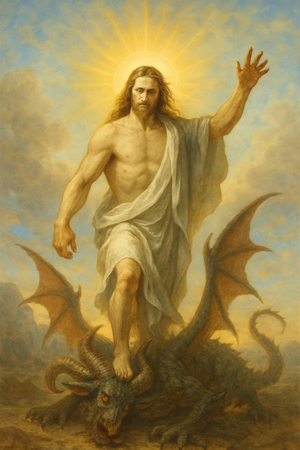
When a horrific, inexplicable act of intentional evil is carried out by someone, should we always blame it on ‘mental illness’? I think we need to examine the reality more closely in many cases and acknowledge that we are engaged in a battle with spiritual wickedness in high places.
1 Peter 5:8 – “Be sober, be vigilant; because your adversary the devil, as a roaring lion, walketh about, seeking whom he may devour.” (KJV)
Here are four famous quotes on the subject.
C.S. Lewis (The Screwtape Letters, 1942): “There is no neutral ground in the universe: every square inch, every split second, is claimed by God and counterclaimed by Satan.”
John Piper (Desiring God): “Life is war. That’s not all it is. But it is always that. Our weakness in prayer is owing largely to our neglect of this truth.”
Charles Spurgeon (sermon on The Christian Soldier): “Satan always hates Christian fellowship; it is his policy to keep Christians apart. Anything which can divide saints from one another he delights in. Since union is strength, he does his best to promote separation.”
A.W. Tozer (This World: Playground or Battleground?): “People think of the world not as a battleground, but as a playground. We are not here to fight; we are here to frolic. We are not in a foreign land; we are at home. We are not getting ready to live; we are already living. And the idea that this world is a battleground has now been rejected by the great majority of Christians.”
Here, Wright addresses the image of believers being suctioned up into the air and taken away to heaven at the return of Christ, as popularized in modern novels and movies:
“…Paul conjures up images of an emperor visiting a colony or province. The citizens go out to meet him in open country and then escort him into the city. Paul’s image of the people “meeting the Lord in the air” should be read with the assumption that the people will immediately turn around and lead the Lord back to the newly remade world.
Paul’s mixed metaphors of trumpets blowing and the living being snatched into heaven to meet the Lord are not to be understood as literal truth, as the Left Behind series suggests, but as a vivid and biblically allusive description of the great transformation of the present world of which he speaks elsewhere.”
Wright makes another very poignant observation about the current worldview of some Christians who believe, wrongly in my opinion, that scripture teaches that believers will be scooped up to avoid a ‘Great Tribulation’, then return seven years later with Jesus to dish out the final portion of God’s wrath on the world.
“Paul’s misunderstood metaphors present a challenge for us: How can we reuse biblical imagery, including Paul’s, so as to clarify the truth, not distort it? And how can we do so, as he did, in such a way as to subvert the political imagery of the dominant and dehumanizing empires of our world? We might begin by asking, What view of the world is sustained, even legitimized, by the Left Behind ideology? How might it be confronted and subverted by genuinely biblical thinking? For a start, is not the Left Behind mentality in thrall to a dualistic view of reality that allows people to pollute God’s world on the grounds that it’s all going to be destroyed soon? Wouldn’t this be overturned if we recaptured Paul’s wholistic vision of God’s whole creation?“
Let’s allow the whole Word of God to speak to us and teach us rather than magnifying pet verses out of context and being seduced by pop theology – like Left Behind.
Editors note: the guest article appearing here does not necessarily reflect the views of Bible Rebel editors or other guest authors and contributors. Bible Rebel seeks to present a wide range of ideas and viewpoints in order to fulfill our mission to provide resources for “Curious Fearless Faith”.This is the first part in a new series on prayer called ‘Supplication In The Spirit’ by Steve Sann.
Praying for the Specifics
While working at home late one evening, in my early ministry years, I picked up the phone to be startled by the panicked voice of one of our youth leaders. In the background were the uncontrollable screams of his wife. Whatever launched her into hysterics, it was clear she was beyond reasoning, incommunicative.
Staggered and dazed, I didn’t know what to do. The man was pleading with me to take charge, “cast out the spirits or whatever,” and then thrust the phone to his wife. On the other end was the voice of a young woman in unreserved confusion. Trying to calm the situation was futile, as she would have none of that! Yet, through the melee that followed, a half-hour later, we were able to finally disconnect in some semblance of peace. I fell back into my office, shaken and perplexed.
Not long afterward, my wife appeared at the door, returning home from an event across state. Foregoing the usual courtesies, studying my face, she quizzed me: “Is there something strange going on here?” She explained: “While on the highway home, a picture of our house flashed into my mind. Suddenly I saw up on the side of the house the reflection of flashing red emergency lights! I began praying in the spirit like ‘a house-a-fire’ for whatever the situation was here at home!” She sighed, “I didn’t stop until a half-hour later when I sensed the emergency had passed.”
“Supplication” is exactly that: coming before God with a specific list of needs for ourselves and others. It may be that God gives you the specifics, expecting you to pray for another. Or, you may be listing to God for the needs of which you are already aware. Either way, when we bring specific needs before God in tongues, we are fulfilling, by definition, “supplication in the spirit.”
In today’s prayer publications, seldom a word is mentioned regarding supplication in tongues. Yet, as you may recall, in Ephesians 6, it was reinforced to make unfailing supplication in the spirit: Ephesians 6:18: Praying always with all prayer and supplication in the Spirit, being watchful to this end with all perseverance and supplication for all the saints. Twice in this one verse are we told to supplicate, always and with all perseverance, for all the saints. If supplication is this important, God confirming it with repeated absolutes, we can be confident we know what and how to carry it out effectively.
R.T. France’s interpretation of the “Son of Man coming in clouds”
R.T. France, who passed away in 2012, was a respected New Testament scholar and commentator who interpreted Mark 13:26 and Mark 14:62 as references not to a future, visible second coming of Jesus, but to His heavenly vindication and enthronement, drawing heavily on Daniel 7:13 and the literary/theological context of Jewish apocalyptic imagery.
Following is a summary, enhanced by Mr. AI, of France’s view.
Mark 13:26 – “Then they will see the Son of Man coming in clouds with great power and glory.”
France’s View: This is not a literal, visible return of Jesus to earth.
He argues that Jesus is drawing on Daniel 7:13, where the Son of Man comes on the clouds to God (the Ancient of Days)—not to earth.
Therefore, this “coming” is not about return, but about the transfer of authority and the vindication of Jesus after His suffering and death.
“They will see” should be understood figuratively, meaning people (particularly those who rejected Jesus) will recognize the consequences of His vindicated status, especially through:
The destruction of the temple (A.D. 70),
The spread of the gospel,
And the judgment upon Jerusalem.
🔹 “The ‘coming’ of the Son of Man in clouds is an enthronement scene, not a return-to-earth scene.” — R.T. France, The Gospel of Mark, NICNT (2002)
Mark 14:62 – “…you will see the Son of Man seated at the right hand of Power, and coming with the clouds of heaven.”
France sees this as a prophetic declaration of vindication, spoken directly to the high priest and the Sanhedrin.
The phrase “seated at the right hand of Power” implies divine authority, referring to Psalm 110:1.
“Coming with the clouds” again echoes Daniel 7:13, but not in the sense of descending from heaven. Instead, it describes Jesus’ ascension to divine status and authority.
The Sanhedrin would “see” this through the events that followed: Jesus’ resurrection, the birth of the church, and the judgment on Jerusalem.
🔹 “Jesus’ response is a claim not of eventual return, but of imminent exaltation… a challenge to those who are about to condemn Him.” — R.T. France, The Gospel of Mark, NICNT
Summary of France’s Key Points
Phrase
Interpretation
“Coming on the clouds”
Danielic imagery of heavenly exaltation, not return
“They will see”
Figurative: people will recognize the implications of Jesus’ divine authority
Mark 13:26
Public vindication of Jesus as the Son of Man, seen through judgment and gospel progress
Mark 14:62
A warning to the high priest: the one they condemn will soon be exalted over them
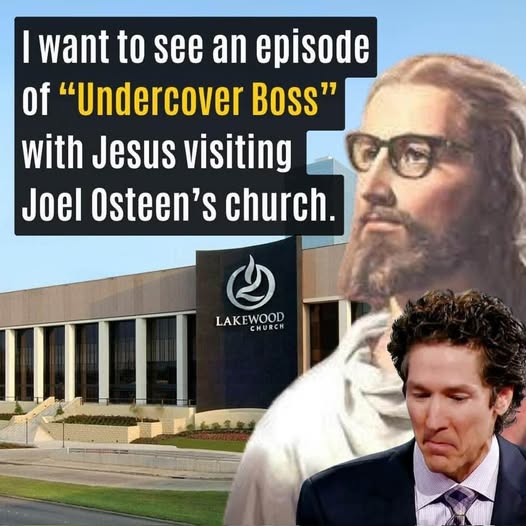
The other day I came across the meme I’m using for this post and it reminded me of a previous series I did on the ‘Prosperity Gospel’ and the ‘Health And Wealth’ theology. So I want to revisit and focus on one of the subjects of that series – Joel Osteen.
Who is Osteen?
Joel Osteen, the senior pastor of Lakewood Church in Houston, Texas, has an estimated net worth that varies across sources. Some reports suggest his net worth is around $100 million (Celebrity Net Worth), while others estimate it to be approximately $40 million to $60 million (Wikipedia).
Additionally, some sources claim his net worth is as high as $180 million (CA Club India).
Osteen resides in a 17,000-square-foot mansion valued at $10.5 million in the River Oaks neighborhood of Houston. He has stated that he does not receive a salary from Lakewood Church, which has an annual budget of $70 million, relying instead on income from his best-selling books and related products (Wikipedia).
But What did Jesus teach?
Well, it seems pretty clear to me—or to anyone else with a lick of common sense—that when Jesus said in Matthew 6:33, “But seek first the kingdom of God and His righteousness, and all these things shall be added to you…” He didn’t have $10 million mansions, private luxury jets, and massive piles of cash in mind.
But what did He have in mind? Read the context:
Matthew 6:25–34 (NKJV) “Therefore I say to you, do not worry about your life, what you will eat or what you will drink; nor about your body, what you will put on. Is not life more than food and the body more than clothing? 26 Look at the birds of the air, for they neither sow nor reap nor gather into barns; yet your heavenly Father feeds them. Are you not of more value than they? 27 Which of you by worrying can add one cubit to his stature?
28 So why do you worry about clothing? Consider the lilies of the field, how they grow: they neither toil nor spin; 29 and yet I say to you that even Solomon in all his glory was not arrayed like one of these. 30 Now if God so clothes the grass of the field, which today is, and tomorrow is thrown into the oven, will He not much more clothe you, O you of little faith?
31 Therefore do not worry, saying, ‘What shall we eat?’ or ‘What shall we drink?’ or ‘What shall we wear?’ 32 For after all these things the Gentiles seek. For your heavenly Father knows that you need all these things. 33 But seek first the kingdom of God and His righteousness, and all these things shall be added to you. 34 Therefore do not worry about tomorrow, for tomorrow will worry about its own things. Sufficient for the day is its own trouble.”
You don’t need an advanced degree in theology or philosophy to understand the plain words spoken by our Lord here. All you need is basic reading comprehension.
What things “shall be added to you”? Mansions? A fleet of luxury fishing boats? A hoard of gold coins? No—the “things” are the necessities of life, like food and clothing.
Does He teach that you can’t or shouldn’t have more than the necessities? No—but our Lord’s message is clear: the desire for God’s righteousness is muddied and distorted when we focus on the riches of this age instead of His kingdom.
It’s impossible to have total reliance on God when one has lots of cash, cars, jets, and Swiss bank accounts to fall back on—right?
Editors note: the guest article appearing here does not necessarily reflect the views of Bible Rebel editors or other guest authors and contributors. Bible Rebel seeks to present a wide range of ideas and viewpoints in order to fulfill our mission to provide resources for “Curious Fearless Faith”.This is Part 3 in a new series on prayer called ‘Cease Not To Pray’ by Steve Sann.
This woman’s incident paints a vivid picture of how our prayer is crucial to bringing God onto the scene. Prayer unleashes God’s presence and power into this world. In all their journeys, He arrives prepared to protect and prosper those for which you pray. Knowing this, we should seek to implement the most effective prayer technique possible in our lives. What makes tongues, in many applications, the most effective form of prayer? I Corinthians 14:2: For he who speaks in a tongue does not speak to men but to God, for no one understands him; however, in the spirit he speaks mysteries [or, secrets].
What makes praying in the spirit so uniquely different than praying with our understanding? When speaking in tongues, we are speaking a language God is giving us at that moment. Since we cannot understand it, what we speak is unknown to us; hence, it is a secret, a mystery to us. All the time, however, God understands our prayer without question.
And herein we discover its remarkable uniqueness: praying by the spirit is truly perfect prayer. It is perfect because it is a prayer crafted by God Himself, untainted by our fallible minds! Spoken in a foreign language and bypassing our understanding, our mind is unable to interfere by interjecting our own limitations, fears, guesswork or doubts. We pray to God the exact prayer words that He gives our spirit, making our prayer perfect in every way. By speaking a language that is foreign to us, God guards the spirit’s perfect prayer from our natural tendency to “improve” it! Verse 14 explains it this way: I Corinthians 14:14: For if I pray in a tongue, my spirit prays, but my understanding is unfruitful.
Here again, this verse points out that the speaker’s understanding is unfruitful, and unproductive, as he cannot understand the words spoken. Also, note here and throughout I Corinthians 14, in order for our spirit to pray, we are the activators. We are one hundred percent in control. The spirit does not act of its own will any more than my mouth moves of its own will. The spirit is melded into our very being and functions by the willful believing action of the believer. Notable examples are found in Acts 2:4 and Philippians 4:13.
God’s spirit within us has become part of our total makeup. It is our spiritual “radio receiver”, our connection with God. Like an organ of our body, the spirit remains a vital part of us throughout our lives. When we speak in tongues, the spirit conveys the information from God, enabling us to pray perfectly. We move our lips, our mouths, our tongues. We form the words as the spirit gives us the language. What we speak is God’s business, but that we speak is our business. Our responsibility: To Speak!
To monitor current news and events related to faith and culture.
To provide an alternative viewpoint to the world’s pervasive climate of darkness, nihilism, and hopelessness for those seeking truth, light, and purpose.
To examine and question the assumptions of religious tradition and provide a resource for information and inspiration for people of faith who have become dissatisfied with an increasingly lifeless and empty ‘churchianity’.
To present the Biblical truths which reveal God’s nature and purposes and proclaim the lifechanging, world-altering, radical message of Yeshua the Messiah – Jesus Christ, our risen Lord and Savior.
At Bible Rebel, this is our one and only creed: Our living God is a loving God and the Bible is His revealed word and will. Our hope and eternal salvation relies entirely on the work of God’s only begotten son, Jesus Christ, who is the way, the truth, and the life.
So, expect some controversial viewpoints and uncomfortable ideas in some of the coming content from Bible Rebel.
We’ll also be continuing our regular features and guest articles and series:
Rethinking The Rapture
They Said It
Guest articles
And more…
Watchdogs
As always, we’ll be keeping a watchdogs eye on all of the latest political, religious, biblical archaeology, and cultural news and events from around the world and bringing to you in bite-size chunks to keep you informed.
Finally, are you interested in contributing content to Bible Rebel?
Bible Rebel is always looking for interesting, compatible content for our biblerebel.com website/blog. We are accepting writing and video submissions for review and possible publication on our platform.
If you have a teaching series, opinion piece, research piece or other content that fits with the Bible Rebel mission we’d like to see it!
If your content fits our mission and creed, included below, then email it to us at in**@********el.com. Written pieces should be no more than 500 words and video content no longer than 7 minutes – either can be submitted as part of a longer series for consideration.
Thanks, and stay tuned for the next newsletter in August.
In a previous piece in this ‘Rethinking The Rapture’ series I referenced New Testament scholar N.T. Wright’s 2001 essay, Farewell to the Rapture in the context of the Left Behind books and the pop theology of a secret Rapture.
Here, I’d like to return to Wright’s essay and offer a couple of more quotes from it in order to illustrate some of the thinking behind the views held by those who reject the evangelical, Left Behind, invisible Rapture interpretation of eschatology.
“It is Paul who should be credited with creating this scenario. Jesus himself, as I have argued in various books, never predicted such an event. The gospel passages about “the Son of Man coming on the clouds” (Mark 13:26, 14:62, for example) are about Jesus’ vindication, his “coming” to heaven from earth. The parables about a returning king or master (for example, Luke 19:11-27) were originally about God returning to Jerusalem, not about Jesus returning to earth. This, Jesus seemed to believe, was an event within space-time history, not one that would end it forever.”
You’ll need to open your Bible and put on your thinking cap for some serious, critical biblical exegesis as you consider what Wright is saying here.
And here:
“The Ascension of Jesus and the Second Coming are nevertheless vital Christian doctrines, and I don’t deny that I believe some future event will result in the personal presence of Jesus within God’s new creation. This is taught throughout the New Testament outside the Gospels. But this event won’t in any way resemble the Left Behind account. Understanding what will happen requires a far more sophisticated cosmology than the one in which “heaven” is somewhere up there in our universe, rather than in a different dimension, a different space-time, altogether.
The New Testament, building on ancient biblical prophecy, envisages that the creator God will remake heaven and earth entirely, affirming the goodness of the old Creation but overcoming its mortality and corruptibility (e.g., Romans 8:18-27; Revelation 21:1; Isaiah 65:17, 66:22). When that happens, Jesus will appear within the resulting new world (e.g., Colossians 3:4; 1 John 3:2).”
We’ll dive deeper into these ideas in coming ‘Rethinking The Rapture’ posts – for now, I hope you will take a hard look at what Wright is conveying here.
The latest from CNN as of Sunday afternoon: At least 80 people have died in connection with the flash floods that struck central Texas early Friday, according to officials. The toll includes at least 21 children in Kerr County, where 11 girls and one counselor are still missing from Camp Mystic, authorities said.
An often-asked question: “How could anyone believe in an all-powerful, loving God who would allow so much evil and suffering in the world?“
That’s a very difficult question, and there are countless books, articles, sermons, doctoral theses, movies, songs, and philosophical/theological debates on that subject (often referred to as theodicy or the problem of suffering), dating back centuries, that attempt to answer it.
The typical and extremely simplistic reasoning offered by some Christians as to why God would allow children at a Christian camp to drown goes something like this: “Well, God needed more angels in heaven.”
I believe that explanation is light-years away from the truth—and could even be considered inappropriately cavalier.
For me, beginning to understand the “why” of it all starts with this simple proposition: in order for there to be a level playing field where human beings are able to exercise actual free will, the conditions that create the possibility for failure, tragedy, and death must exist. Free agency is meaningless if there are no possible negative consequences resulting from human choices.
Matthew 5:45 – “For He maketh His sun to rise on the evil and on the good, and sendeth rain on the just and on the unjust.”
God is entirely just, and He has committed Himself to abiding by the conditions that allow free agency—and the processes of nature in a now fallen creation—to operate.
God doesn’t break His own rules, and He absolutely has a grand purpose in mind, which He will bring to pass by His own power and in His own time.
For now, we live in a broken and fallen world, and sometimes it’s nearly impossible for us to see light through all the darkness, given our very limited understanding—but a day certain is coming when we will know, even as we are known.
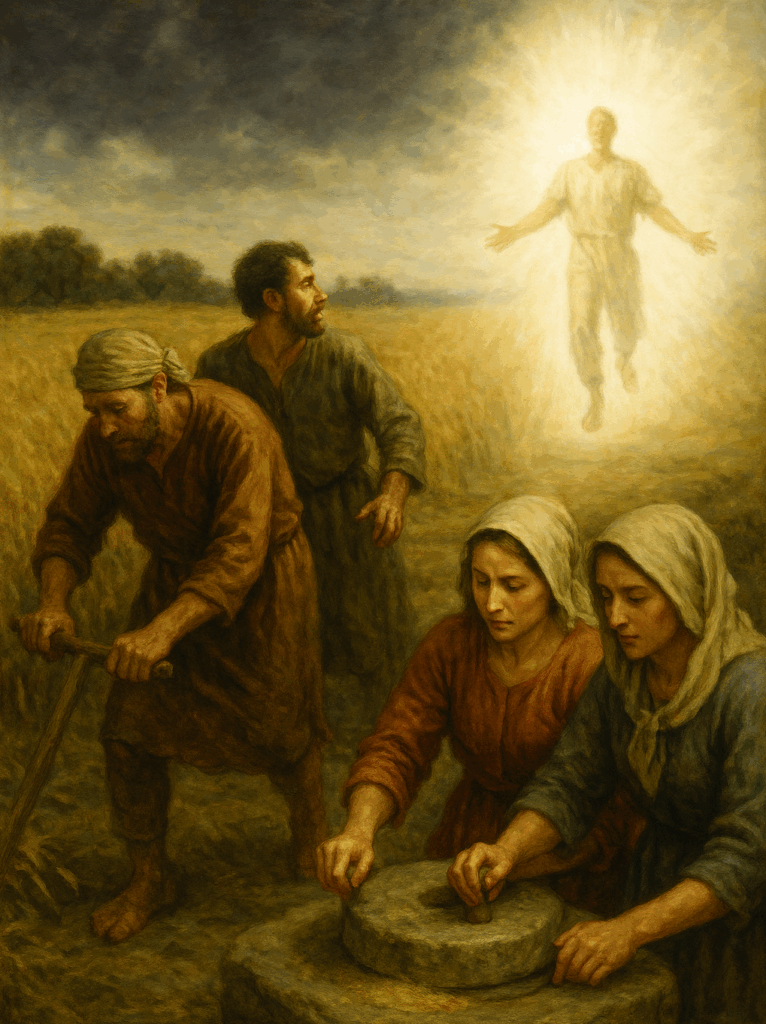
Let’s return to an earlier post in this Rethinking the Rapture series, where I raised a question concerning the words of Jesus in Matthew 24: “One will be taken and one left.”
Matthew 24:40–42 (KJV):
“Then shall two be in the field; the one shall be taken, and the other left. Two women shall be grinding at the mill; the one shall be taken, and the other left. Watch therefore: for ye know not what hour your Lord doth come.”
Would the disciples, to whom Jesus was speaking those words at that time and in that place, have understood Him to be referring to a future Rapture of the Church—where some people would disappear into the sky in a secret event, while their walking or working companions would be left behind on earth?
The context strongly suggests that they would not have understood His words to mean a future Rapture.
The immediately preceding verses, 37–39, compare the coming of the Son of Man to the days of Noah, when people were eating, drinking, and marrying—until the flood came and took them all away.
Plainly, the ones who were “taken” were those swept away in the flood in judgment. The ones left behind were Noah and his family, who were spared and remained on the earth to begin anew after the flood judgment.
Understanding this context should make it crystal clear who Jesus was referring to in Matthew 24:40–42 when He said, “One will be taken and one left.” The one taken is taken in judgment, not in a Rapture. And the one left remains to experience the blessings of the Kingdom—not the punishment of woe and tribulation.